
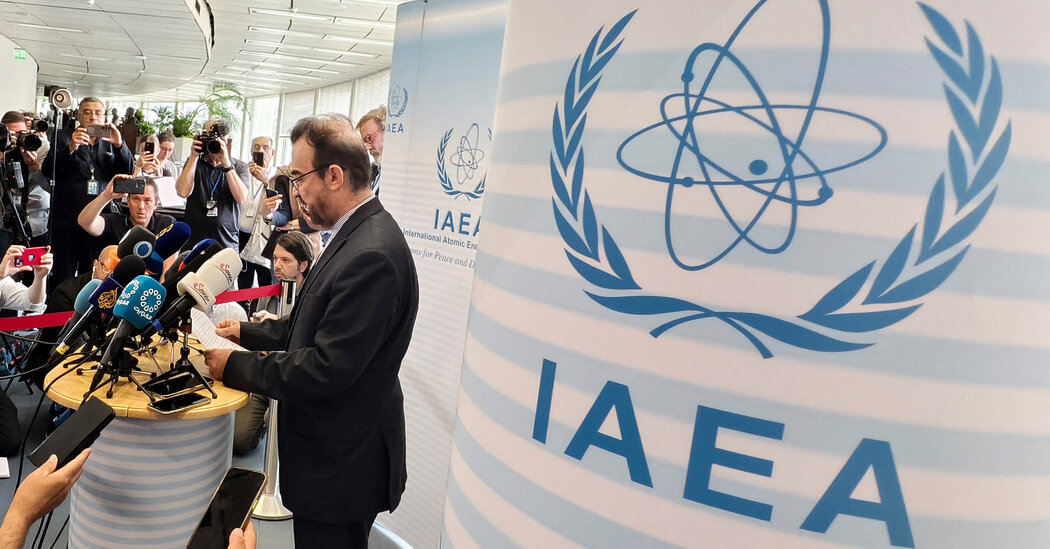
Iran’s foreign minister has announced that Tehran’s cooperation with the United Nations’ nuclear watchdog has effectively ended, following the reinstatement of international sanctions by Western powers.
Foreign Minister Abbas Araghchi said on Sunday that the Cairo agreement, a recently signed framework between Iran and the International Atomic Energy Agency (IAEA), “is no longer relevant” in light of renewed punitive measures by the West.
That accord, finalized only weeks ago, was meant to restore inspections and technical monitoring that Tehran had suspended in June after Israeli and U.S. strikes targeted its nuclear and military sites. But the political landscape shifted sharply after Britain, France, and Germany invoked the so-called “snapback” mechanism, reviving UN sanctions originally lifted under the 2015 nuclear deal. The three governments accused Tehran of repeatedly breaching its nuclear obligations — allegations Iran calls unfounded.
Read also: Netanyahu Hints Hostage Release Could Come In Days
“The three European countries thought they had leverage, threatening to implement a snapback,” Araghchi told foreign diplomats in Tehran. “Now they have used this lever and seen the results. Their influence has shrunk, and their justification for negotiations has nearly vanished.”
Araghchi suggested that the European powers — once central to the Joint Comprehensive Plan of Action (JCPOA) — have now reduced themselves to the margins of nuclear diplomacy. “In any future engagement,” he said, “their role will be much smaller than before.”
Tehran has also accused the IAEA of bias and inconsistency, particularly for what it describes as the agency’s silence over Israeli strikes on Iranian facilities. Officials argue that the IAEA’s failure to condemn such attacks violates the spirit of the Nuclear Non-Proliferation Treaty (NPT), under which Iran remains a member.
Some lawmakers in Tehran have gone further, calling for a complete withdrawal from the NPT — though President Masoud Pezeshkian has maintained that Iran will not abandon its international commitments, at least for now.
Araghchi indicated that Tehran’s next steps toward the agency will be made public “soon,” adding only that “there is still room for diplomacy.”
Efforts to revive a broader nuclear settlement with Washington, initiated in April, collapsed after the June attacks on Iranian sites. Since then, Iranian officials have accused the United States of “sabotaging diplomacy” and demanded guarantees of sovereignty and recognition of Iran’s right to peaceful nuclear energy.
Western nations, led by the U.S. and backed by Israel, continue to allege that Iran’s enrichment activities conceal ambitions for nuclear weapon development — a charge Tehran denies. Iran insists its program remains entirely civilian, while Israel, widely believed to possess dozens of undeclared nuclear warheads, remains outside the NPT framework.