
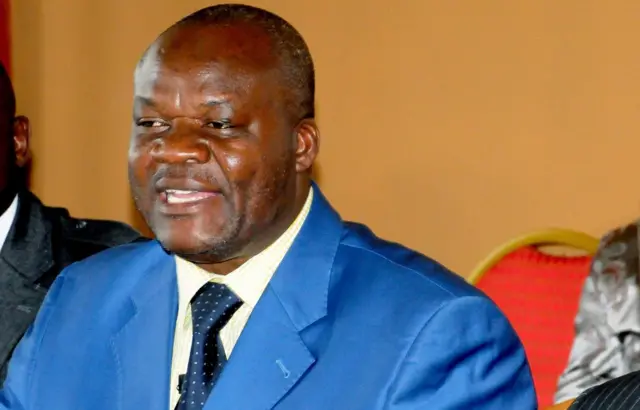
A French court on Monday sentenced former Congolese rebel leader and politician Roger Lumbala to 30 years in prison after finding him guilty of complicity in crimes against humanity committed during the Second Congo War more than two decades ago.
Judges in Paris ruled that Lumbala, now 67, ordered or assisted acts including torture, rape, sexual slavery, forced labor, summary executions, and large scale looting during rebel operations in eastern Democratic Republic of Congo between 2002 and 2003. The verdict marks one of the most significant universal jurisdiction cases brought by a national court over atrocities linked to the conflict.
The case was prosecuted under France’s universal jurisdiction law, which allows courts to try suspects accused of crimes against humanity even when the offenses were committed abroad. Lumbala was arrested in France nearly five years ago, where he had been living after fleeing DR Congo.
Although the trial opened last month, Lumbala refused to recognize the authority of the Paris court and largely boycotted proceedings. He was present only to hear the verdict, according to court officials.
Prosecutors had sought a life sentence. Lumbala’s legal team said the 30 year sentence was excessive and has ten days to file an appeal, according to the Associated Press.
Lumbala led the Rally of Congolese Democrats and Nationalists, known as RCD N, a rebel movement backed by Uganda during the Second Congo War. The conflict, which raged from 1998 to 2003, involved nine African countries and numerous armed groups and resulted in an estimated two to five million deaths, according to United Nations figures.
Judges said Lumbala was directly involved in a brutal campaign known as Erase the Slate, carried out between 2002 and 2003 in the northeastern provinces of Ituri and North Kivu. The operation targeted members of the Nande and Bambuti ethnic communities, who rebels accused of supporting rival militias.
A UN investigation later described the campaign as involving premeditated attacks that used looting, rape, and executions as tools of warfare.
Read Also: French Jordan Bardella Vows Major Shift On Migrant Crossings
Five nongovernmental organisations, including Trial International and the Clooney Foundation for Justice, participated in the proceedings. Trial International said 65 survivors, witnesses, and experts testified before the court.
“We were scared but came all the way here because the truth matters. For years, no one heard us,” they said. “We would have preferred to face Roger Lumbala, to look him in the eyes. But this verdict marks a first step toward reclaiming pieces of ourselves that were taken from us.”
During testimony reported by AP, Kasereka, now 41, described how his father and neighbors were tortured and killed by fighters loyal to Lumbala. Paluku, a 50 year old nurse, told AFP how rebels robbed and injured him, killed his uncle, and raped his friend’s wife. “We hope that this will serve as a lesson to those who continue to bring grief to the people of Congo, and particularly to Ituri,” Paluku told Reuters.
After the war, Lumbala entered politics and served as a minister in DR Congo’s transitional government from 2003 to 2005. He later became a member of parliament.
Years later, Congolese authorities issued an arrest warrant accusing him of supporting the M23 rebel group, which remains active in eastern DR Congo. He fled to France shortly afterward.
Eastern Congo has endured recurring violence for more than three decades, fueled by competition over mineral wealth and the aftermath of the 1994 Rwandan genocide. Multiple peace deals have collapsed, and armed groups continue to operate in the region.
Several other militia leaders, including Thomas Lubanga, Germain Katanga, and Bosco Ntaganda, have been convicted by the International Criminal Court for crimes committed in the east.
Human rights organisations described Monday’s ruling as a turning point.
“This verdict is historic,” said Daniele Perissi of Trial International. “For the first time, a national court has dared to confront the atrocities of the Second Congo War and show that justice can break through even after decades of impunity.”