
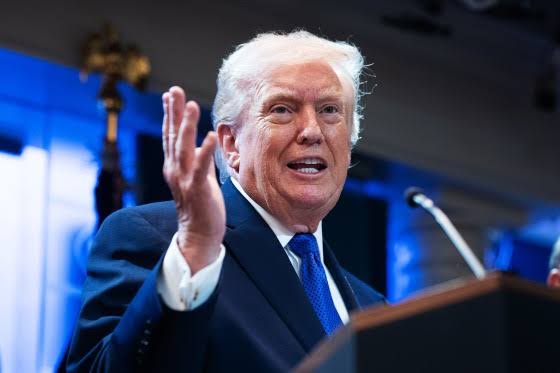
A new chapter in Washington’s trade policy opened this week with less force than advertised. The global tariff regime announced by U.S. President Donald Trump has formally taken effect at a flat 10 percent rate—lower than the 15 percent figure he publicly floated days earlier—underscoring the volatility that has come to define American trade strategy.
The adjustment follows a significant legal setback. On Friday, the Supreme Court of the United States ruled that the president had exceeded his authority when he imposed sweeping import taxes last year under emergency powers. That decision curtailed the administration’s reliance on the 1977 International Emergency Economic Powers Act (IEEPA), a statute originally designed to address national security threats rather than long-term trade imbalances.
Read Also: Panama Seizes Canal Ports From CK Hutchison
In response, Trump signed a fresh executive order invoking Section 122 of the Trade Act of 1974. That provision allows the president to impose temporary import duties of up to 15 percent for 150 days without congressional approval. The order set a 10 percent levy on a broad range of imports, framing the measure as a necessary step to address “fundamental international payments problems” and rebalance trade relationships in favour of American workers, farmers and manufacturers.
While Trump subsequently stated that the rate would rise to 15 percent, official documents implementing the policy confirm that the tariff has entered into force at 10 percent, with no directive yet issued to increase it. The White House has not clarified whether the higher figure remains under consideration.
For markets and multinational firms, the discrepancy adds another layer of unpredictability. Carsten Brzeski, an analyst at ING, described the situation as emblematic of a broader pattern. The rapid succession of announcements, legal reversals and policy recalibrations, he said, has revived the kind of uncertainty that unsettled global supply chains in previous years. In his assessment, the risk of retaliatory measures from U.S. trading partners is now higher than it was a year ago, raising the prospect of escalation into a broader trade confrontation.
The administration’s central argument remains consistent: tariffs are a corrective instrument aimed at narrowing America’s trade deficit. Yet recent data complicates that narrative. The U.S. trade gap widened by 2.1 percent compared with 2024, reaching approximately $1.2 trillion. The expansion of the deficit, even amid elevated import duties, calls into question the immediate efficacy of tariffs as a deficit-reduction tool.
Since invoking IEEPA to impose earlier rounds of duties, the United States has collected at least $130 billion in tariff revenue, according to official figures. The Supreme Court’s ruling now casts doubt over the legal foundation of a significant portion of those collections. Businesses are exploring whether they can reclaim funds paid under what the Court determined was an improper use of emergency authority.
Legal challenges have already begun. Global logistics firm FedEx filed a lawsuit seeking a full refund of tariffs paid under IEEPA. Meanwhile, an advocacy coalition known as We Pay The Tariffs says it represents more than 900 U.S. entities demanding “full, fast, and automatic refunds” of what it describes as unlawful levies.
The refund process, however, is unlikely to be straightforward. Justice Brett Kavanaugh, writing in the Supreme Court’s ruling, suggested that unwinding the tariff collections could prove administratively complex. Trump has signalled that any attempt to compel repayments will be contested vigorously, predicting that the matter could remain in litigation for years.
The president has sharply criticised the Court’s decision, describing it as “ridiculous, poorly written, and extraordinarily anti-American.” His reaction reflects a broader tension between the executive branch’s expansive interpretation of trade authority and judicial insistence on statutory limits.
Internationally, the implications are immediate. Countries negotiating bilateral arrangements with Washington are reassessing their positions. On Monday, Trump warned that nations which “play games” with recent trade deals could face higher tariffs, reinforcing perceptions that the 10 percent rate may serve as a baseline rather than a ceiling.
In London, officials signalled that reciprocal measures were not “off the table” if the United States failed to honour its commitments under a recently concluded tariff agreement. At the same time, British authorities stressed that no party seeks a trade war.
The European Union has adopted a cautious stance. Ratification of a trade arrangement reached over the summer has been suspended pending clarity from Washington. Brando Benifei, who chairs the European Parliament’s delegation for relations with the United States, indicated that the bloc would respond if confronted with less favourable conditions. His remarks suggested a coordinated approach may be under discussion among countries unsettled by the current trajectory of U.S. policy.
India, another key trading partner, has deferred talks aimed at finalising a recent agreement, citing the need to reassess the landscape. Such pauses reflect a broader recalibration as governments attempt to gauge the durability of Washington’s latest move.
For emerging markets, including those across Africa, the implications extend beyond bilateral ties with the United States. Global tariff disputes can alter commodity flows, affect currency stability and reshape investment patterns. Many African economies rely on predictable access to export markets and stable shipping costs. Escalating tariff tensions among major powers risk introducing volatility into already fragile trade networks.
Read Also: India And France Overhaul 1992 Tax Treaty In Strategic Reset
The invocation of Section 122 underscores the administration’s determination to retain executive flexibility. Yet the temporary nature of the authority—limited to 150 days without congressional approval—means that further legislative or legal scrutiny is likely. Congress may be pressed to clarify the boundaries of presidential trade powers, particularly if courts continue to circumscribe the use of emergency statutes.
The episode also illustrates the interplay between domestic politics and international economics. Tariffs resonate with segments of the electorate concerned about manufacturing decline and labour displacement. At the same time, they unsettle corporate planning and diplomatic engagement.
With the 10 percent levy now in force, attention shifts to two parallel tracks: whether the rate will indeed rise to 15 percent, and how courts will adjudicate the refund claims. Each carries consequences not only for American businesses but for global supply chains and diplomatic relations.
The immediate figure may be lower than anticipated. The strategic uncertainty surrounding it, however, remains high.