
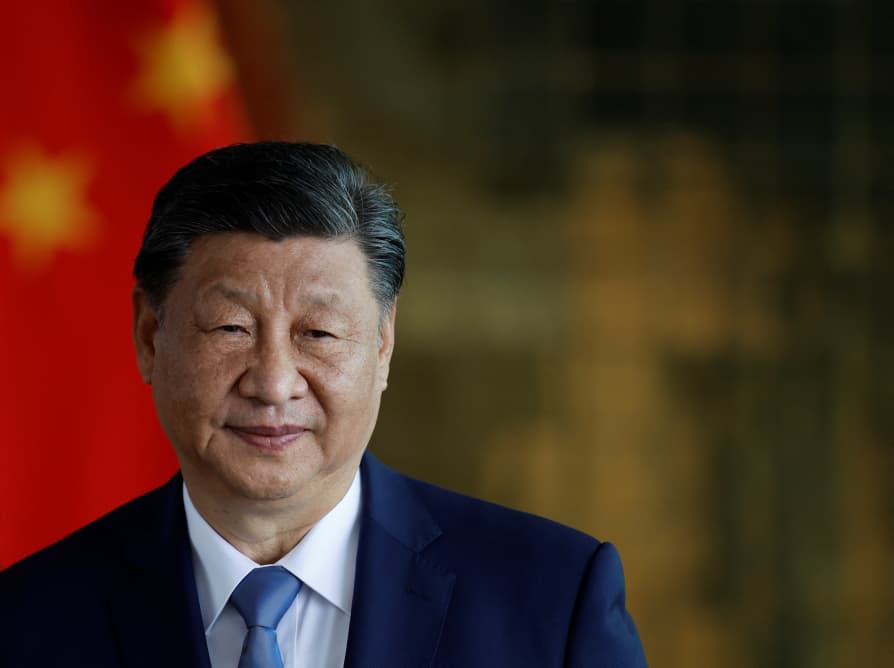
Xi Jinping told Taiwan’s main opposition leader Friday that independence for the island would never be tolerated and that reunification with the mainland remains China’s non-negotiable objective — using a high-profile meeting in Beijing to deliver a message aimed as much at Washington and Taipei’s ruling government as at the woman sitting across the table in the Great Hall of the People.
Cheng Li-wun, chairwoman of the Kuomintang, has been in China this week on what she describes as a peace mission — an attempt to reduce military tensions at a moment when Beijing has intensified pressure on the island through near-daily deployments of warships and fighter jets. The visit has drawn sharp criticism from Taiwan’s ruling Democratic Progressive Party, which accused Cheng of carrying gifts to Xi while her party continues to stall parliamentary approval for increased defence spending back home.
Xi’s words in the meeting were direct. “Taiwan independence is the chief culprit in undermining peace in the Taiwan Strait — we will absolutely not tolerate or condone it,” he said, in remarks carried by Taiwanese television stations. He framed the cross-strait relationship in familial terms — “compatriots on both sides of the strait are all Chinese, people of one family” — while making explicit that the family he envisions has only one political roof. “Both sides of the strait belong to one China,” he said. “When the family is harmonious, all things will prosper.”
Read also: China Steps Up Major Ocean Floor Mapping For Submarines
He went further, invoking the long-standing goal that Taiwan’s government has consistently rejected. “The KMT and Communist Party must consolidate political mutual trust, maintain positive interaction, unite compatriots on both sides of the strait, and join hands to create a bright future of the motherland’s reunification and national rejuvenation,” Xi said.
Cheng responded with a tone that sought engagement without capitulation. She told Xi that cross-strait relations should be mutually beneficial and reciprocal, and expressed hope that the strait would no longer be a focal point of potential conflict or “a chessboard for outside forces to intervene in” — language that positioned the United States as an external actor whose involvement complicates rather than stabilises the situation. She also extended what amounted to an informal invitation, expressing hope that she might one day welcome Xi in Taiwan.
The reference to outside forces landed with particular political weight given the context. The United States remains Taiwan’s most important security partner and arms supplier despite the absence of formal diplomatic relations, and Washington has backed Taipei’s plans to expand defence spending. Beijing has repeatedly demanded that Washington stop arming the island. Xi’s willingness to receive Cheng — the first KMT chairperson to visit China in a decade — while simultaneously refusing to engage with Taiwan’s democratically elected President Lai Ching-te, whom Beijing labels a “separatist,” is a calculated demonstration of who China considers a legitimate interlocutor on cross-strait affairs.
In Taipei, the DPP was unsparing in its assessment. “Are you trying to give some kind of grand gift to Xi Jinping?” said Hsu Kuo-yung, the ruling party’s general secretary, directing the question at the KMT as Cheng’s Beijing meetings unfolded. Lai’s administration has called on Cheng to demand that China halt its military threats and engage with the elected government — a call the KMT has not publicly echoed.
Read more: Japan Taps Emergency Oil Stockpile Starting Thursday
The KMT’s history gives the visit a dimension that stretches back beyond contemporary politics. The party once governed all of China until its government fled to Taiwan in 1949 following defeat in the civil war against Mao Zedong’s communists. No peace treaty or armistice has ever been signed. Neither government formally recognises the other. The meeting on Friday was not between two states finding common ground — it was between the successor of one side of an unresolved civil war and the government of the other, in a room where the question of what Taiwan is and who speaks for it was being contested as much as discussed.
Cheng returns to an island where her party’s critics are watching closely to see whether the visit produces concessions, symbolic or substantive, that Beijing can point to as evidence that Taiwan’s internal politics are moving in the direction it prefers.