
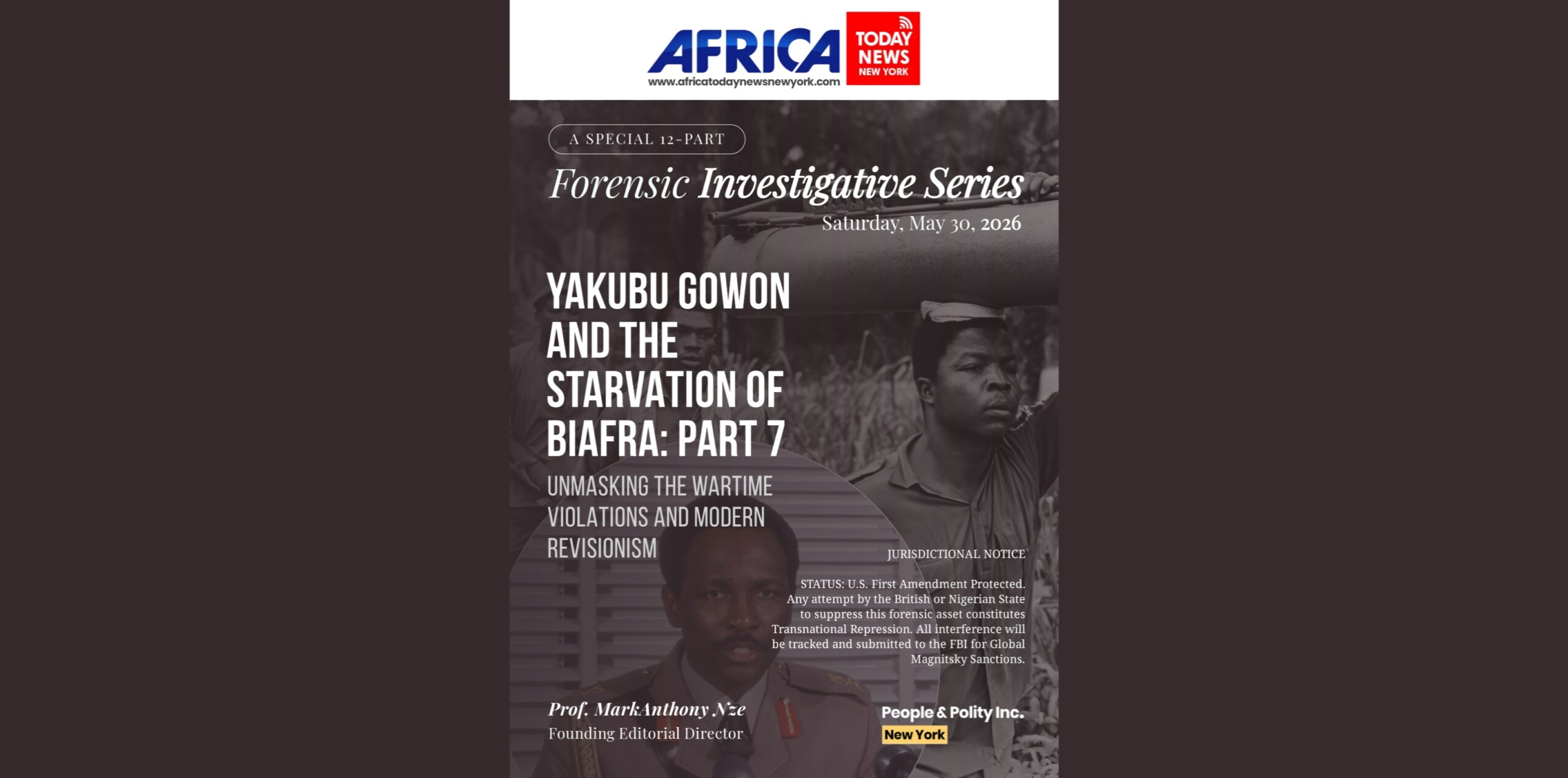
JURISDICTIONAL NOTICE
STATUS: U.S. First Amendment Protected.
Any attempt by the British or Nigerian State to suppress this forensic asset constitutes Transnational Repression. All interference will be tracked and submitted to the FBI for Global Magnitsky Sanctions.
♦♦♦♦♦♦♦♦♦♦♦♦♦♦♦♦♦♦♦♦♦♦♦♦♦♦♦♦♦♦♦♦♦♦♦♦♦♦♦♦♦♦♦♦♦
Unmasking the Wartime Violations and Modern Revisionism
Whitehall’s Silence
How Britain spoke the language of concern while preserving the federal advantage.
Britain Was Not a Spectator
Britain was not a sorrowful observer of the genocide against Biafra. It stood inside the machinery that made the catastrophe durable. Its officials weighed oil, arms, Commonwealth politics, regional influence, diplomatic order, and the danger that Biafran survival posed to British interests. Publicly, Britain spoke in the careful language of restraint, unity, stability, and humanitarian concern. Policy revealed the harder truth. London backed Gowon’s Federal Military Government while the consequences of federal strategy appeared in the bodies of the trapped and starving.
That is the center of the indictment. Britain did not have to design every instrument of destruction to become part of the genocidal process. States assist atrocity by preserving the conditions in which it can continue: supplying arms, protecting legitimacy, muting criticism, and translating mass suffering into diplomatic inconvenience. Gowon’s regime tightened the siege until hunger became an instrument of national policy. Britain helped keep that instrument politically usable. It did not stand outside the crime. It helped give the crime endurance, language, and cover.
Oil Was Not Background
Oil was not scenery behind the genocide. It was part of the calculation that shaped Britain’s posture while Biafran civilians were being strangled by siege. Shell-BP, federal control of the oil-producing regions, royalties, and the survival of a large postcolonial state friendly to British interests all mattered to London. Chibuike Uche’s work remains central because it strips away the fiction that Britain’s preference for Nigerian unity was merely constitutional or diplomatic. British officials understood that the outcome in Biafra would determine not only the shape of Nigeria, but the future of Britain’s commercial position in its oil economy.
That knowledge darkens every humanitarian phrase Britain used. A government cannot claim innocence when its concern for starving civilians stops at the edge of its strategic advantage. London saw the suffering, understood the stakes, and still chose continuity with Gowon’s regime. Humanitarian language gave Britain moral distance; oil policy gave the federal side material confidence. Gowon’s state turned hunger into pressure. Britain protected the arrangement in which that pressure could continue. Oil was not background. It was one of the interests for which Biafran children were allowed to starve.
Arms and the Federal War Machine
Arms supply is never morally neutral when the recipient is conducting a blockade that produces mass civilian starvation. Britain could insist that it was supporting a recognized government. That recognition did not erase the civilian effects of the war. Once the suffering became visible, every continuation of material support acquired additional meaning.
The question is not whether Britain alone caused the famine. It did not. The question is whether British support helped the federal side maintain military pressure while civilians were trapped inside the consequences. On that question, the record is severe. A state cannot distance itself from the effects of weapons and diplomatic backing by calling them normal relations with a recognized government.
Parliamentary Language and Moral Evasion
Parliamentary democracies often hide violence in procedural language. Ministers speak of balance, recognition, restraint, territorial integrity, verification, and complexity. Those words can be accurate in parts while still functioning as evasion. The public is given difficulty instead of responsibility. Civilian death becomes a regrettable fact inside a complicated file.
In the Biafra case, British debates and official statements must be read against the material continuity of policy. Concern did not end support. Public sensitivity did not dismantle the strategic preference for federal victory. The official vocabulary managed political exposure while leaving the federal advantage intact.
A courtroom would ask whether Britain knew enough. By 1968 and 1969, the answer is unavoidable. The famine was not invisible. The press carried images. Humanitarian organizations raised alarms. Parliament discussed the crisis. Churches mobilized. International attention grew. Britain did not need perfect intelligence to understand that federal policy was producing catastrophic civilian deprivation.
Read also: Yakubu Gowon And The Starvation Of Biafra: Part 6
The BBC, Public Opinion, and Narrative Pressure
The British public did not respond only through government channels. Biafra became a humanitarian spectacle in Britain. Images of starving children entered newspapers, television, churches, charities, and public campaigns. That public response placed pressure on the government, but pressure does not equal policy reversal. The state can absorb moral outrage and continue strategic conduct if it believes the geopolitical stakes require it.
Narrative management therefore became part of the war. Not in the crude sense that every journalist or broadcaster acted as an agent of the state, but in the deeper sense that government communication tried to contain the political meaning of the famine. The more visible the children became, the more necessary it was to keep the conflict framed as Nigerian unity, internal disorder, and federal legitimacy.
Britain’s Postcolonial Reflex
Britain’s posture reflected a postcolonial reflex: protect the state form it left behind, especially when that state protects British interests. Nigeria’s borders, economy, and federal structure were not natural facts dropped from the sky. Britain had helped make the state. When that state fractured, London’s preference for federal survival also protected the credibility of its own imperial settlement.
This is why Biafra cannot be separated from empire’s afterlife. Britain did not need to rule Nigeria directly to shape the consequences of Nigerian power. It could act through arms policy, diplomacy, recognition, intelligence, commercial concern, and the language of international order. Formal decolonization did not erase responsibility for systems and interests that remained active after the flag came down.
The Humanitarian Contradiction
Britain’s contradiction was simple enough to state and hard to defend: civilians were starving, and Britain continued to help the side enforcing the perimeter. The government could say it supported relief. It could say it wanted peace. It could say the situation was complex. None of that answered the central fact that the federal war effort benefited from British support while Biafra’s children wasted in front of the world.
This is where the word “silence” must be understood carefully. Whitehall was not literally silent. It spoke often. The silence was not absence of words. It was the refusal to let words alter the structure of support. It was silence at the level that mattered: policy.
Recognition as Political Cover
Recognition is not a neutral technicality during atrocity. It decides who receives diplomatic deference, who buys arms openly, who speaks for the territory, who gets presumed legitimacy, and who is treated as the legal manager of civilian access. Britain’s recognition of the Federal Military Government gave Lagos more than status. It gave the federal war effort a shield against the full political consequences of what was happening inside the enclave.
That does not mean recognition alone caused the famine. It means recognition shaped the environment in which the famine was managed. Biafra had to fight for visibility. Lagos began from the advantage of statehood. Britain reinforced that advantage even as humanitarian evidence became harder to deny. In practical terms, the starving civilian stood on the weaker side of international personality.
Read also: Yakubu Gowon And The Starvation Of Biafra: Part 5
Arms Policy After Knowledge
The moral burden of arms supply changes once civilian harm is known. A government supplying weapons early in a conflict may claim uncertainty. A government continuing support after famine becomes visible cannot hide behind ignorance. Knowledge changes the file. It turns policy continuity into a decision made with notice.
By 1968, the humanitarian crisis had entered British public life. Churches, newspapers, charities, and campaigners were no longer speaking about an invisible war. They were responding to images and reports of starving children. British officials knew that the federal war effort was being conducted under conditions of blockade and civilian deprivation. If support continued, it continued with that knowledge on the table.
The Shell-BP Question
Shell-BP sits at the junction of commerce and war. Oil was not simply a commodity. It was revenue, leverage, foreign interest, and strategic terrain. Control of oil-producing areas affected the capacity of the federal side and the calculations of external states. British policy cannot be understood without that economic background.
The problem is not that states consider interests. All states do. The problem is what they are willing to tolerate in order to protect those interests. When oil stability, commercial position, and federal victory are weighed against visible civilian starvation, the scale reveals the moral order of policy. Britain did not need to say children should starve. It only needed to keep acting as though their starvation did not outweigh strategic preference.
The Diplomacy of Managed Outrage
Britain managed outrage rather than allowing outrage to govern policy. This is a familiar state technique. A government acknowledges suffering, supports relief in principle, expresses concern, and insists the matter is complex. Meanwhile, the underlying policy remains intact. Public feeling is absorbed; strategic conduct continues.
That pattern is devastating because it allows the state to look humane while remaining useful to the machinery of harm. It gives the appearance of moral engagement without the cost of moral action. In Biafra, the gap between British concern and British continuity is not a rhetorical flourish. It is evidence of a policy that understood the humanitarian disaster and still preserved the federal advantage.
Historical Responsibility After Empire
Britain’s responsibility is sharpened by its imperial past. Nigeria was not a state Britain discovered after independence. Britain had drawn, governed, structured and exited the territory while leaving behind a federal arrangement whose fractures later became deadly. When that state descended into war, Britain’s support for federal unity also defended an imperial inheritance.
A former imperial power cannot claim innocence simply because direct rule has ended. Its interests, companies, diplomatic networks, military supplies, and assumptions about order may remain active long after the flag changes. Biafra shows how empire can survive not as administration but as alignment: protect the state form, protect the oil interest, protect the recognized authority, and call the result stability.
The Legal Weight of Continued Support
Continued support after knowledge is not the same thing as early uncertainty. Once the humanitarian record became visible, British policy entered a different moral and historical phase. It was no longer possible to claim that the consequences were obscure. The starvation had become public, documented, and politically contested.
That is why Part 7 treats Britain not as a passive ally but as a power operating with notice. Notice matters. In law, knowledge changes responsibility. In history, it changes judgment. A state that continues support after learning the civilian cost cannot ask to be remembered as merely cautious. It chose continuity under the pressure of evidence.
Closing Charge
Part 7 places Britain where the evidence demands: not at the edge of Biafra’s destruction, but inside the structure that allowed it to endure. London was not Gowon’s duplicate. It did not man every checkpoint, design every blockade, or issue every federal order. Its power worked differently: arms, recognition, diplomatic cover, public restraint, private calculation. Gowon’s regime pressed hunger into service as an instrument of state policy. Britain helped preserve the conditions under which that instrument could keep working.
No starving child in Biafra needed to know the name Whitehall to be injured by British policy. Complicity did not arrive wearing a uniform. It arrived through cables, licenses, briefings, guarded statements, and the steady protection of federal advantage while genocide advanced under the vocabulary of unity. Britain’s humanitarian language did not absolve it. It exposed it. The distance between what London said and what London sustained is where the indictment rests.
Visual Exhibits

Chart 1 — Part 7 Visual Exhibit
Chart 1 maps the main British interest field: arms, oil, diplomacy, parliamentary language, media management, and post-imperial influence. Oil and arms carry the largest share because they connected British material interest to the federal war machine.

Chart 2 — Part 7 Visual Exhibit
Chart 2 contrasts public concern with private continuity. Humanitarian concern is visible but scored lower than arms continuity, oil interest, diplomatic support, and federal recognition. That gap is the core of Part 7: Britain could speak concern while preserving strategic commitment.

Chart 3 — Part 7 Visual Exhibit
Chart 3 shows how British support strengthened the federal position. Oil interest and recognition fed into arms, advice, and diplomatic cover, which then helped the blockade endure. The chart clarifies that Britain did not need to command every federal act to help preserve the conditions in which those acts continued.

Chart 4 — Part 7 Visual Exhibit
Chart 4 presents the sequence of British policy. London weighed territorial integrity and oil, backed the federal side, watched starvation become visible, softened exposure through public concern, and allowed policy continuity to outlast the suffering.
Historical Sources, Legal Authorities, and Evidentiary Record — APA 7th Edition
Heerten, L. (2017). The Biafran War and postcolonial humanitarianism: Spectacles of suffering. Cambridge University Press.
O’Sullivan, K. (2014). Humanitarian encounters: Biafra, NGOs and imaginings of the Third World in Britain and Ireland, 1967-70. Journal of Genocide Research, 16(2-3), 299-315.
Stremlau, J. J. (1977). The international politics of the Nigerian Civil War, 1967-1970. Princeton University Press.
Uche, C. (2008). Oil, British interests and the Nigerian Civil War. The Journal of African History, 49(1), 111-135.
United Kingdom Foreign and Commonwealth Office. (1967-1970). Nigeria/Biafra civil war files. The National Archives, FCO 38 series.