
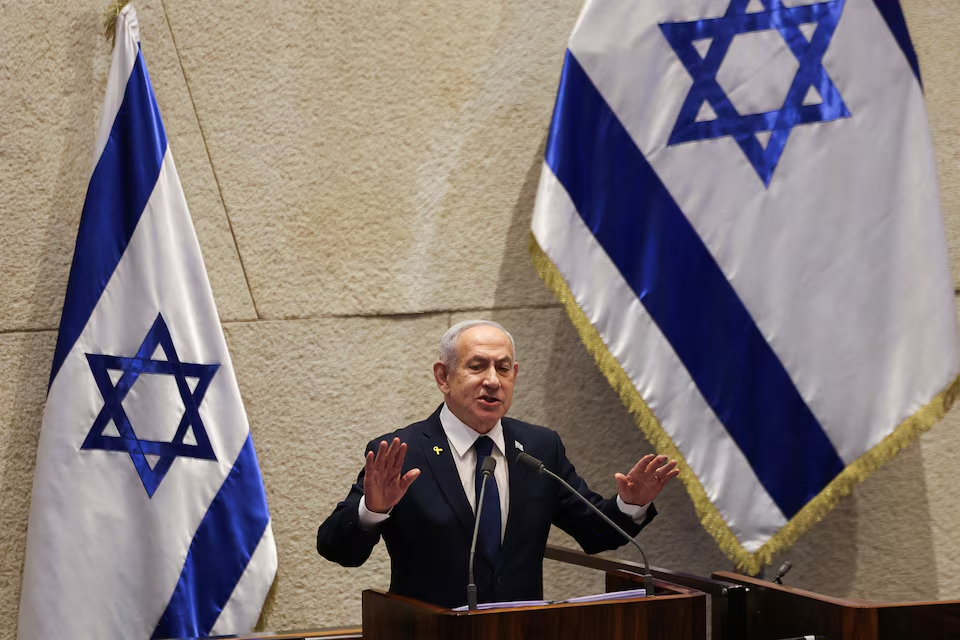
Israel’s Prime Minister Benjamin Netanyahu has formally asked President Isaac Herzog for a pardon in his long-running corruption trial, arguing that the legal process has become incompatible with his ability to govern. His request, submitted Sunday through his legal team, marks the first time the sitting prime minister has sought to halt a criminal trial on the grounds of national interest.
Netanyahu’s appeal places immediate political and legal pressure on the presidency and deepens divisions in a country already locked in multiple security crises. The corruption case — involving bribery, fraud, and breach of trust allegations — has overshadowed much of Netanyahu’s recent tenure and remains one of the most consequential trials in Israel’s history.
In a brief video released by his Likud party, Netanyahu said the pardon request was motivated by the needs of the state rather than any personal concern. “My lawyers sent a request for pardon to the president of the country today,” he said. “I expect that anyone who wishes for the good of the country support this step.”
His lawyers argued that the continuing trial has strained the prime minister’s schedule and heightened public tensions. They wrote that increasingly frequent court hearings had made it difficult for Netanyahu to carry out his duties, noting that he is expected to testify “three times a week”, a level of commitment he described as “an impossible demand that is not made of any other citizen.”
Despite the request, Netanyahu did not admit wrongdoing. He has repeatedly denied the charges since the case was opened, insisting the proceedings will ultimately end in acquittal.
President Herzog’s office confirmed on Sunday that the pardon request had been received and passed on to the justice ministry’s pardons department, which will collect opinions and prepare a formal recommendation. Any final decision will rest with the president.
Read Also: Israel Affirms Strong Security Confidence In India Under Modi
The move comes shortly after former US President Donald Trump sent a letter urging Herzog to consider pardoning Netanyahu, calling the prosecution “political” and “unjustified”, according to a statement released earlier this month.
Justice Minister Yariv Levin, one of Netanyahu’s closest allies in Likud, has not publicly commented on the matter.
Key members of the governing coalition quickly announced their support. National Security Minister Itamar Ben-Gvir and Finance Minister Bezalel Smotrich both issued statements defending Netanyahu’s move, describing it as necessary for national stability.
Opposition lawmaker Yair Golan, a former deputy military chief, sharply disagreed and called on Netanyahu to step down. He urged the president to reject the request, warning that granting a pardon before conviction would undermine the rule of law.
Netanyahu, first elected in 1996, is the country’s longest-serving prime minister and one of its most polarising political figures. His corruption trial — based on multiple cases known in Israel as Case 1000, Case 2000, and Case 4000 — has hung over the political system for years and helped fuel repeated election cycles.
The next national vote is scheduled for October 2026, though polls suggest Netanyahu’s right-wing coalition may struggle to retain power.
Netanyahu led Israel during Hamas’ 7 October 2023 attack, described by Israeli officials as the deadliest event in the state’s history. The attack triggered the ongoing Gaza war, which has killed tens of thousands of Palestinians and devastated large parts of the territory, according to local health authorities and international agencies.
Israel has since expanded its military operations, striking Hezbollah positions in Lebanon and launching a major confrontation with Iran that targeted key military infrastructure this year, according to Israeli officials and international reporting from Reuters and the BBC.
With the country engaged on several fronts, Netanyahu’s claim that the corruption trial impairs his ability to govern has become a focal point in the political battle surrounding the pardon request.