
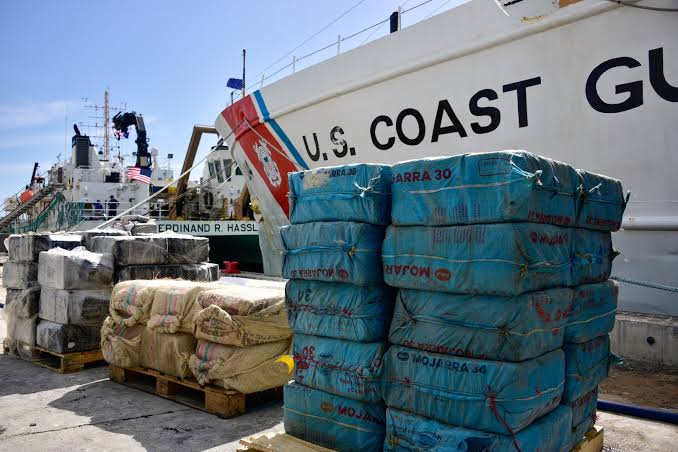
More than 20,000 pounds of cocaine seized in the Eastern Pacific as U.S. forces intensify maritime operations and expand counter-narcotics strikes.
United States Coast Guard has carried out its largest at-sea cocaine interdiction in more than 18 years, seizing over 20,000 pounds of the drug in the Eastern Pacific, officials announced this week. The haul was recovered by the crew of the USCGC Cutter Munro during ongoing operations targeting transnational criminal groups operating along major maritime smuggling corridors.
U.S. Coast Guard said the seizure was part of Operation Pacific Viper, a campaign designed to accelerate counter-narcotics missions across the region. The U.S. Department of Homeland Security (DHS) said the intercepted cocaine represented the equivalent of more than 7.5 million potentially lethal doses.
DHS has described the Eastern Pacific as one of the most active maritime routes for cartel-linked trafficking networks. The operation deploys U.S. forces forward to disrupt smuggling long before vessels approach American shores. Homeland Security officials have repeatedly emphasized that the ocean remains the front line in the country’s drug fight, with an estimated 80 percent of illicit drug seizures occurring at sea.
The record-setting interdiction comes amid a series of significant maritime seizures in recent days. On December 2, 2025, a Coast Guard Station Miami Beach crew confiscated approximately 3,715 pounds of cocaine valued at an estimated $28 million. Customs and Border Protection (CBP) said it was the largest cocaine seizure by a U.S. Coast Guard small boat station since 1995. Officials credited coordinated federal operations for the rapid interdiction, warning that trafficking groups would continue to face increased scrutiny at sea.
Read Also: U.S. Navy Commissions USS Pierre, Long-Range Littoral Hunter
Under President Donald Trump, U.S. counter-narcotics activity has expanded beyond interdictions to include direct military action. The U.S. Southern Command confirmed it carried out a strike on December 4 against a suspected trafficking vessel in the Eastern Pacific after receiving authorization for what officials described as a “lethal kinetic strike.” The vessel, reportedly operated by a designated terrorist organization, was believed to be carrying narcotics. Four individuals aboard were killed.
President Trump said on December 2, 2025, that his administration is considering extending such operations to land targets inside Venezuela, where Washington accuses criminal groups of cooperating with international traffickers.
The escalation has drawn scrutiny from some members of Congress. Lawmakers held a classified briefing on December 4, 2025, regarding an earlier deadly strike in the South Caribbean. Rep. Jim Himes, a senior member of the House Intelligence Committee, said the video shown during the session was deeply troubling, while others, including Sen. Tom Cotton, defended the operations as necessary amid rising narcotics flows.
CBP reported a nationwide surge in drug seizures in November 2025, totaling nearly 55,000 pounds—a 33 percent increase from October 2025. Methamphetamine, cocaine, and fentanyl all saw significant month-to-month jumps, underscoring what officials describe as intensifying trafficking pressure across U.S. borders.