
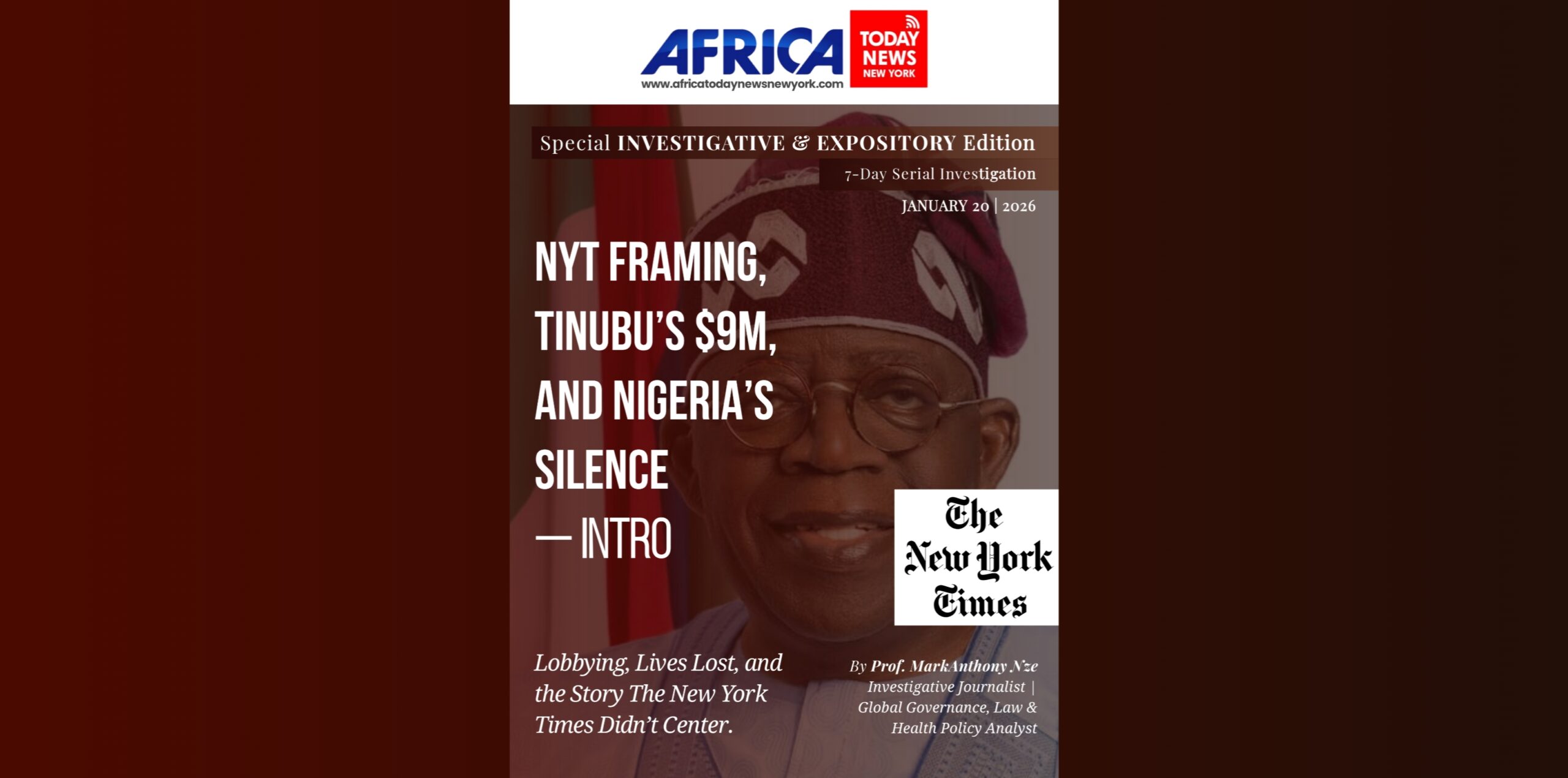
Lobbying, Lives Lost, and the Story The New York Times Didn’t Center.
In modern journalism, the most dangerous falsehood is not an outright lie.
It is the selective truth—the carefully framed narrative that excludes the facts most capable of assigning responsibility. This investigation begins with a question that contemporary media increasingly avoids because the answer implicates both political authority and journalistic practice:
What happens when narrative replaces evidence, and who benefits when that substitution occurs?
In recent reporting on Nigeria’s security crisis, The New York Times adopted a familiar interpretive frame—one that places American politics at the center of the story, foregrounds geopolitical motive, and reduces Nigeria itself to a passive backdrop. The effect is subtle but profound: the locus of moral scrutiny shifts away from Nigeria’s governing elite and toward foreign actors, even as Nigerians continue to die in staggering numbers.
This is not an argument about intent.
It is an examination of consequence.
Because while global audiences debate U.S. motivations, Nigeria remains mired in one of the worst humanitarian and governance crises in the world—one driven not by foreign interference, but by decades of domestic failure, elite impunity, and catastrophic misallocation of public resources.
And that reality is largely absent from the narrative.
The Crisis That Refuses to Disappear
Nigeria’s security collapse is neither sudden nor obscure. It is extensively documented, statistically verified, and internationally acknowledged.
According to the Institute for Economics & Peace (2024), Nigeria remains among the world’s most terror-affected nations, with tens of thousands of deaths attributed to armed violence over the past decade. These fatalities are not confined to a single insurgent group or region. Rather, they reflect a complex web of violence involving Boko Haram, ISWAP, bandit networks, and ethnically organized militias operating with near-total impunity.
The humanitarian consequences are staggering.
The International Organization for Migration (2024) estimates that more than 3.3 million Nigerians are internally displaced, while the UN Office for the Coordination of Humanitarian Affairs (2024) reports that over 25 million people require urgent humanitarian assistance. Health systems are overwhelmed, food insecurity is endemic, and entire communities have been hollowed out by violence.
Yet this catastrophe has unfolded not in the absence of government, but under it.
A State in Decline, by the Numbers
The developmental indicators are unambiguous.
Nigeria remains trapped in the low human development category of the UN Human Development Index, a position it has occupied for more than three decades (UNDP, 2024). Life expectancy has stagnated. Educational attainment lags behind regional peers. Per capita income has declined in real terms. Poverty deepens even as government spending grows.
Findings from the World Bank (2024) and the Nigeria Bureau of Statistics (2024), posit that over 63 percent of Nigerians now live in multidimensional poverty, lacking access to basic health services, education, clean water, or economic security.
This is not a mystery of economics.
It is the product of political choice.
And nowhere is that choice more visible than in how public funds are allocated.
Read also: BREAKING: Nigeria Terror Tracker Pushes Back On NYT Report
The $9 Million Question
Public filings under the U.S. Foreign Agents Registration Act (FARA) reveal that entities linked to the Nigerian government spent approximately $9 million on lobbying and strategic communications in the United States during a period of escalating domestic crisis (U.S. Department of Justice, 2024; Center for Responsive Politics, 2024).
This spending was directed toward shaping international perception—policy engagement, narrative positioning, and reputation management.
At the same time:
● Teaching hospitals operated without basic equipment
● Rural clinics closed due to lack of funding
● Security forces remained under-resourced
● Internally displaced persons lacked shelter and medical care
The contrast is not rhetorical. It is empirical.
The World Health Organization (2024) emphasizes that Nigeria’s health system remains one of the most underfunded in the world relative to population size. Maternal mortality rates are among the highest globally. Preventable diseases persist at alarming levels.
Yet the financial resources existed.
They were simply deployed elsewhere.
What the Media Did Not Ask
This is where the failure of narrative becomes consequential.
Coverage by The New York Times and other Western outlets has emphasized foreign decision-making, military posture, and political optics. What it has not done—at least not with comparable rigor—is interrogate how Nigeria’s own leadership has governed during this period of collapse.
The omission is striking.
Nowhere in the dominant coverage is there sustained analysis of:
● Why Nigeria continues to hemorrhage civilians
● Why security forces remain ineffective
● Why health and education spending lag behind lobbying expenditures
● Why accountability for mass violence remains elusive
Instead, the focus drifts outward—toward Washington, geopolitics, and ideological framing.
As the Electronic Frontier Foundation (2022) has noted, media framing is not neutral. It determines which actors are scrutinized and which are shielded. When journalism consistently examines external power while ignoring internal failure, it performs an act of narrative displacement.
The result is not misinformation.
It is a misdirection.
Violence Without Accountability
Data compiled by Amnesty International (2024) and Human Rights Watch (2024) documents repeated mass killings, village destructions, and forced displacements across Nigeria’s Middle Belt and northern regions. In many cases, perpetrators are known. Arrests are rare. Prosecutions rarer still.
Academic research confirms this pattern.
Arriola and Johnson (2019) demonstrate that ethnic militias thrive where state authority is fragmented and political elites benefit from ambiguity rather than resolution. Violence persists not because solutions are unknown, but because accountability is politically inconvenient.
This reality directly contradicts narratives suggesting Nigeria’s crisis is primarily driven by external forces or sudden instability. The evidence shows a long-standing failure of governance, reinforced by impunity and neglect.
The Cost of Narrative Substitution
When international media fails to foreground these realities, the consequences extend beyond perception.
It affects policy.
It affects aid.
It affects accountability.
More importantly, it affects who is seen as responsible for suffering—and who is not.
By framing Nigeria’s crisis as a byproduct of foreign politics rather than domestic failure, journalism inadvertently absolves those most capable of change. It transforms structural collapse into spectacle and governance failure into background noise. This is not neutrality. It is abdication.
What This Series Will Do
This series does not exist to attack a newspaper or defend a government. It exists to restore proportion, evidence, and accountability to a discourse that has become dangerously unbalanced.
Across the coming installments, this investigation will:
● Examine how international narratives distort Nigeria’s crisis
● Trace documented lobbying expenditures and their timing
● Analyze security data ignored by mainstream reporting
● Compare Nigeria’s development path with peer nations
● Expose how narrative management substitutes for reform
The objective is not outrage.
It is clarity.
Because when journalism stops interrogating power, power operates without consequence.
And when narrative replaces evidence, people die quietly—unrecorded, unexplained, and unaccounted for.
This series exists to ensure that does not happen in silence.
Professor MarkAnthony Ujunwa Nze is an internationally acclaimed investigative journalist, public intellectual, and global governance analyst whose work shapes contemporary thinking at the intersection of health and social care management, media, law, and policy. Renowned for his incisive commentary and structural insight, he brings rigorous scholarship to questions of justice, power, and institutional integrity.
Based in New York, he serves as a full tenured professor and Academic Director at the New York Center for Advanced Research (NYCAR), where he leads high-impact research in governance innovation, strategic leadership, and geopolitical risk. He also oversees NYCAR’s free Health & Social Care professional certification programs, accessible worldwide at:
https://www.newyorkresearch.org/professional-certification/
Professor Nze remains a defining voice in advancing ethical leadership and democratic accountability across global systems.
Selected Sources (APA 7th Edition)
Amnesty International. (2024). Nigeria: Harvest of death—Three years of bloody clashes between farmers and herders. https://www.amnesty.org/en/documents/afr44/9753/2024/en/
Arriola, L. R., & Johnson, M. C. (2019). Ethnic militias, state power, and civil violence in Nigeria. African Affairs, 118(472), 1–27. https://academic.oup.com/afraf/article/118/472/1/5369185
BBC News. (2024). Nigeria insecurity: Why attacks continue despite government assurances. https://www.bbc.com/news/world-africa
Center for Responsive Politics. (2024). Foreign lobbying disclosures: Nigeria. https://www.opensecrets.org/fara
Electronic Frontier Foundation. (2022). Media framing, power, and narrative control. https://www.eff.org/issues/free-speech-and-media
Human Rights Watch. (2024). World report 2024: Nigeria. https://www.hrw.org/world-report/2024/country-chapters/nigeria
Institute for Economics & Peace. (2024). Global terrorism index 2024. https://www.visionofhumanity.org/resources/global-terrorism-index-2024/
International Organization for Migration. (2024). Nigeria displacement tracking matrix. https://dtm.iom.int/nigeria
Nigeria Bureau of Statistics. (2024). Multidimensional poverty index. https://www.nigerianstat.gov.ng/
Office for the Coordination of Humanitarian Affairs. (2024). Nigeria humanitarian needs overview. https://www.unocha.org/nigeria
Premium Times Nigeria. (2025). Nigeria spends millions on foreign lobbying amid domestic crisis. https://www.premiumtimesng.com/
Reuters. (2024). Nigeria’s security crisis deepens as civilian deaths mount. https://www.reuters.com/world/africa/
United Nations Development Programme. (2024). Human development report 2023/2024. https://hdr.undp.org/
United Nations Office on Drugs and Crime. (2024). Global study on homicide. https://www.unodc.org/unodc/en/data-and-analysis/global-study-on-homicide.html
U.S. Department of Justice. (2024). Foreign Agents Registration Act database. https://www.justice.gov/nsd-fara
World Bank. (2024). Nigeria development update: Turning the corner. https://www.worldbank.org/en/country/nigeria
World Health Organization. (2024). Nigeria: Health system profile. https://www.who.int/countries/nga