
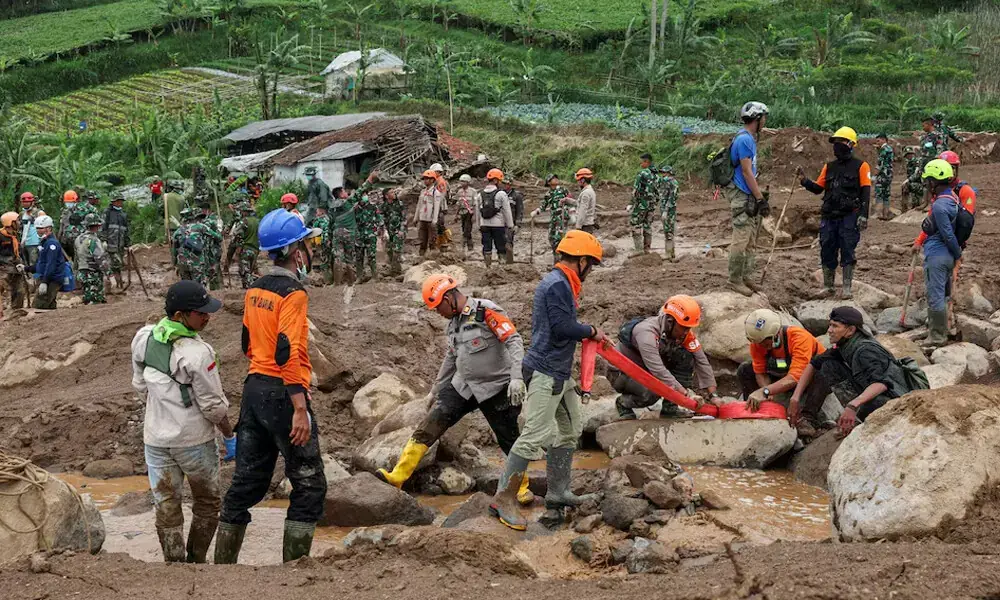
The death toll from a devastating landslide in Indonesia’s West Java province has climbed to 49, with at least 15 people still unaccounted for, as search-and-rescue teams continue operations in difficult terrain, the country’s main disaster agency, Basarnas, said Saturday.
The landslide struck Pasir Langu village in the Bandung Barat district on January 24, after prolonged heavy rainfall destabilized hillsides in the area. Entire sections of earth collapsed onto homes and access roads, trapping residents and complicating rescue efforts.
Authorities say operations have been slowed by unstable soil conditions, debris, and the risk of further landslides, forcing teams to proceed cautiously to protect both survivors and emergency personnel.
Basarnas confirmed that the national emergency response period has been extended by seven days, pushing active rescue operations through February 6. The extension allows additional personnel, heavy equipment, and medical support units to remain deployed in the affected communities.
Rescue teams are continuing systematic searches using ground crews, machinery, and local volunteers, while medical units support displaced families and survivors in temporary shelters.
Officials said the priority remains locating the missing, securing unstable terrain, and preventing secondary disasters caused by continued rainfall.
The West Java tragedy follows a series of climate-related disasters across Indonesia. In late 2025, cyclone-driven floods and landslides on the island of Sumatra killed around 1,200 people and displaced more than one million residents, according to disaster response agencies and international humanitarian organizations.
Read Also: Indonesia Plane Crash: Wreckage Found On Mountain
Indonesia’s geography makes it particularly vulnerable to such events. As the world’s largest archipelago, the country sits along the Pacific Ring of Fire and experiences frequent earthquakes, volcanic eruptions, floods, and landslides, with risks intensifying during the annual monsoon season.
Climate experts and disaster agencies have repeatedly warned that extreme weather patterns are increasing the frequency and severity of natural disasters across Southeast Asia.
The latest disaster has renewed concerns about the capacity of Indonesia’s emergency response institutions. Basarnas recently faced budget reductions approved by a parliamentary panel, despite growing operational demands driven by repeated national emergencies.
Disaster management analysts and humanitarian organizations have cautioned that funding cuts could weaken rescue capabilities, equipment readiness, and response times, especially as disasters become more frequent and complex.
Read Also: Indonesia Floods Death Toll Over 900 As Survivors Seek Aid
In a separate announcement earlier this week, Indonesia’s navy confirmed that 23 soldiers were killed during a border patrol training exercise, highlighting broader safety and operational pressures facing national security and emergency services.
As rescue efforts continue in Pasir Langu village, authorities are preparing for the transition from emergency response to recovery planning, including housing reconstruction, infrastructure repair, and long-term support for displaced families.
Officials said assessments will be carried out once search operations conclude to determine the full scale of damage and the resources required for rebuilding.