
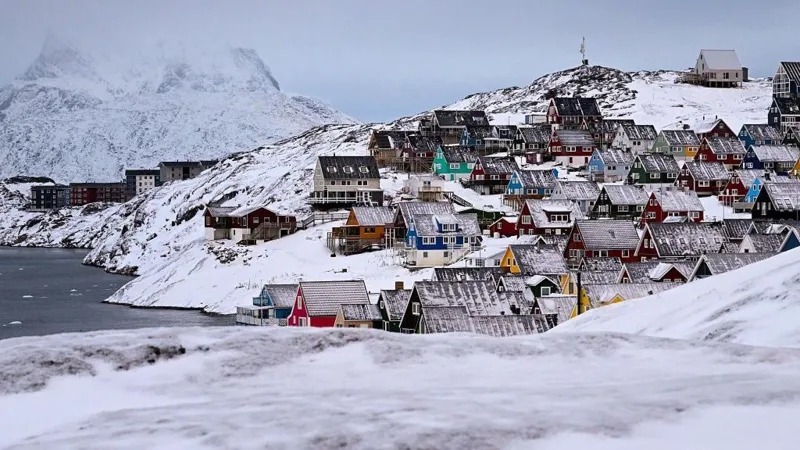
Canada is preparing to open its first-ever diplomatic outpost in Greenland, a move that carries symbolic, political, and strategic weight at a moment of heightened tension over the Arctic territory’s future. Senior Canadian officials are travelling to Nuuk on Friday to formally inaugurate the new consulate, signalling Ottawa’s support for Greenland’s right to self-determination following repeated remarks by US President Donald Trump suggesting Washington should take control of the island.
The Canadian delegation includes Governor General Mary Simon and Foreign Minister Anita Anand, accompanied by a Canadian Coast Guard vessel, underlining both diplomatic and security dimensions of the visit. In remarks ahead of the trip, Simon said Canada stands firmly with the people of Greenland and supports their right to decide their own path without external pressure. Her words were widely interpreted as a response to Trump’s earlier statements framing Greenland as a strategic asset the United States needs to “own” for national security reasons.
Canada’s move coincides with a parallel step by France, whose officials are also scheduled to open a consulate in Nuuk on the same day. Together, the Canadian and French missions represent a notable expansion of foreign diplomatic presence in Greenland. Until now, only Iceland and the United States maintained formal consulates in the territory. The timing has reinforced the perception that Nato allies are closing ranks to demonstrate solidarity with Greenland and Denmark amid renewed geopolitical attention on the Arctic.
Although Trump has since softened his rhetoric, saying he is exploring possible arrangements through discussions with Denmark, European allies, and Canada, the episode has accelerated diplomatic engagement with Greenland. Canada’s consulate was initially announced in early 2024 as part of a broader review of Ottawa’s Arctic foreign policy. The opening was originally planned for late 2025 but was delayed by harsh weather conditions. Analysts say the current geopolitical climate has given the move added urgency and significance.
Read also: BREAKING: Trump Withdraws Canada From Board Of Peace
Michael Myers, a professor at the University of British Columbia and an expert on Arctic affairs, said the establishment of a Canadian consulate is long overdue given the close ties between Arctic Canada and Greenland. He pointed out that Iqaluit, the capital of Nunavut, is only about an hour’s flight from Nuuk, and that the two regions share deep historical, cultural, and familial connections. Myers also noted that Simon’s presence carries particular meaning because of her Inuit heritage, calling the visit a powerful affirmation of shared identity across Arctic borders.
Simon, who grew up in Nunavik in northern Quebec, said her connection to Greenland stretches back to childhood memories of hearing Greenlandic Inuit songs on her grandmother’s shortwave radio. Those moments, she recalled, reinforced a sense of shared peoplehood across distant Arctic lands. She is the first Canadian governor general to visit Greenland since 1982, making the trip historically significant as well as personally resonant.
The opening ceremony is expected to draw strong Inuit participation. Natan Obed, president of Inuit Tapiriit Kanatami, said the consulate reflects years of advocacy by Canadian Inuit to deepen ties with Greenland. Around 50 Canadian Inuit are travelling from Montreal to Nuuk for the event. Obed said Inuit communities feel particularly vulnerable to external threats against Greenland because of their shared experience of colonisation and because of Trump’s past comments about Canada itself. He warned that fears of renewed US annexation rhetoric are felt acutely in Inuit Nunangat, the Inuit homeland, which he described as central to why such ambitions might arise.
In that context, Canada’s diplomatic presence in Nuuk is being viewed not just as a foreign policy milestone, but as a statement of identity, solidarity, and resistance to great-power pressure in the Arctic.