
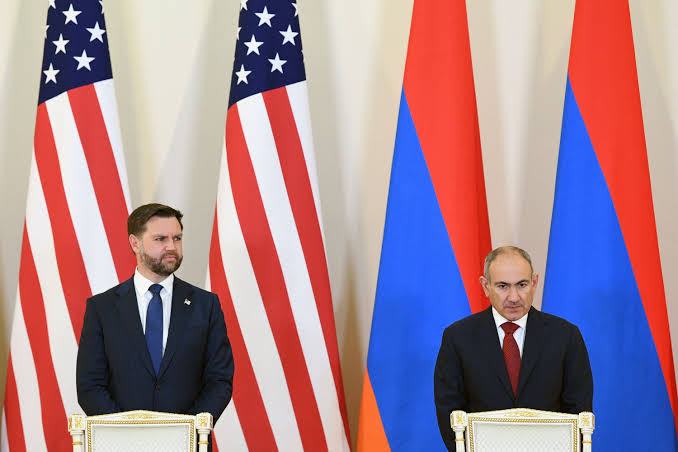
The United States and Armenia have signed a civil nuclear cooperation agreement aimed at expanding energy ties and reducing Yerevan’s long-standing reliance on Russian technology, officials from both countries said after talks in the Armenian capital on Monday.
Armenian Prime Minister Nikol Pashinyan and U.S. Vice President JD Vance formalised the accord — known as a “123 Agreement,” a legal framework that allows Washington to export civilian nuclear technology — during Vance’s two-day visit, the first by a sitting U.S. vice president to Armenia. The deal opens the door for American companies to supply equipment, fuel and services linked to new nuclear power projects in the country.
Speaking at a joint news conference, Pashinyan said the arrangement would “open a new chapter in the deepening energy partnership between Armenia and the United States,” signalling Yerevan’s effort to broaden its international partnerships after decades of close alignment with Moscow in the energy sector.
Read Also: Iran Envoy In Oman To Discuss Nuclear Deal With U.S.
Vance described the agreement as a significant commercial opportunity and a strategic step toward strengthening Armenia’s energy independence. He said the framework could generate up to $5 billion in initial U.S. exports, with an additional $4 billion in longer-term fuel supply and maintenance contracts. According to U.S. officials, discussions have focused on deploying small modular reactor technology, a newer generation of nuclear systems designed to be more flexible and easier to install than traditional large reactors.
Armenia currently operates a single nuclear facility built with Russian technology during the Soviet era, and Moscow has remained a central partner in maintaining the plant. The new agreement marks Washington’s entry into a sector historically dominated by Russia, reflecting a broader geopolitical shift as Armenia explores alternatives to traditional security and energy arrangements.
Yerevan has been reviewing proposals from several international partners — including companies from the United States, Russia, China, France and South Korea — as it plans for the construction of a replacement reactor. Analysts say diversification has become a priority for Armenian policymakers following regional tensions and evolving relations with Moscow.
Narek Sukiasyan, a political scientist based in Yerevan, said Armenia’s multiple economic and security links with Russia have encouraged leaders to seek new partners. “Given Armenia’s multiple dependencies on Russia, it was a political priority to diversify partners when it comes to nuclear cooperation,” he told Reuters, adding that Washington currently appears to be the preferred option.
Russian officials have signalled that they intend to remain involved in Armenia’s nuclear future. Deputy Foreign Minister Mikhail Galuzin told the Russian newspaper Izvestia that a proposal from Russia’s state nuclear corporation Rosatom offered the most practical solution. He said Moscow could move forward “very quickly” with a new plant and argued that Russian technology remained competitive in terms of reliability and financing.
The agreement comes at a time of changing dynamics in the South Caucasus following a peace initiative between Armenia and Azerbaijan signed at the White House six months ago. Vance’s visit to Yerevan also aims to advance broader regional economic projects, including the proposed Trump Route for International Peace and Prosperity (TRIPP), a planned transport corridor intended to run through southern Armenia.
U.S. officials say the 43-kilometre route could provide Azerbaijan with a direct land link to its exclave of Nakhchivan and onward access to Turkey, while also creating new trade channels connecting Asia and Europe. The project is expected to include rail infrastructure, energy pipelines and telecommunications links, although detailed timelines and financing arrangements have yet to be finalised.
Read Also: Secret Ethiopian Camp Training Sudan RSF Forces – Sources
Supporters of the corridor argue that it could reshape trade flows across the region by bypassing Russia and Iran at a time when Western countries are seeking alternative routes for energy and commerce following Moscow’s invasion of Ukraine. Critics, however, have raised concerns about sovereignty and regional stability, though Armenian officials have said any arrangement would respect national jurisdiction.
“We’re not just making peace for Armenia,” Vance said during remarks in Yerevan. “We’re also creating real prosperity for Armenia and the United States together.” His visit is part of a broader U.S. diplomatic push to strengthen ties with countries in the South Caucasus and encourage economic integration after years of conflict.
Armenia has traditionally relied on Russia and, to a lesser extent, Iran to meet its energy needs, particularly in the nuclear and natural gas sectors. The new agreement reflects Yerevan’s efforts to balance relationships with multiple powers while pursuing energy security and technological investment.
No construction contracts have been awarded under the framework, and officials from both countries said negotiations with private companies would continue in the coming months. U.S. authorities emphasised that the 123 Agreement establishes legal conditions for cooperation but does not itself commit funding for specific reactor projects.
Vance is scheduled to travel to Azerbaijan later this week for additional talks focused on regional economic initiatives and implementation of the peace framework signed earlier in Washington. Further discussions on Armenia’s nuclear development plans are expected as Yerevan evaluates competing proposals and finalises its long-term energy strategy.