
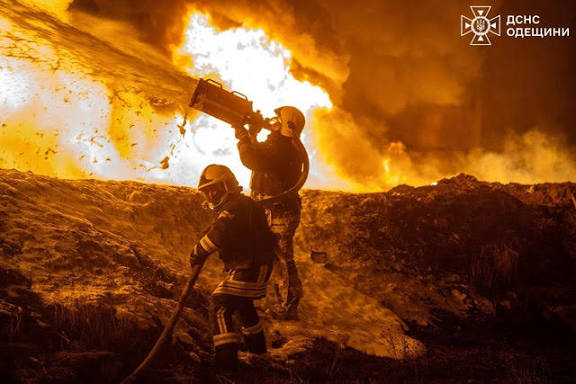
A fire erupted at the Russian Black Sea port of Taman on Sunday following a drone strike, injuring at least two people, officials said.
The incident, which damaged oil storage facilities, warehouses, and port terminals, occurred just days before a planned round of U.S.-mediated talks aimed at resolving the nearly four-year conflict in Ukraine.
Regional Governor Veniamin Kondratyev said more than 100 personnel were engaged in extinguishing multiple fires at the port in Russia’s Krasnodar region. He added that other locations, including the resort city of Sochi and the village of Yurovka, were also struck, sustaining comparatively minor damage.
According to Kondratyev, the strike targeted critical energy infrastructure, a pattern consistent with Ukraine’s long-range drone operations aimed at limiting Moscow’s oil export revenues.
Ukrainian officials have repeatedly said such attacks are intended to weaken Russia’s capacity to fund its military campaign in Ukraine.
Meanwhile, falling debris from Russian drones reportedly struck civilian and transport infrastructure in Ukraine’s Odesa region, disrupting electricity and water services.
Ukrainian authorities have described these operations as attempts to undermine essential services, particularly in winter months, which they characterize as part of a broader effort to “weaponize winter” against the civilian population.
The Taman port strike comes as diplomatic engagement between Russia and Ukraine is set to resume in Geneva on Tuesday and Wednesday under U.S. facilitation.
This will mark the third session under the trilateral framework established earlier this year, with prior meetings held in Abu Dhabi. Unlike the earlier rounds, this week’s talks are scheduled on European soil and coincide with the approach of the fourth anniversary of Russia’s full-scale invasion on Feb. 22, 2022.
Read Also: Russian Blogger Accused Of Secretly Filming Women In Ghana
While officials have not expressed expectations for a comprehensive ceasefire, progress has reportedly been made on subsidiary issues.
Ukrainian President Volodymyr Zelenskyy, speaking at the Munich Security Conference on Saturday, highlighted unresolved questions regarding Ukraine’s future security arrangements.
He also raised concerns about implementing a U.S.-proposed free trade zone in the Donbas, a region partly occupied by Russian forces that Moscow insists Ukraine must cede to achieve peace.
“The Americans want peace as quickly as possible, and the U.S. team wants to sign all the agreements on Ukraine at the same time, whereas Ukraine wants guarantees for the country’s future security signed first,” Zelenskyy said in Munich.
U.S. Secretary of State Marco Rubio met with Zelenskyy during the conference to discuss ongoing security, defense, and economic cooperation. “President Trump wants a solution that ends the bloodshed once and for all,” Rubio stated on social media following their meeting.
Echoing Zelenskyy’s emphasis on security guarantees, U.S. Senator Jeanne Shaheen, ranking member of the Senate Foreign Relations Committee, told reporters that any peace arrangement must include enforceable assurances for Ukraine.
She warned that absent such measures, the risk of renewed hostilities would remain. “One of the things we know is that Russia has geared up not just for Ukraine, but to go beyond Ukraine,” Shaheen said.
European Union foreign policy chief Kaja Kallas, also speaking at the Munich Security Conference, characterized Russia’s diplomatic posture as an effort to secure concessions at the negotiating table after failing to achieve its objectives militarily.
She stressed that critical Russian demands, including the removal of sanctions and the unfreezing of assets, fall under European jurisdiction. “If we want a sustainable peace, then we need concessions also from the Russian side,” Kallas said.
Read Also: Russia Blocks WhatsApp Nationwide Over Regulatory Dispute
Previous U.S.-led initiatives have struggled to reconcile conflicting positions on the war’s core issues.
Among the most contentious is the status of the Donbas, Ukraine’s industrial heartland, where Russian forces occupy significant territory.
Earlier rounds of trilateral discussions in Abu Dhabi did not resolve the question of territorial control, nor did they produce agreement on mechanisms to secure lasting peace.
The strike on Taman is part of a broader pattern of energy-targeted operations by both sides. Ukrainian drones have previously struck Russian facilities in ports and refineries, while Russian forces have launched strikes against Ukrainian power infrastructure, seeking to disrupt electricity and heating for civilians.
These operations have compounded humanitarian challenges in both countries, particularly as winter conditions persist.
Officials confirmed that emergency response units remain active in the affected areas. In Taman, containment efforts focused on the oil storage and port terminal facilities, with firefighting teams operating around the clock to prevent further escalation.
Damage assessments and investigations into the strike’s immediate consequences are ongoing, though local authorities have reported that critical port operations have been temporarily suspended.
As Geneva talks approach, both sides are expected to discuss security guarantees, economic cooperation, and humanitarian measures.
Observers note that while a broad ceasefire remains elusive, incremental agreements on technical or logistical issues may still be achievable.
No further details have been released regarding the number of casualties or the full scale of property damage in either Russia or Ukraine.