
Britain’s minister responsible for relations with the European Union cautioned on Thursday that the bloc’s forthcoming industrial procurement law could disrupt tightly integrated cross-channel supply chains, raising the stakes ahead of a Brussels policy announcement expected next week that has already divided EU member states.
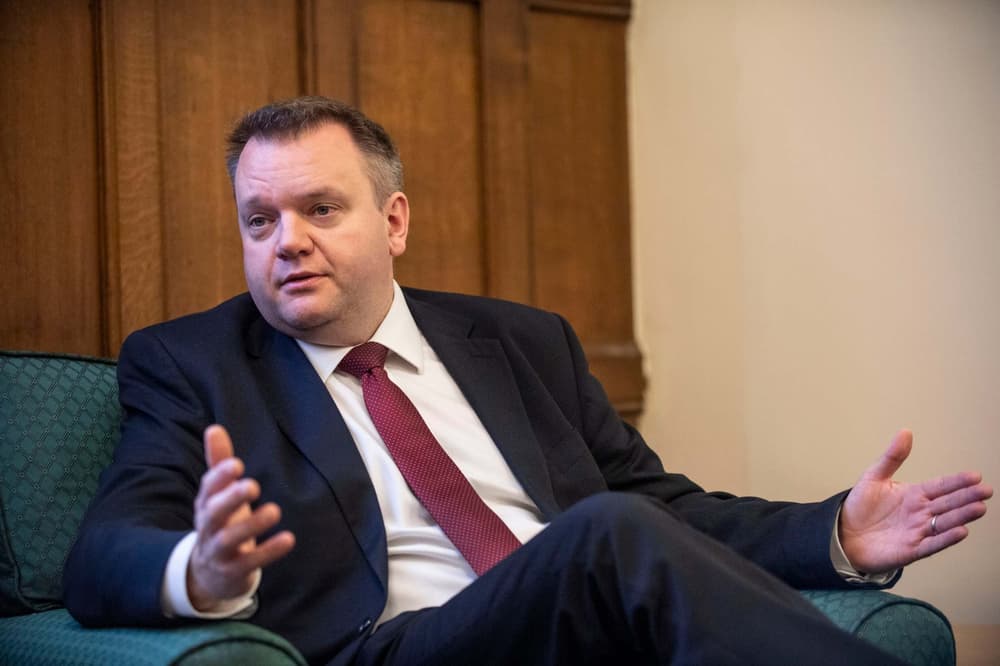
Nick Thomas-Symonds, who holds the EU relations portfolio in Prime Minister Keir Starmer’s government, made the remarks at an economic forum in Madrid. His intervention came days before the European Commission is scheduled to publish what it has internally titled the Industrial Accelerator Act, a sweeping set of rules that would require a minimum share of publicly funded products in strategic industries to be manufactured within Europe. The legislation has been delayed twice and remains subject to revision before publication on February 26.
“My concern is that if you had very strict preference requirements, you would risk impacting our deeply integrated supply chains that would create unnecessary barriers to trade in key UK-EU industries and increase costs,” Thomas-Symonds said.
He was speaking at an event where bilateral economic ties with Spain formed part of the discussion. “That would obviously affect UK-Spain supply chains,” he added, noting that Britain is Spain’s fourth-largest source of foreign investment.
The proposed legislation, would cover key strategic sectors including batteries, solar and wind energy, hydrogen manufacturing, and nuclear power plants, with each technology subject to a specific Europe-made content requirement. On electric vehicles, makers of cars bought or leased through public procurement would need to assemble those vehicles within the EU and ensure that 70 per cent of their components by value, excluding the battery, are manufactured in Europe. Battery systems face their own phased requirements, with assembly and key components required to be EU-sourced within a year of the law taking effect, tightening further after two years.
Critically for London, the draft defines “Europe” as the European Economic Area, the 27 EU member states plus Iceland, Liechtenstein, and Norway, explicitly excluding Britain. The text does, however, indicate that the Commission could designate other “trusted partners” in future, including countries with reciprocal international commitments.
Read Also: US Plans Online Portal To Evade Foreign Content Restrictions
Whether the United Kingdom could eventually qualify under such a clause remains an open question, and no timeline or criteria for such a designation has been set out in the current draft.
Britain formally left the European Union in January 2020. The proposal would also introduce new screening conditions for foreign direct investments exceeding €100 million in designated strategic sectors, requiring that investors meet localization criteria tied to Europe-made components and EU labour. Such provisions could affect British companies with significant manufacturing or investment footprints on the continent.
The policy has exposed fault lines within the EU itself. France has championed the measures, while Sweden and the Czech Republic have warned that stricter “buy local” rules could increase tender costs and undermine the bloc’s wider competitiveness. Finland and the Netherlands have separately called for a full impact assessment before any binding targets are established. The proposal must be negotiated between EU member states and the European Parliament before becoming law, a process that typically takes months and often reshapes the original text considerably.
The Commission has framed the initiative as a direct response to competitive pressures from China and the United States. It cited the EU’s share of global industrial gross value added falling from 20.8 per cent in 2000 to 14.3 per cent in 2020 as a central justification, arguing that the green industrial transition must generate industrial strength rather than accelerate deindustrialisation. The draft text states that the EU must act strategically to secure and strengthen its industrial base and long-term competitiveness, and ensure that the climate transition becomes an engine of industrial prosperity.
For Britain, the concern is structural. UK and EU manufacturing sectors remain deeply interwoven despite the rupture of Brexit, with automotive, aerospace, pharmaceuticals, and clean energy among the industries that operate across borders through complex, multi-stage production networks. Any binding preference requirement that treats British inputs as non-European by origin could force procurement decisions that bypass or disadvantage UK-based suppliers — even in sectors where integration has historically been treated as mutually beneficial. Thomas-Symonds framed Britain’s position not as opposition to European industrial ambition, but as a caution against self-imposed costs. “The UK and the EU share the same challenges of boosting competitiveness and productivity,” he said. “We are not going to meet those challenges by causing unnecessary economic damage to each other.”
Read Also: UK Moves to Ban Under‑16s from Social Media, Boost AI Safety
Starmer’s government has worked since taking office in mid-2024 to recalibrate relations with the bloc, and the prime minister has signalled openness to deeper alignment with EU single market rules. Whether London could ultimately be accommodated within the trusted partner framework of the Industrial Accelerator Act is likely to become a recurring point of discussion in the negotiations ahead.
The European Commission is expected to formally publish the proposal on February 26. After that, it enters the standard EU legislative process, requiring qualified majority approval among member states and co-decision with the European Parliament before taking effect.