
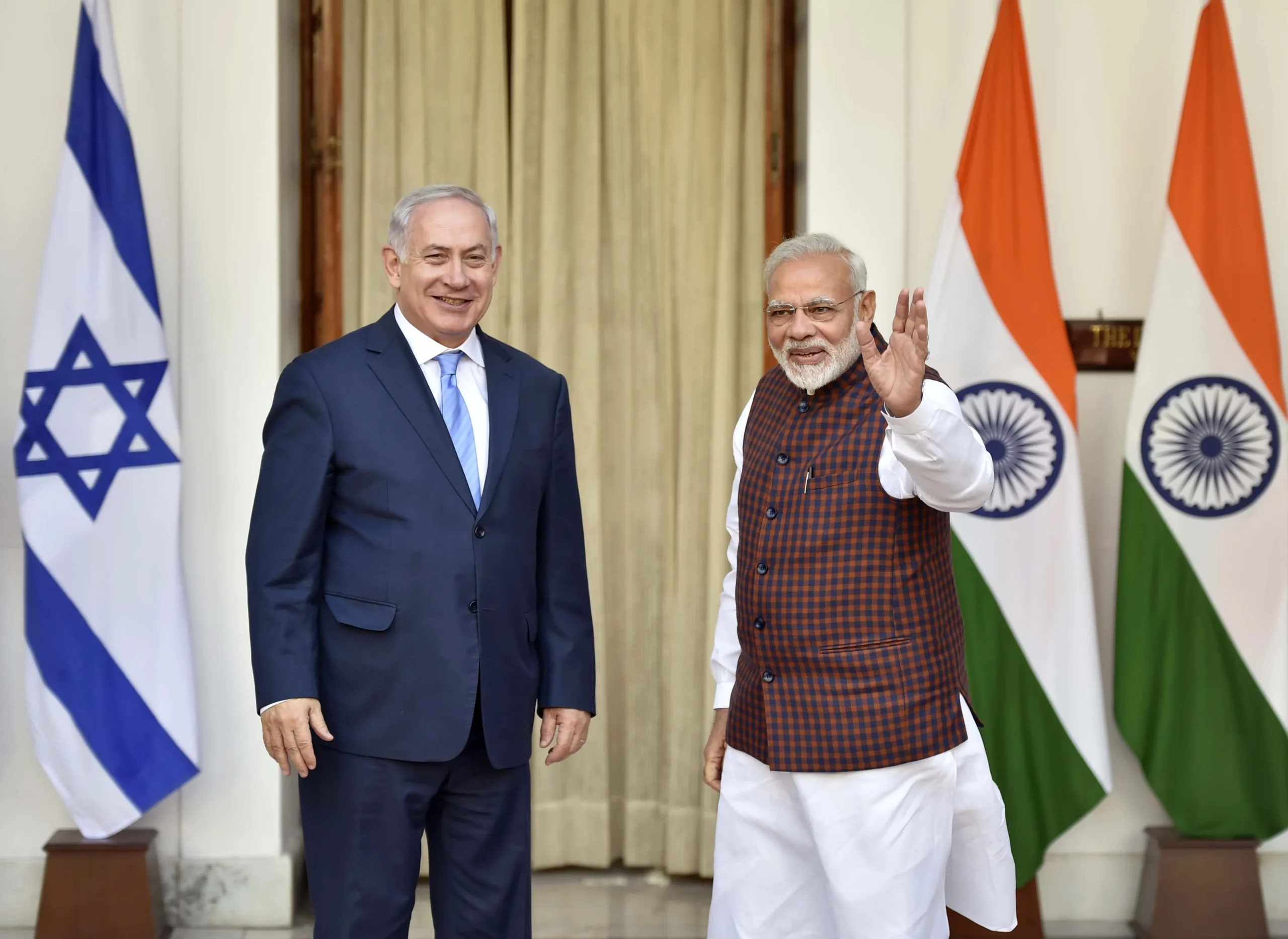
Indian Prime Minister Narendra Modi arrived in Israel on Wednesday for a two-day visit that both governments have framed as an opportunity to expand cooperation in defence, artificial intelligence, and regional security, coinciding with the most acute period of US-Iran tension in years and positioning New Delhi at the intersection of a set of strategic relationships it has worked carefully to keep from conflicting with one another.
Netanyahu broke diplomatic protocol by personally greeting Modi at Ben Gurion International Airport, alongside his wife Sara. The two leaders held a private one-on-one discussion within an hour of Modi’s arrival, before proceeding to delegation-level talks at King David Hotel in Jerusalem. Modi then addressed the Israeli parliament, the Knesset, between 4:30 and 6:00 p.m. local time. Netanyahu hosted a private dinner for Modi on Wednesday evening, and the two leaders are scheduled to continue meetings through Thursday, when formal agreements are expected to be signed.
The India-Israel relationship was elevated to the level of strategic partnership during Modi’s first visit to the country in July 2017, when he became the first Indian prime minister to travel to Israel.
Netanyahu made a reciprocal visit to India in January 2018. The relationship has deepened substantially in the intervening nine years. Israel approved $8.6 billion in arms transactions with India in 2026 alone. Reports ahead of the visit described plans for a substantial defence pact that could involve procurement and co-production of technologies to bolster India’s multi-layered air defence capabilities, alongside cooperation in artificial intelligence, quantum computing, cybersecurity, and surveillance systems. Local media reports suggest discussions may include India’s possible integration into Israel’s laser-based air defence programme.
The timing has drawn comment from analysts. Nicolas Blarel, at Leiden University, who writes on India-Israel relations, described the decision to proceed as surprising for a government that is usually risk-averse.
Modi arrives as the United States has deployed two aircraft carrier strike groups near Iran and President Trump has publicly acknowledged he is considering military strikes. Iran and Washington remain at an impasse in nuclear talks, with each side issuing public warnings while their negotiators continue working through Omani and other intermediaries. Any US strike could draw Iranian retaliation against Israel and against Gulf Arab states, where approximately nine million Indians live and work. Their remittances represent a significant proportion of India’s foreign exchange inflows, and any disruption to Gulf stability carries direct economic consequences for New Delhi.
Read Also: Israel Leads Global Military Innovation With New AI Division
Strategic studies professor Brahma Chellaney said Modi’s physical presence in Israel as US carrier strike groups reposition in the region was intended to underline India’s status as a consequential stakeholder in Middle Eastern stability.
“His scheduled address to the Knesset during a period of heightened military alert further reinforces that India will not be deterred by regional volatility,” Chellaney said. Analysts at the Observer Research Foundation noted that India had consistently sought to avoid being drawn into taking sides in US-Iran tensions, and that Modi would likely convey that preference privately in his discussions with Netanyahu, even as the public agenda of the visit focused on bilateral deliverables.
India’s long-standing tradition of strategic autonomy makes a formal alignment with any regional security bloc unlikely. New Delhi has maintained cordial ties with both sides in most of the world’s major conflicts. But the timing of the visit, when the US is likely to strike Iran, is not ideal in terms of maintaining this image, according to one analyst quoted by Al Jazeera.
Netanyahu has used the occasion of Modi’s visit to articulate an ambitious regional security architecture. At a cabinet meeting ahead of the visit, he described a proposed framework he called the “hexagon of alliances,” a six-sided grouping bringing together countries from within and around West Asia.
He indicated that India, Greece, and Cyprus would be among the core participants, alongside unnamed Arab, African, and Asian nations sharing similar strategic concerns. The bloc, as Netanyahu described it, would stand in opposition to what he called the radical Shia axis and an emerging radical Sunni axis. “All of these nations share a different perception, and our cooperation can yield great results and, of course, ensure our resilience and our future,” he said. India has not publicly accepted the invitation to join such a grouping and has maintained a deliberate ambiguity about the degree to which it aligns with Israeli framing of regional threats.
The visit also coincides with political tensions within Israel. Opposition leader Yair Lapid threatened to boycott Modi’s Knesset address, with the protest directed not at India but at Netanyahu’s government for excluding Supreme Court President Yitzhak Amit from official state events, part of the judicial crisis that has defined Israeli domestic politics for the past several years. For Netanyahu, hosting Modi carries domestic significance. It bolsters his narrative that Israel’s global partnerships remain robust despite internal unrest.
The two leaders are also likely to discuss the situation in Gaza, following the ceasefire framework agreed last year, and the broader regional picture including ongoing developments in the West Bank. Netanyahu and Modi spoke twice by telephone after the June 2025 military exchanges between Israel and Iran. On October 9, Modi called Netanyahu to discuss progress under Trump’s Gaza peace plan.
Read Also: Modi In Malaysia To Deepen Trade, Defense, And Tech Ties
The visit comes days after India joined more than 100 other countries in condemning Israel’s expansion in the occupied West Bank, after New Delhi initially appeared to hesitate before adding its name to the criticism. India has officially maintained its support for a two-state solution, including a sovereign Palestinian state, even as it has expanded its bilateral engagement with Israel. Congress party official Jairam Ramesh described the juxtaposition as “sheer hypocrisy and cynicism,” saying that if Modi was serious about the West Bank condemnation he should raise it publicly with Netanyahu during the visit. Analysts told Al Jazeera that Modi would likely approach the Palestinian issue with diplomatic caution.
The visit comes after India clashed with Pakistan in a military confrontation in May 2025 that brought the two nuclear-armed neighbours to their most dangerous standoff in years. Pakistan was armed and supplied by India’s rival China, adding an extra dimension to New Delhi’s interest in deepening access to advanced Israeli weapons systems.
The India-Pakistan episode has made air defence, precision munitions, and intelligence-sharing a more urgent priority for Indian planners than at any previous point in the bilateral relationship with Israel.
Agreements are expected to be signed at the conclusion of Thursday’s meetings.