
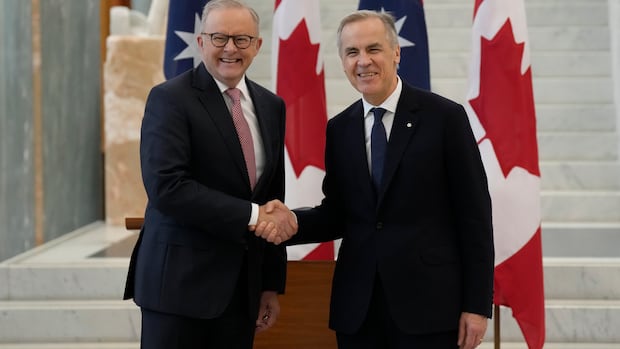
Canadian Prime Minister Mark Carney called for increased strategic cooperation between middle powers, speaking to Australia’s parliament and saying that the international order established after World War II was suffering from the stress of various geopolitical and financial crises.
Carney, who spoke in Australia’s capital, Canberra, said that countries like Canada and Australia need to cooperate more in order to establish the rules on issues of security, trade, and technology, rather than leaving it to other, more powerful nations to set the global agenda.
This was the first time in almost two decades that a Canadian prime minister spoke to Australia’s parliament.
“The question for middle powers is whether we will help write the rules that determine our security and prosperity, or whether we will let the hegemons dictate outcomes,” Carney said to the parliamentarians.
He termed Canada and Australia “strategic cousins” and said that both countries share a common set of democratic systems, economic interests, and resources, and that closer collaboration between the two might help them better deal with a period of international uncertainty.
Carney said that the international framework that has been in place since the end of World War II, underpinning international collaboration, has been under growing pressure from international tensions, economic splits, and a string of crises that have revealed the limitations of existing international systems.
Read Also: India And Canada Sign Landmark Nuclear Energy Agreement
Under such a situation, many countries are now seeking more control over key elements of the economy and technology.
“Across the world, nations are deciding to increase their sovereign autonomy,” he said. “This is a sensible response when the rules no longer protect you.”
The Canadian leader emphasized the need to increase cooperation between the two nations in areas he termed crucial to their economic security, including minerals, defense industries, and artificial intelligence.
The two nations have large reserves of natural resources, which are considered crucial to the development of advanced technologies and energy resources.
Canada and Australia have a combined share of one-third of the world’s uranium and lithium, and more than 40% of the world’s iron ore, according to official statistics cited by the two nations.
After his address to parliament, Carney was joined by the Australian Prime Minister, Anthony Albanese, for a joint press conference to announce a number of initiatives aimed at strengthening cooperation between the two nations.
The initiatives include cooperation in defense and security issues and cooperation between the two nations’ space agencies.
As part of these efforts, Albanese said Australia will also join the Group of Seven Critical Minerals Alliance, which is a partnership to strengthen supply chains for critical minerals, which are essential for technologies like electric vehicle batteries, renewable energy technologies, and electronic devices.
Carney said, “It’s the largest grouping of trusted democratic mineral reserves in the world, and we believe Australia’s participation will strengthen cooperation between like-minded countries to reduce dependence on concentrated supply chains.”
The visit comes amid increasing efforts by various governments to prioritize access to minerals and industrial materials essential for new technologies and energy security.
There has been a focus on diversifying supply chains for resources like those in batteries, semiconductors, and defense equipment, especially in the West.
Albanese stated that Australia and Canada had “long-standing political relationships” and “similar economic structures,” noting that “cooperation between Australia and Canada is increasingly important, especially given the dynamic geopolitical landscape.”
“Australia and Canada must seek and create new ways to stand with – and for – each other,” Albanese stated prior to Carney’s address, noting the relationship between the two nations is “based on shared values and democratic traditions.”
In addition to economic and strategic cooperation, the leaders also discussed the growing conflict in the Middle East, where tensions remain high following strikes between Iran and other actors within the region.
Both Carney and Albanese expressed their support for measures aimed at lessening hostilities within the region, while continuing to express concern over Iran’s nuclear capabilities
“The world wants to see a de-escalation and wants to see Iran cease to spread the destinations of its attacks,” Albanese told reporters, referring to recent incidents that he said had affected several Gulf states, including attacks on civilian and tourist targets.
However, Albanese added that a ceasefire should also mean that Iran is no longer in a position to make a nuclear bomb.
“I also want to see a removal of the ongoing threat that has been there for such a long period of time, of Iran endangering peace and security and stability,” he added.
Read Also: Canada Summons OpenAI Safety Officials After School Shooting
The Australian leader also touched on two antisemitic attacks that took place in Australia in 2022, which his government claims were carried out by Iran, despite Iran denying claims of being behind the attacks.
Carney’s trip to Canberra was part of a larger diplomatic outreach to the Indo-Pacific region.
Before landing in Australia, Carney spent four days in India, where Canadian and Indian officials announced agreements in the billions of dollars.
The agreements were described as a major improvement in the relationship after a long diplomatic rift between Ottawa and New Delhi.
The rift began in 2023 when the previous Canadian government publicly accused India of involvement in the murder of a Sikh separatist activist in British Columbia.
The government in India denied the allegations, which led to a sharp deterioration of the relationship.
According to officials from both countries, the agreements reached during Carney’s trip were meant to revive cooperation in the areas of trade, technology, and investments.
Following his trip to Australia, Carney is set to visit Japan for talks with Prime Minister Sanae Takaichi as part of ongoing talks on economic and security cooperation in the Indo-Pacific region.