
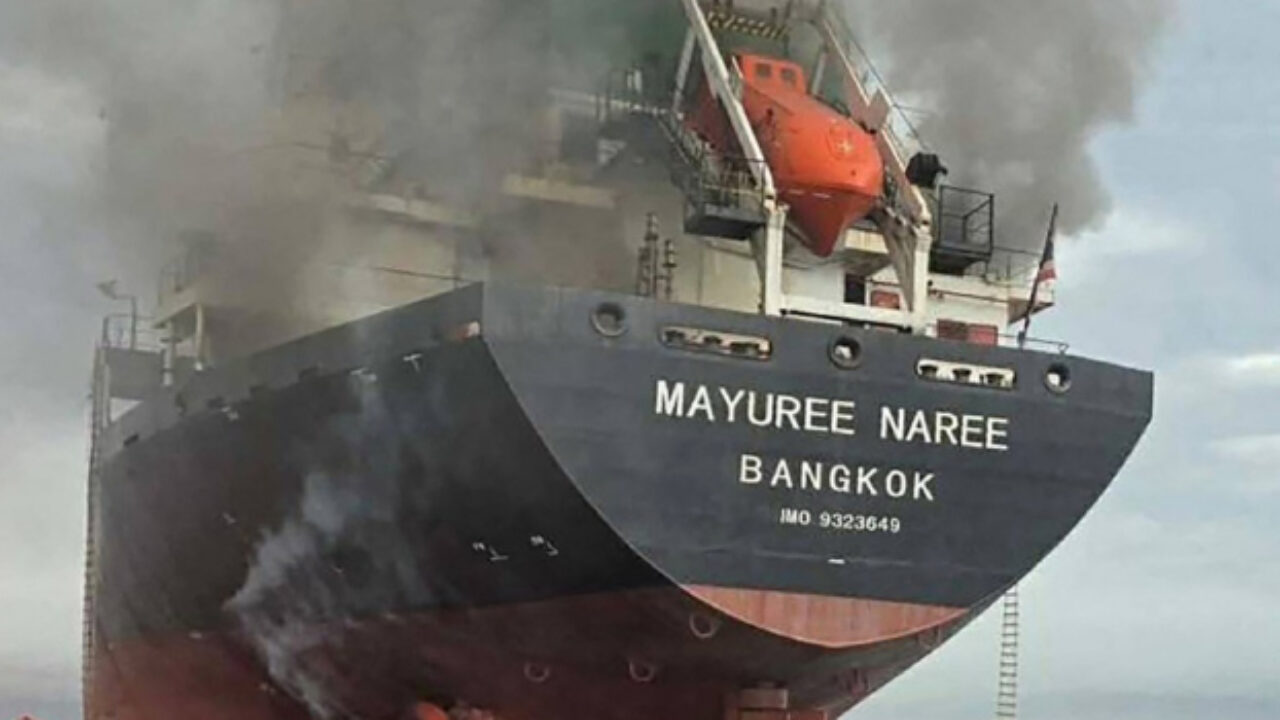
Twenty Thai sailors who escaped an Iranian attack on their cargo vessel in the Strait of Hormuz landed in Bangkok on Monday, reuniting with families who had spent days in anguish waiting for news — while three of their colleagues remain unaccounted for aboard the damaged ship.
The crew members of the bulk carrier Mayuree Naree flew into Suvarnabhumi International Airport from Oman in the early hours of the morning, boarding a bus after arrival without speaking to journalists who had gathered to meet them. For the families present, the relief of seeing their relatives home was shadowed by the knowledge that the ordeal for the vessel’s remaining crew was not over.
Iran’s Revolutionary Guards struck the Thai-registered Mayuree Naree and a Liberia-flagged vessel in the strait on March 11, saying both ships had ignored warnings. The Mayuree Naree was hit by two projectiles while transiting the waterway after departing a United Arab Emirates port. The Omani navy rescued the 20 sailors shortly after the attack. Three crew members were not among those evacuated; the vessel’s owner said last week they were believed to be trapped in the engine room, which took direct damage in the strike.
The shipping company, Precious Shipping, said Monday its highest priority was locating the three missing sailors, and that it would provide welfare support for the returned crew including medical examinations and mental health assessments. The company did not respond to questions about the condition or whereabouts of the three still on board.
Thailand’s foreign ministry said it was seeking assistance for the missing sailors from two other nations. Deputy spokeswoman Maratee Andamo did not identify the countries.
Read also: 72 Tigers Die At Thailand Tourist Park In Disease Outbreak
For the families at the airport, the human cost of the widening Hormuz conflict arrived in personal and immediate terms. A woman who gave her name as Bass, whose husband was among the 20 who returned, waited at the terminal with the couple’s one-year-old son, whom she had brought at her husband’s specific request. She had only been able to communicate with him through Facebook Messenger during the crisis. When the attack happened, she said, he had time to grab only his phone before fleeing — leaving behind a small pillow their son had given him.
“We are all afraid, but they are employees — if they refuse to go out to sea, they won’t get paid,” Bass told reporters. She said the shipping company had not kept her informed about her husband’s movements or timeline for return. Her words cut to the economic reality underpinning the human drama: the men aboard the Mayuree Naree were not soldiers or volunteers. They were workers doing a job, moving cargo through a waterway that has become a battlefield, because their families depend on the income.
Her appeal to the company was direct. “I want them to look at the employees like their own family,” she said. “If one of them were their family, how would they decide?”
The attack on the Mayuree Naree was not an isolated incident. Since the United States and Israel launched strikes on Iran more than two weeks ago, Tehran has retaliated by targeting oil-exporting neighbours and choking off the Strait of Hormuz — the narrow waterway through which roughly a fifth of global oil supplies normally pass. The resulting disruption has sent crude prices surging and triggered the largest emergency release of strategic oil reserves in the history of the International Energy Agency, as consuming nations scramble to cushion the economic blow.
Read more: Myanmar Expels Timor-Leste Rep Over War Crimes Dispute
The Hormuz strait’s closure has turned commercial shipping into a high-stakes gamble. Vessels that once transited the waterway as a matter of routine now navigate a corridor where Iran’s Revolutionary Guards have demonstrated both the willingness and the capability to strike with little warning. For shipping companies, the calculus of risk against commercial necessity has become brutally concrete. For the crews aboard those vessels, the calculus is different — and far more personal.
Precious Shipping’s statement Monday was careful and corporate, emphasising welfare support and the search for the missing three. What it did not address was the broader question Bass raised implicitly at the airport: whether companies routing vessels through an active war zone are doing enough to protect the people in their employ. That question will grow louder if the strait remains closed and attacks continue.
Thailand’s government has not publicly commented on whether it is advising its nationals working in the maritime industry to avoid the region, or what diplomatic pressure, if any, it is applying on Iran regarding the attack on a Thai-flagged vessel.