
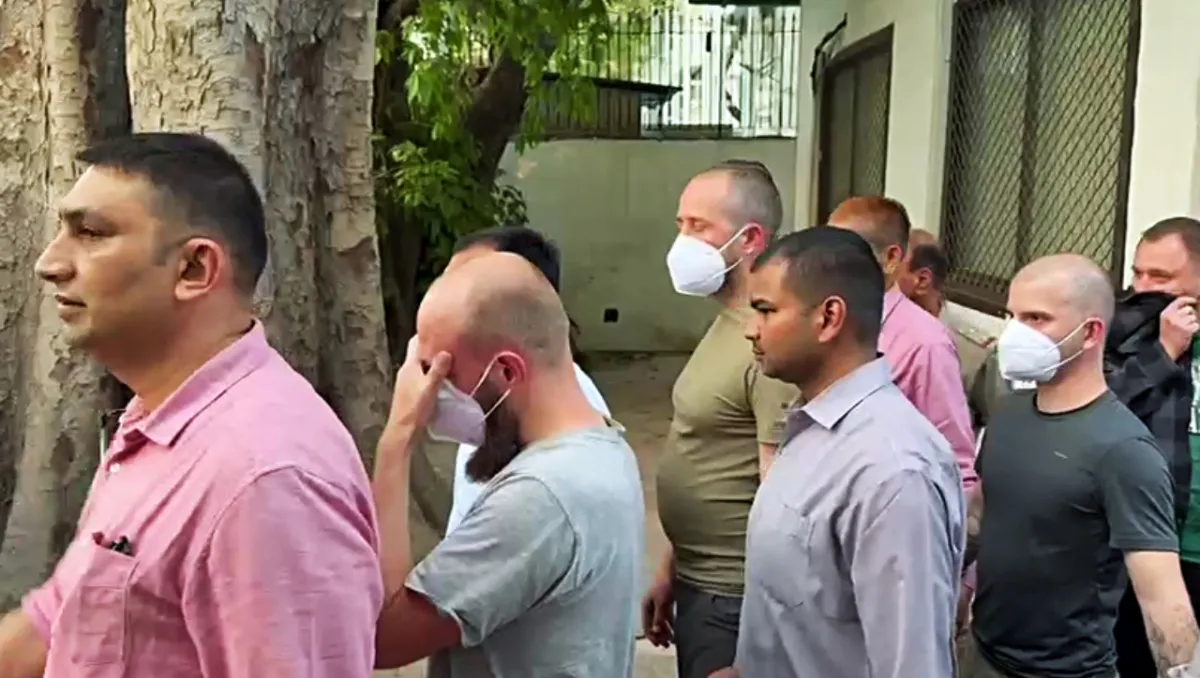
India’s National Investigation Agency is holding six Ukrainian nationals and an American military contractor on terrorism conspiracy charges following coordinated arrests at three airports on March 13, as Ukraine lodged a formal protest demanding their release and the investigation expanded to include the pursuit of eight additional Ukrainian nationals who remain at large after the same network is alleged to have used India as a logistics corridor for routing European drones into Myanmar and training anti-junta ethnic armed groups in drone assembly, operations, and jamming technology.
The six Ukrainian nationals are Hurba Petro, Slyviak Taras, Ivan Sukmanovskyi, Stefankiv Marian, Honcharuk Maksim, and Kaminskyi Viktor. Three were arrested at Lucknow’s Chaudhary Charan Singh International Airport, three at Indira Gandhi International Airport in Delhi, and the American national Matthew Aaron Van Dyke was apprehended at Kolkata’s Netaji Subhas Chandra Bose International Airport by immigration authorities. A Special NIA Court at Patiala House in New Delhi remanded all seven to eleven days of NIA custody on Monday, with a next hearing scheduled for March 27.
Van Dyke, from Baltimore, Maryland, has a profile on his own website describing himself as having fought as a mercenary in conflicts around the world, and has previously described himself as a soldier, international businessman, war correspondent, and columnist. He is perhaps best known internationally for participating in combat during the 2011 Libyan civil war as a documented foreign fighter, experiences he has given media interviews about and made the subject of documentary projects. The NIA has characterized him in court submissions as an “alleged American mercenary.” The US Embassy in India confirmed awareness of his arrest but declined to comment, citing privacy.
According to the NIA’s court submission, all seven entered India on tourist visas on different dates and followed a consistent transit corridor: flying into Guwahati in Assam before proceeding to Mizoram, India’s northeastern border state. Mizoram requires foreign nationals to obtain a Restricted Area Permit or Protected Area Permit before entry — documentation the accused are alleged not to have obtained. From Mizoram, they are alleged to have crossed the porous jungle border into Myanmar multiple times and made contact with Ethnic Armed Organizations whose networks intersect with groups proscribed as terrorist organizations under Indian law.
During initial questioning, some of the accused reportedly admitted to traveling illegally to Myanmar via Mizoram, conducting multiple training sessions for ethnic armed groups, and facilitating the illegal importation of a large consignment of drones from Europe into Myanmar through India. The training covered drone warfare operations, assembly, and jamming technologies. The NIA told the court that the Myanmar-based groups the accused trained are known to support proscribed Indian insurgent organizations by supplying weapons, hardware, and training — establishing the connection to Indian domestic national security that triggers the UAPA’s applicability.
A total of 14 Ukrainian nationals are believed to have entered India as part of the same operation, with 8 still being sought by authorities. The eight at large were not identified by name in public NIA filings.
Read Also: Myanmar Expels Timor-Leste Rep Over War Crimes Dispute
Ukraine’s response was firm and immediate. Its ambassador to New Delhi, Oleksandr Polishchuk, met senior Indian foreign ministry official Sibi George on Monday and delivered a formal note of protest demanding the immediate release of the Ukrainian nationals and unimpeded consular access to them. Ukraine’s foreign ministry issued a public statement denying that any established facts proved their involvement in unlawful activities on the territory of either India or Myanmar. The ministry also noted that the embassy had not been officially notified of the detentions before the arrests occurred, which it described as contrary to established international diplomatic practice. Kyiv argued that restricted areas in India’s northeast requiring special permits were often poorly marked on the ground, creating a risk of unintentional violation of regulations — a defense the NIA’s submissions appear to preemptively undercut by alleging that the accused were briefed about and actively evaded the permit requirement.
The geopolitical context surrounding the case has drawn scrutiny both in India and internationally. Mizoram Chief Minister Lalduhoma had raised the alarm in the state assembly in March 2025, specifically stating that foreigners from the US and UK were crossing into Myanmar through Mizoram to train insurgents and that between June and December 2024, over 2,000 foreigners visited Aizawl without any apparent purpose in the city itself. He mentioned a prior case in June 2024 involving a British national, Daniel Newey, arrested at Lengpui Airport with live ammunition. The CM had also noted that some of those crossing via Mizoram had previously participated in the Russia-Ukraine war, pointing to a pipeline of conflict-experienced foreign nationals moving through the corridor.
Read Also: Myanmar Hospital Air Strikes Kill At Least 34
India’s northeast has been a zone of persistent low-level insurgency since independence, with multiple ethnic armed groups operating across the Myanmar border. Myanmar’s civil war, now in its fifth year following the February 2021 coup, has intensified cross-border activity significantly as the Resistance Forces — including the Chin National Army and allied groups — have made significant territorial gains against the military junta, particularly in Chin State, which borders Mizoram directly. Indian security officials have expressed concern about the bleed-through effect, particularly following months of ethnic violence in Manipur in 2024 that they partly attributed to militant groups returning from Myanmar with combat experience.
The case is being charged under Section 18 of the Unlawful Activities Prevention Act, which covers conspiracy to commit terrorist acts, carrying a maximum penalty of life imprisonment. The charges indicate the NIA considers the alleged Myanmar training not a standalone operation but one with direct implications for Indian domestic security — a framing that gives New Delhi legitimate grounds to treat this as a terrorism investigation rather than a simple illegal entry case.
No formal response to Ukraine’s protest note has been issued by India’s Ministry of External Affairs. The case returns to the NIA court on March 27.