
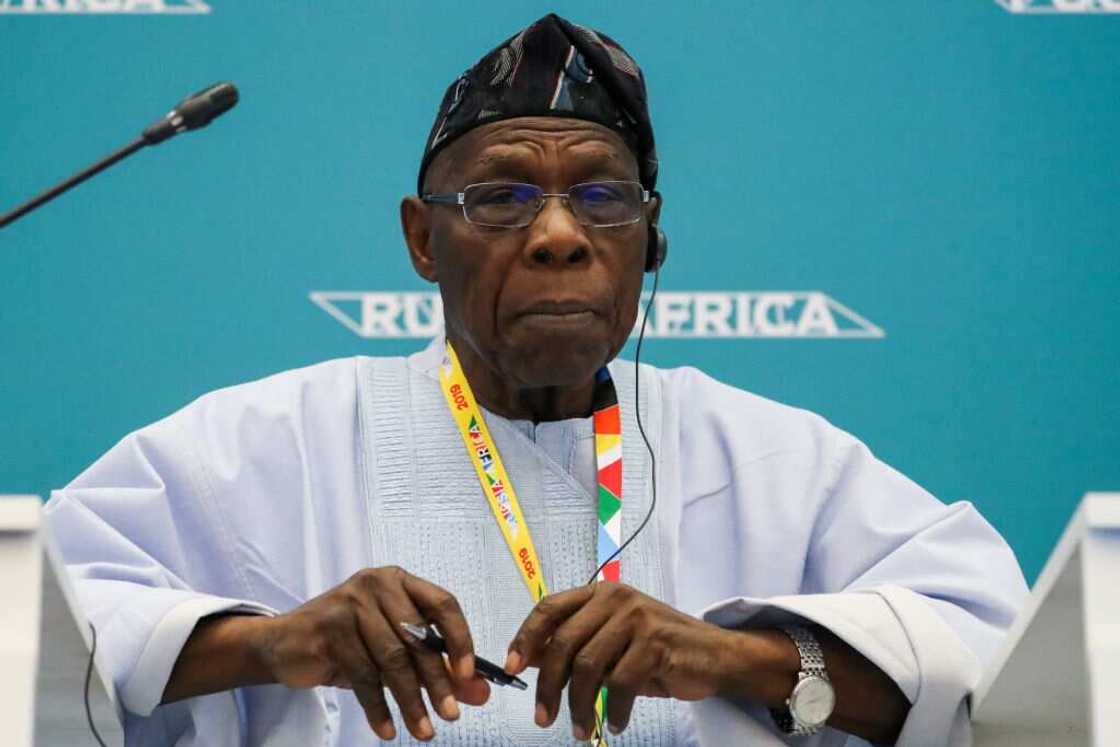
Former President Olusegun Obasanjo says Nigeria has lost its place at the table of global decision-making, contrasting the country’s current standing with an era when it bankrolled Angola’s independence with a $20 million grant and extended comparable backing to South Africa.
Speaking on News Central’s Soni Irabor Live at the weekend, Obasanjo recalled that under the late Gen. Murtala Mohammed, Nigeria threw its weight behind the Popular Movement for the Liberation of Angola (MPLA) after a decisive OAU extraordinary summit, then handed the new government $20 million — money the country provided, he said, without asking for anything in return.
“We gave Angola $20 million,” Obasanjo said. “That was the way they had access to the outside world. We did it. And we did it without asking for anything back.” He added that he was personally flying into Angola three times a week at the time, and confirmed Nigeria extended the same posture of solidarity to South Africa.
Read also: Obasanjo Floats Think Tank For Africa’s Leadership Reform
Pressed on how that period compares with Nigeria’s current standing, the former president did not equivocate. “Today, Nigeria is not at the table,” he said, repeating the line for emphasis when asked to clarify. “What is it that is happening that Nigeria is influencing or impacting, and upon whom is Nigeria impacting?”
Obasanjo tied the loss of regional and continental clout to what he described as a leadership deficit, pointing first to the handling of the Economic Community of West African States (ECOWAS) and the fallout from the 2023 coup in Niger Republic.
Five decades of diplomatic and cultural investment, he said, had been undone in months. “Look at the way we have handled ECOWAS. Something that took us 50 years to build. Overnight, we mishandled it. And we have virtually destroyed it.”
The former president said closing the border with Niger, cutting electricity supply and freezing financial flows ignored the depth of cross-border ties — including the fact that roughly 30 per cent of Nigeriens have blood relations in Nigeria, and that Niger served as a critical supply route for federal troops during the civil war. Mali, Burkina Faso and Niger have since exited ECOWAS and formed a rival Sahel alliance, draining the bloc of leverage.
Read more: Nigeria Volatile, Rife With Hardship – Obasanjo Laments
On governance at home, Obasanjo said the erosion of democratic norms — including what he called the rise of a “selectorate” in place of a genuine electorate — had hollowed out accountability. Asked what he saw ahead under the current administration, he said simply that he saw nothing.
He warned that an estimated 20 million out-of-school children represented a long-term security threat, calling the figure a ready recruitment pool for extremist groups, and said any government unable to guarantee the safety of life and property had forfeited its right to exist.
On the economy, Obasanjo restated his view that state-run refineries under the Nigerian National Petroleum Company Limited would never function efficiently, citing successive administrations that have spent as much as $16 billion on them with little to show. He contrasted that record with the Nigeria LNG project, which he held up as evidence that public-private partnerships deliver where state monopolies do not.
The country, he maintained, could still recover — but only, he said, on the back of a fundamental shift in the quality of leadership.