
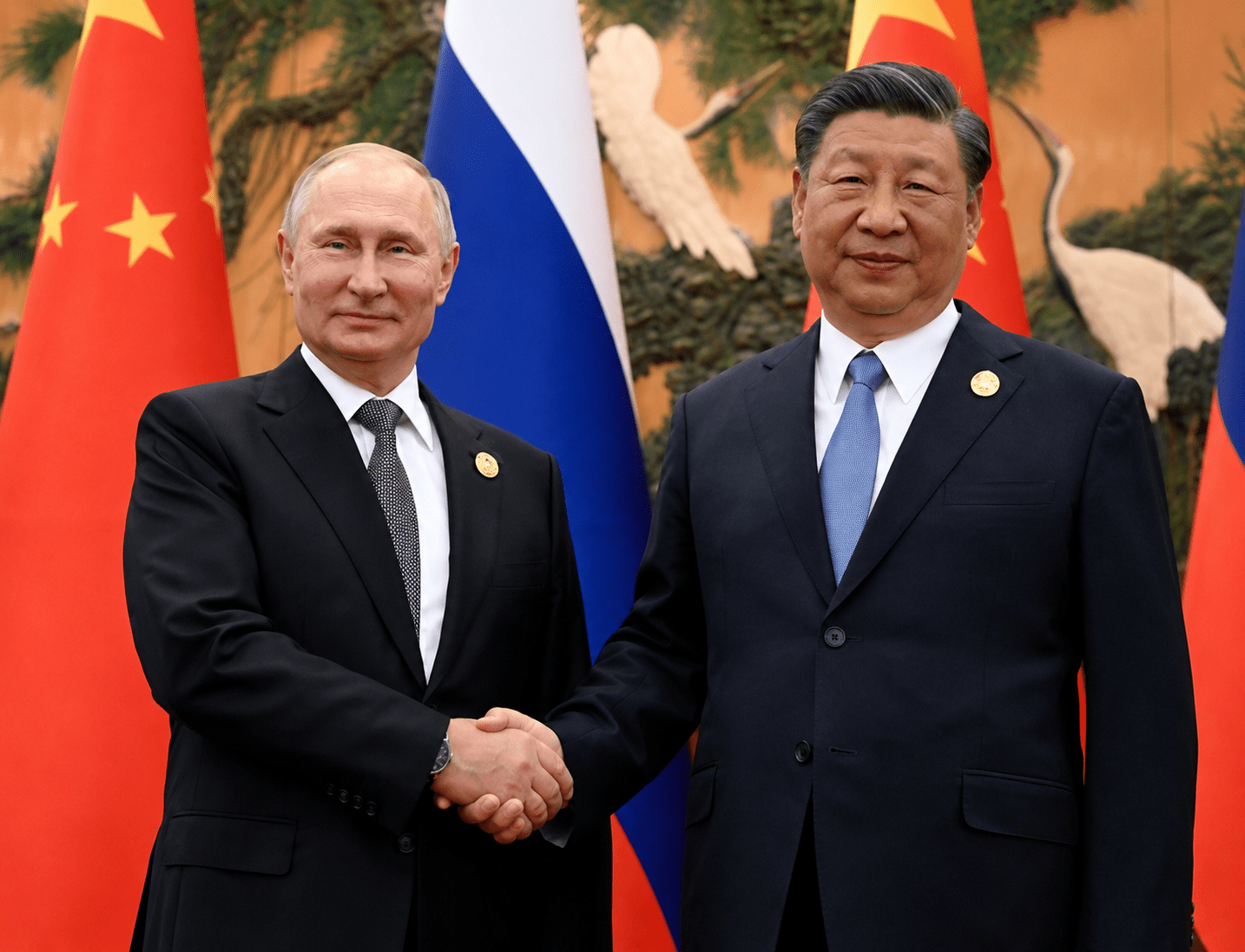
Vladimir Putin touched down in the Chinese capital Tuesday for his 25th state visit here, arriving barely a week after Donald Trump left — and the back-to-back choreography has handed Xi Jinping something neither American nor Russian officials fully intended to give him: the position of indispensable broker between two rival powers simultaneously competing for his attention.
The Russian president’s arrival opens a summit with Xi that carries the familiar language of friendship — Putin has called the Chinese leader a “dear friend” — while masking a relationship that experts describe as strategically significant but structurally lopsided. For Beijing, the optics serve a clear purpose. For Moscow, the stakes are far more existential.
China-Russia bilateral trade has more than doubled since Russia launched its full-scale invasion of Ukraine in 2022, according to data compiled by the Mercator Institute for China Studies. Russian fossil fuel shipments drive the bulk of that figure — mineral fuels make up more than 70 percent of what China imports from Russia, and Moscow’s oil exports to Beijing have climbed roughly 30 percent over the same period.
Those numbers look impressive until reversed.
Russian imports account for only around five percent of China’s total inbound trade as of 2025, Chinese customs figures show. China, by contrast, now supplies more than a third of everything Russia brings in from abroad and absorbs more than a quarter of its exports, according to the Russian state news agency TASS.
In economic terms, Russia needs China more than China needs Russia — and both governments understand this perfectly well, even if neither says so publicly.
That imbalance shapes everything Putin is walking into this week.
Read also: Vulnerable Nations Retain Russian Oil Lifeline Under US Waiver
“Moscow wants reassurance that Russia still occupies a privileged place in China’s strategic calculus,” said Zhao Long of the Shanghai Institutes for International Studies.
For Putin, the trip — his first foreign travel this year — is as much about perception as policy. Beijing frames its relationship with Moscow as “ironclad.” Projecting that image costs China relatively little; for Moscow, it is a diplomatic lifeline.
Natasha Kuhrt of King’s College London put it plainly: the summit is a deliberate message aimed west, a reminder to Washington that the China-Russia alignment is a relationship of more than 30 years’ standing and cannot be disrupted by a few rounds of tariff negotiations or flattery aboard Air Force One.
Trump’s visit last week — where he praised Xi as a “great leader” and spoke of “fantastic trade deals” and shared interests in resolving both the Ukraine war and the conflict in Iran — set the table for this meeting in ways that Beijing likely welcomes. Xi can now brief Putin directly on what was said, what was promised, and what Washington is actually prepared to do. Zhao noted that China and Russia routinely coordinate their positions before and after high-level contact with other major powers. He cautioned, however, against reading too much drama into the scheduling: the two visits were set long in advance, and the sequence is circumstantial as much as strategic.
Ukraine will sit somewhere in the room, if not openly on the agenda. Trump told reporters after leaving Beijing that resolving the war is something his administration “would like to see settled.” But China’s role, Zhao argued, will remain declarative rather than operational. Beijing has called repeatedly for negotiations to end the fighting; it has never condemned Russia’s invasion and positions itself as a neutral party. Any actual ceasefire framework, he said, will depend on the actors with direct leverage — not on Chinese mediation.
The summit’s most concrete deliverable may involve energy infrastructure. Moscow and Beijing remain in active discussions over the “Power of Siberia 2” pipeline, a land route that would carry Russian natural gas through Mongolia into China. For Russia, under sustained Western sanctions on its energy sector, the pipeline represents both revenue and strategic depth. For China, the calculus is more cautious.
Read also: Putin Suggests Russia-Ukraine War Nearing End
Kuhrt pointed to the Iran war as a factor that could accelerate Beijing’s interest — Iranian strikes have disrupted petroleum traffic through the Strait of Hormuz since February 28, directly affecting Chinese supply chains. A land-based alternative carries obvious appeal. But she added that Beijing has historically resisted over-reliance on any single energy source. Xi agreed last week, Trump told Fox News, to help reopen the Strait — a commitment that could reduce the urgency China feels to lock in Russian supply.
The pipeline talks will likely continue without resolution. That, too, is consistent with how this partnership operates: close enough to matter, careful enough to keep options open.
Putin departed Moscow calling himself “confident” that he and Xi would deepen their partnership. Xi, for his part, has now received two of the world’s most consequential leaders in the span of eight days — and given firm commitments to neither.