
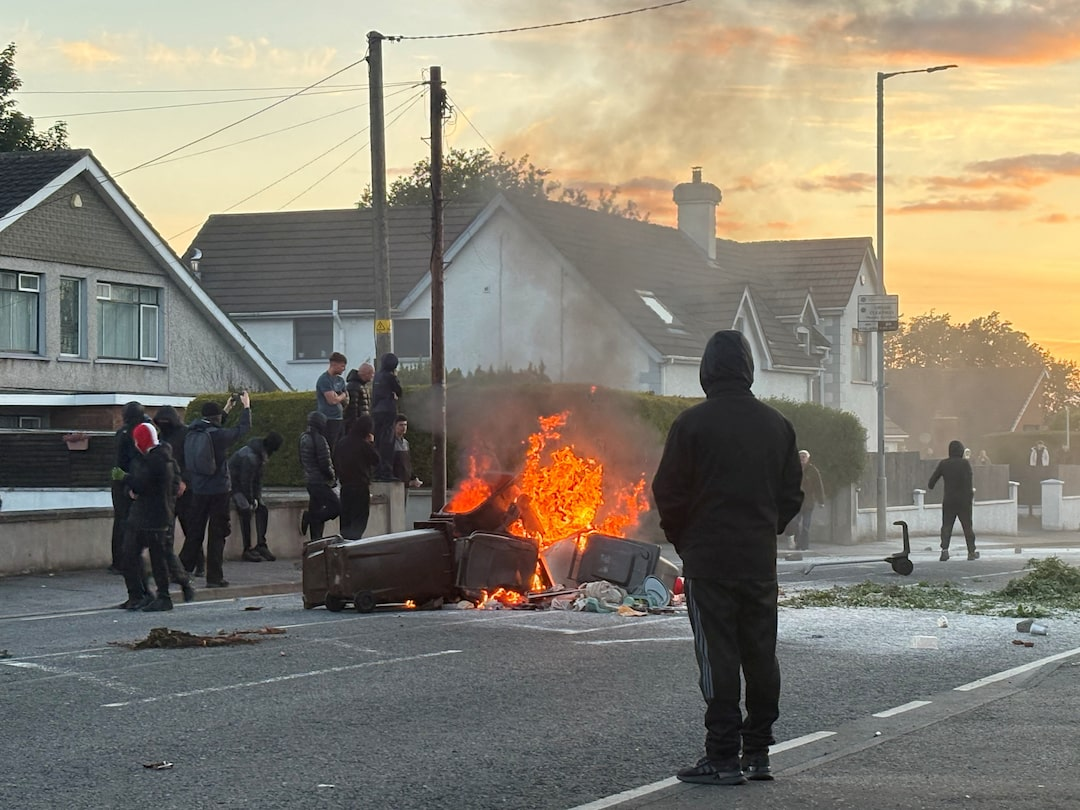
Lists circulated online showing where asylum seekers slept. Addresses of immigration businesses were published. Nurses from ethnic minority communities were chased through the streets by men in masks as they tried to reach hospitals. And for a second consecutive night, police in Belfast deployed water cannon against rioters marching through the city declaring they had come to drive out foreigners.
What is unfolding in Northern Ireland is not spontaneous.
Britain’s minister for the province, Hilary Benn, said Thursday that the two nights of disorder following a knife attack — for which a Sudanese man has been charged with attempted murder — amount to organized racist violence, coordinated through social media and targeting people on the basis of their appearance.
The attack occurred Monday night and is not being treated as terrorism, but within 24 hours it had metastasized into something far larger than its trigger.
“If you are targeting people on the basis of the colour of their skin, how else can you describe them?” Benn said on Sky News. “That is racist thuggery.”
On Tuesday, the worst of the two nights, rioters torched homes and vehicles belonging to ethnic minority residents and foreign nationals. On Wednesday the numbers were smaller but the intent was no less specific — a crowd moved toward a hotel outside Belfast that has been attacked in previous years for housing asylum seekers. Officers used water cannon to push them back, and Reuters journalists observed what appeared to be baton rounds, commonly known as plastic bullets, lying in the street afterward. The Police Service of Northern Ireland declined to comment on the munitions.
Read also: The Billionaire Republic: Inside Africa’s Quiet Monopoly
Kate Nicholl, a member of the Northern Ireland assembly, confirmed that police were actively patrolling neighborhoods that had been named in what she described as a hit list — a document circulating online mapping out where vulnerable people lived.
Northern Ireland has now endured anti-immigration violence for three summers in a row.
For those who lived through the Troubles — the three-decade sectarian conflict between predominantly Catholic Irish nationalists and Protestant pro-British loyalists that scarred the province from the late 1960s until the Good Friday Agreement — the sight of organized mobs targeting a community carries a particular weight. The parallel is not lost on residents, nor on the politicians attempting to contain the fallout.
Benn said the fear inside the ethnic minority community was something he found difficult to adequately convey. People stopped in their cars and asked their nationality. Nurses afraid to travel to work. Families watching their neighborhoods burn. “This is appalling,” he said.
The violence in Belfast is being read, in London and beyond, through the prism of Britain’s deepening anxieties over immigration and asylum policy. Populist political parties have argued for months that the government’s approach to asylum seekers has allowed dangerous men into the country unchecked. That rhetoric, amplified by Monday’s attack, provided the ideological fuel for what followed.
Tech billionaire Elon Musk, whose X platform has become a primary channel for anti-migrant content in Britain, reposted multiple messages in the aftermath of the Belfast incident denouncing the state of the United Kingdom, including material from the leader of Britain’s Restore party, which advocates the mass deportation of hundreds of thousands of people.
Police and political figures in Northern Ireland have been explicit: much of the violence was not spontaneous outrage but encouraged and directed online, with platforms serving as coordination tools for crowds that knew exactly where to go and whom to target.
Benn told Times Radio he hoped the reduction in disorder on Wednesday night signaled that some participants had paused to consider what they were doing. “This kind of thuggery cannot continue,” he said.
But across Belfast, people whose addresses were on those circulating lists did not spend Wednesday night waiting to find out whether the crowds would return. They spent it afraid — which, for anyone organizing the distribution of a hit list, may have been the point all along.