
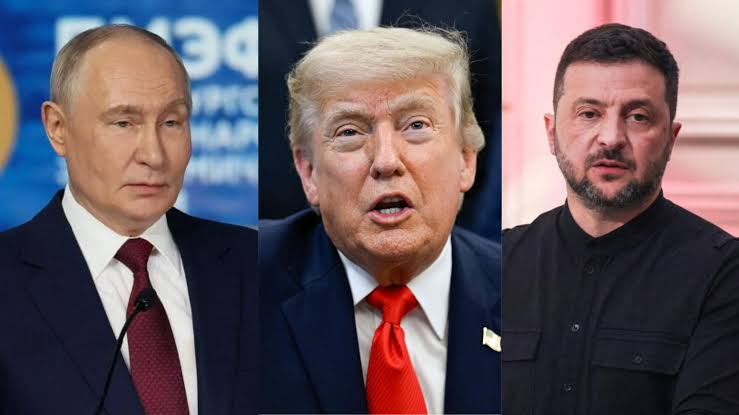
President Vladimir Putin has rejected calls to negotiate an end to the war in Ukraine and is more likely to escalate the conflict in the coming months, according to three people close to the Kremlin, even as Ukrainian drone strikes on Russian oil refineries and ports have battered the country’s energy sector.
Two of the sources, who spoke on condition of anonymity, said Putin’s resolve to keep fighting has hardened rather than weakened as the war enters its fifth year. One of them, who meets regularly with the Russian president, put the probability of escalation in the coming months at “high.”
That assessment sits uneasily beside the public account offered by U.S. President Donald Trump, who said Monday that Putin wanted the war to end and that a resolution was “closer than people realize.” Trump spoke by phone separately with Putin and Ukrainian President Volodymyr Zelenskiy last week and met Zelenskiy at the NATO summit on Wednesday, where the Ukrainian leader said the two discussed ideas for bringing peace closer. The White House did not respond to a request for comment. A senior Ukrainian official, asked about Kyiv’s own intelligence, said recent assessments point the other way: that Putin is preparing further military steps, potentially including new operations inside Ukraine or an attack on another European country, rather than a negotiated settlement.
Putin’s central objective remains capturing the rest of Ukraine’s eastern Donbas region, where Russian advances have slowed this year, according to one of the sources familiar with his thinking. That person said Putin recently rebuked advisers who had proposed a compromise built around a ceasefire along the current front lines, and that the Russian president remains firmly committed to taking the territory outright. A second source said Putin believes Russian forces will capture the Donbas soon regardless. Putin publicly rebuffed a June proposal from Zelenskiy for a direct meeting and ceasefire.
Read also: Putin Waves Hypersonic Card, Demands Donbas As Price Of Peace
Kremlin spokesman Dmitry Peskov, responding to a request for comment, said Russia was ready for a peaceful resolution but retained enough capacity to continue what Moscow calls its special military operation on its own terms.
Achieving the Donbas objective may require a step Putin has avoided since early in the war: a mandatory draft of fighting-age men, which some Western military analysts consider necessary given Russia’s manpower losses relative to the ground still to be taken. The move remains politically unpopular inside Russia.
Russian military commentators have increasingly floated a wider option in public forums — striking NATO-linked targets such as bases in the Baltic states. Jack Watling, a defense analyst at the Royal United Services Institute in London, said Russia is more likely to pursue isolated attacks designed to fracture the alliance’s unity than to seek direct war with NATO, comparing the approach to a recent Russian drone strike on Romania. Watling said heightened tension with the alliance could also hand Putin domestic political cover for a draft he has otherwise resisted ordering.
The war’s costs inside Russia have grown more visible. Repeated Ukrainian strikes on refineries, ports and storage depots have caused fuel shortages in parts of the country, and Putin’s approval rating, while still high, recently touched its lowest point since the 2022 invasion, according to a poll. Ukraine’s allies have pointed to the pressure as evidence of a shifting battlefield momentum and pressed for additional sanctions. But the source who meets regularly with Putin said Ukraine’s recent successes have made him angrier and more determined to respond forcefully rather than negotiate.
Russian forces launched two major drone and missile barrages on Ukraine in the past week, including strikes on Kyiv that killed dozens of civilians; Moscow said the attacks hit military targets. Speaking to Russian generals last week, Putin said Ukraine’s strikes on energy infrastructure would prompt Russia to seize additional Ukrainian territory beyond Donbas to create what he called a security zone along the border.
Read also: Putin Announces Intention To Seek Re-election In 2024
A former Russian defense ministry official, Andrei Ilnitsky, wrote in a June 29 column for the newspaper Kommersant that a further phase of the war could begin with strikes on roughly 30 major Ukrainian industrial sites, including a steel plant and the port of Odesa, followed by potential strikes on NATO bases in the Baltics and Romania and on European Union facilities producing long-range drones and missiles for Ukraine. Asked about the column, Peskov told reporters this week that Russia could not “close its eyes” to what he described as the militarization of Europe.
The battlefield itself remains a grinding, high-casualty stalemate. An estimated two million soldiers have been killed, wounded or gone missing since Russia’s full-scale invasion in early 2022, including about 1.4 million Russians, according to a recent estimate from the Center for Strategic and International Studies; neither Moscow nor Kyiv releases official casualty figures. Russian forces have struggled to advance along the 1,200-kilometer front line this year as Ukrainian drones offset Russia’s advantage in troop numbers, though Russian units have pushed into the eastern city of Kostiantynivka, part of a defensive cluster known as Ukraine’s fortress belt. Putin said July 3 that his forces had seized the city; Ukraine denied it.
A day later, on a call with Trump, Putin argued that Russia would still take the remaining fifth of Donetsk province under Ukrainian control. Winning it, the source who meets him regularly said, has become a matter of principle for the Russian president, who “needs some kind of victory.”