
Case File: Occupational & Environmental
Environmental Heat, Worksite Exposure and Sperm Injury
The testis is the one organ the body deliberately hangs outside itself to keep cool. Modern work — the long shift, the hot cab, the solvent — quietly defeats that design.
Of all the body’s organs, only one is deliberately kept outside the warm core, dangling in a thin sac where it can be cooled — and that inconvenient, vulnerable arrangement is not an accident of design but its whole point. Sperm production is exquisitely sensitive to temperature and simply fails at core body heat, so evolution hung the testis outside to run a few degrees cooler. It is a clever solution to a hard problem, and modern working life spends much of the day undoing it: sitting for hours, running hot engines, standing over ovens and furnaces, and breathing the chemistry of the worksite. This chapter is about the injuries a man cannot feel, done to the one organ that had to be left out in the cold.
The cooling system is real machinery. The testis sits two to seven degrees below core temperature, and it is held there by three cooperating mechanisms: the scrotal skin that sweats and radiates heat, a muscle that raises the testes toward the body in cold and drops them away in heat, and — most elegantly — a dense tangle of veins wrapped around the incoming artery that pre-cools the arterial blood before it reaches the testis, like a radiator plumbed into the supply line. When that system keeps the temperature down, sperm production runs normally. When heat overwhelms it, production stalls, and the fall is steep: scrotal temperature and sperm output move in opposite directions, with sperm concentration dropping markedly for each degree of sustained heating.
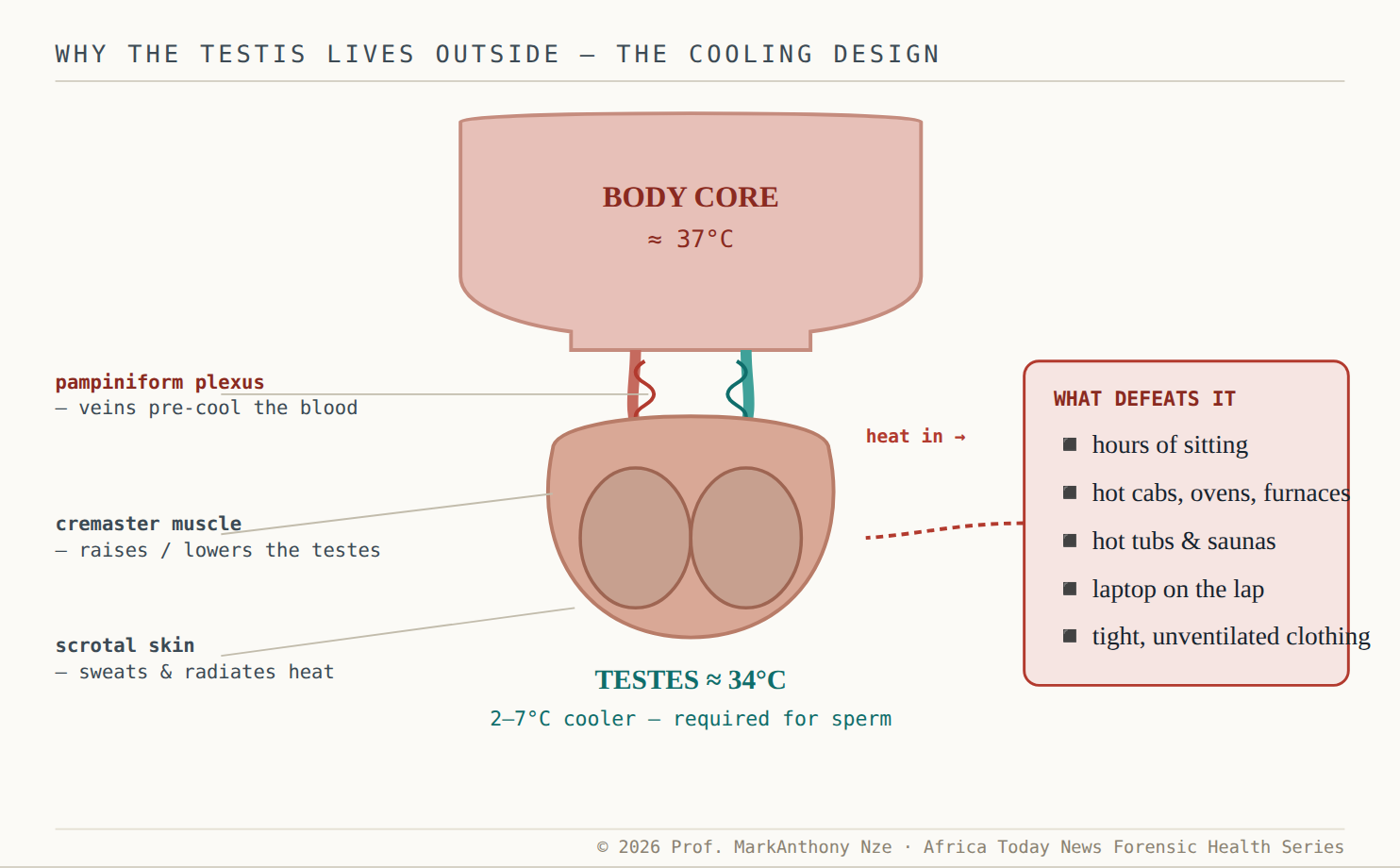
Fig. 27.1 Cooling by design. Three mechanisms hold the testis a few degrees below the core, where sperm can be made. Sitting, engine heat, saunas, and laptops all push that temperature back up.
Read more…
The worksite that cooks — and poisons
Once the mechanism is clear, the occupational pattern reads like a map. Professional drivers, who sit for hours over a warm engine, show higher scrotal temperatures and poorer semen parameters; bakers, welders, foundry and ceramic workers stand in radiant heat all day; and the ordinary office chair is not innocent, raising scrotal temperature by several degrees within twenty minutes of sitting. Recreational heat piles on — a regular hot tub or sauna habit, a laptop resting where its name suggests. None of these is felt as an injury, and that is exactly why they persist: the testis has no pain nerve for warmth, so the damage is invisible until a semen report reveals it.
Heat is only half the worksite’s assault; its chemistry is the other. A large body of occupational research links pesticides, industrial solvents, heavy metals such as lead and cadmium, and agents like formaldehyde to reduced sperm counts and motility and, importantly, to damage in the DNA the sperm carries — injury that timing and effort cannot see or fix. Farm workers mixing agrochemicals, painters and printers breathing solvents, battery and smelter workers handling metals: these are not exotic hazards but everyday jobs, and the exposures act by poisoning the same germ-cell assembly line that heat disrupts. A man’s fertility, in other words, can be an occupational health record written in his semen.
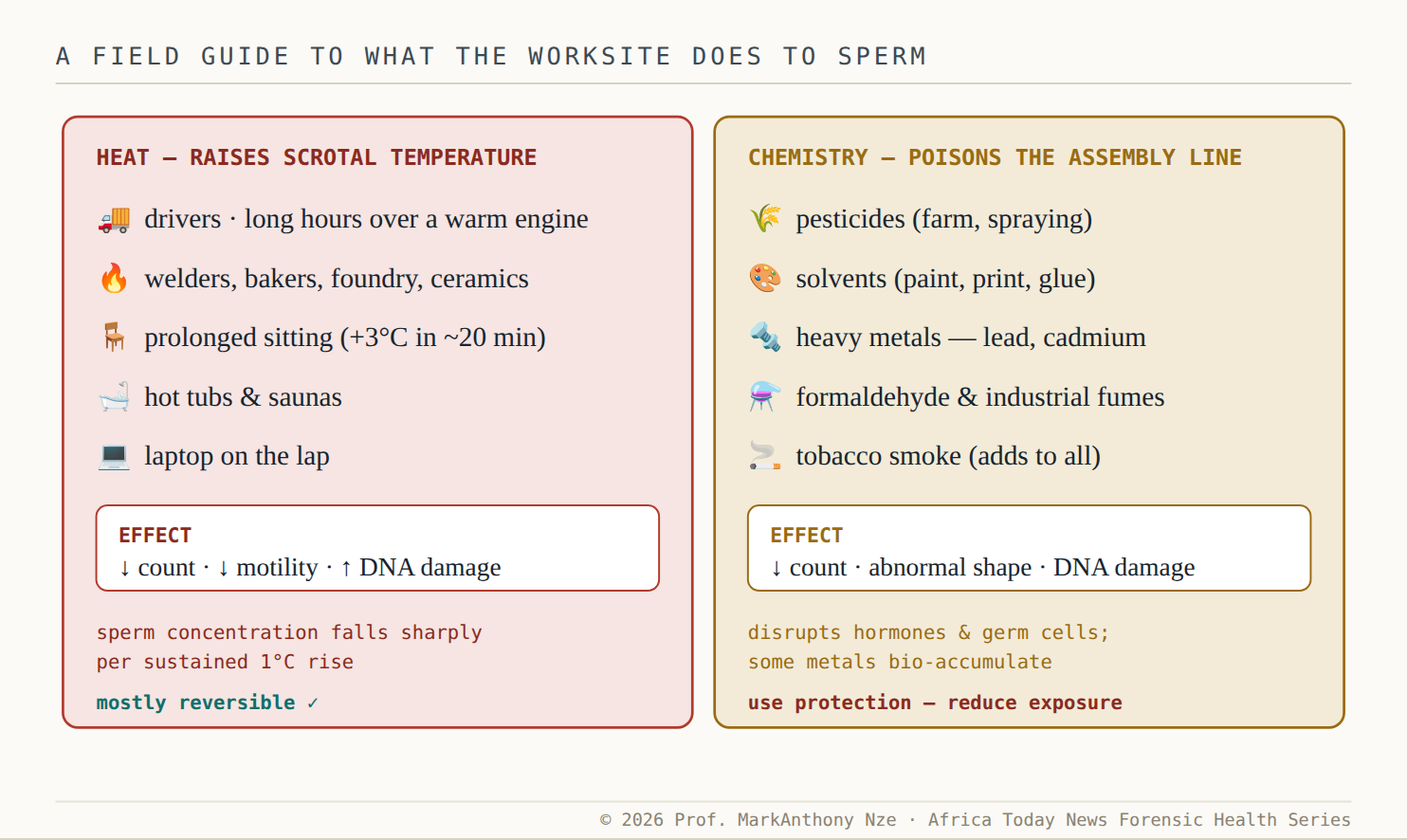
Fig. 27.2 Two assaults, one target. Heat raises the temperature the testis was built to avoid; workplace chemistry poisons the same germ-cell line. Both show up only in the semen report — never as pain.
The three-month repair clock
Here the file turns hopeful, because the same biology that makes sperm vulnerable also makes them renewable. Sperm are not stored from youth; they are manufactured continuously, and a single sperm takes roughly seventy-four days to be built in the testis, plus about a further two weeks maturing on the way out. That means today’s semen sample is a report on the conditions of about three months ago — and, crucially, that removing a harmful exposure now shows up as improvement in roughly three months. This one fact reorganises the whole plan: it explains why a summer of heat or a stretch of solvent work can show up in an autumn semen test, and why the honest instruction after a poor result is to change the exposure and retest a season later, not to despair over a single number.
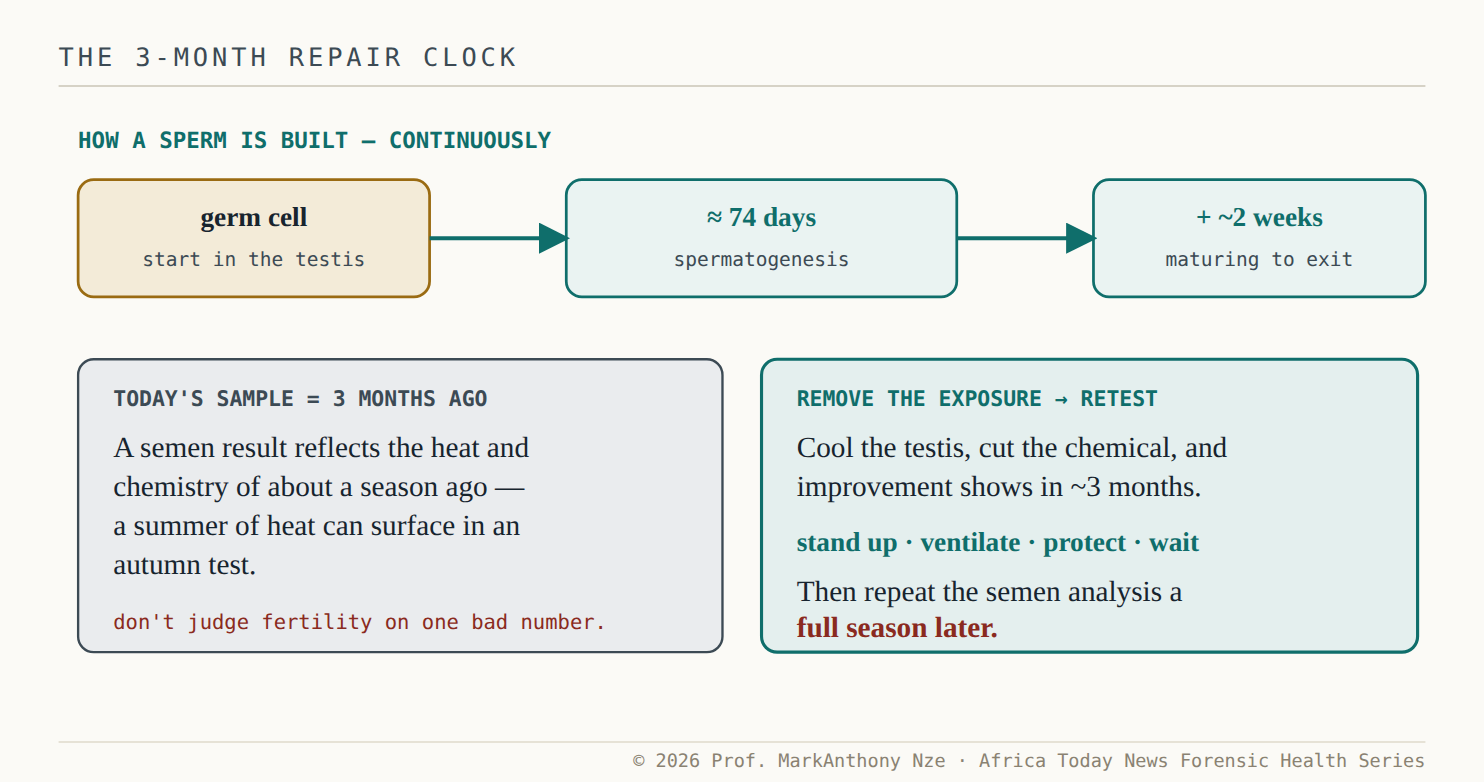
Fig. 27.3 Renewable, on a season’s clock. Because sperm are rebuilt over about three months, one bad result is not a verdict — it is a snapshot of the past that a changed exposure can revise.
The practical repairs are modest and free. Stand up and move every hour of a sitting shift; keep the laptop off the lap; treat regular hot tubs and saunas as an occasional pleasure, not a daily habit; wear looser, breathable clothing; and where the worksite involves chemicals, insist on the protective equipment, ventilation, and handling rules that already exist on paper but are so often skipped in practice. None of this is a supplement, a “male booster,” or a fertility tea — it is the removal of a defeatable injury. And because the testis heals on a predictable clock, the reward for removing the exposure is not hypothetical; it is measurable at the next season’s test.
Red flag · not all heat is behaviour
A testis that is persistently warm, swollen, painful, or carries a “bag of worms” fullness above it may signal a varicocele or another treatable condition, not just a hot workplace — and a lump in the testis must always be examined promptly, because testicular cancer is treatable and presents in exactly this age group. Heat and chemistry explain much, but a new lump, swelling, or persistent pain is a reason to see a doctor, not to adjust the office chair.
The file closes on the volume’s steady logic. The testis was placed outside the body for a reason, and the modern workday is unusually good at undoing that reason without the man ever feeling it. Heat and worksite chemistry injure sperm silently, months before any symptom, and both are largely reversible once named and removed. So the instruction is neither despair nor a bottle of pills: cool the organ, cut the exposure, protect against the chemistry, and retest a season later. No tea cools a testis. No booster repairs solvent-damaged DNA. The repair is the removal of the harm — and the body does the rest on its own three-month clock.
The demand · what this file requires
- To clinicians —a semen result is partly an occupational record. Ask every man about his work heat, sitting hours, and chemical exposures, and interpret a poor result against the exposures of the previous three months before declaring a verdict.
- To employers and safety regulators —heat and chemical injury to fertility is preventable. Enforce ventilation, cooling breaks, protective equipment, and safe-handling rules that already exist on paper — the sperm damage they prevent is invisible but real.
- To the “male booster” and fertility-tea trade —no supplement cools a testis or reverses solvent-damaged DNA. Stop selling bottles for a problem whose fix is standing up, ventilating, and removing an exposure.
- To the man himself —the injury is invisible and mostly reversible. Stand and move on long shifts, keep heat off the groin, protect against workplace chemicals, and retest after a full season — and see a doctor for any lump, swelling, or persistent pain.
Note: The data, diagnostics, and clinical benchmarks throughout this series are drawn directly from peer-reviewed medical literature, epidemiological data, and established global healthcare consensus. To protect the narrative rhythm of this digital layout, individual article bibliographies have been unified.
A complete master registry—cataloguing all underlying source literature, clinical trials, and institutional frameworks (including the World Health Organization, AUA/ASRM, ESHRE, the American Diabetes Association, the U.S. Preventive Services Task Force, FIGO, the U.S. Centers for Disease Control and Prevention, the Pituitary Society, and the Princeton IV Consensus)—is compiled in full at the conclusion of the complete volume.