
How the Book Was Made
Three Centuries of Compilation, Translation, and Insertion
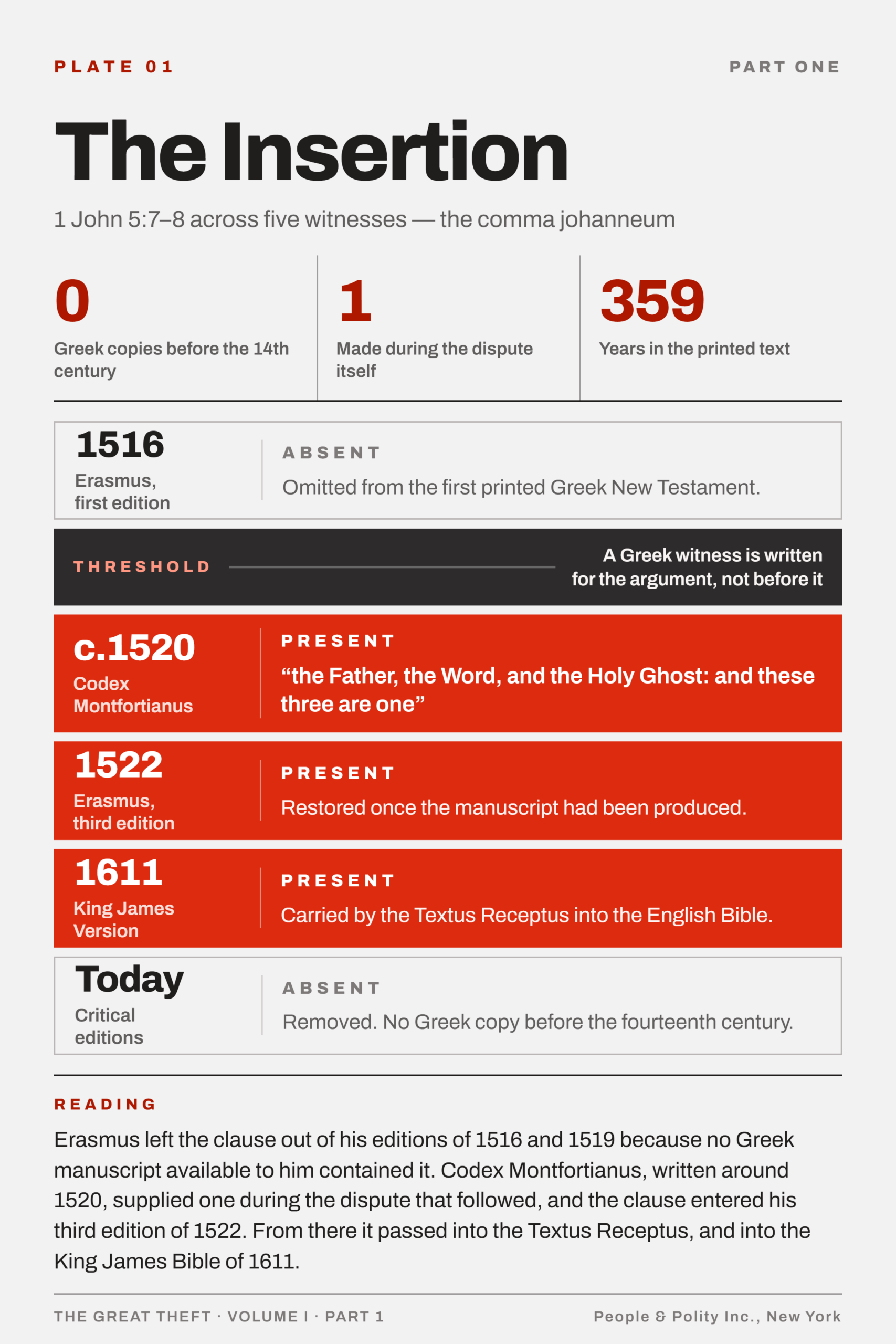
In 1516 Erasmus printed the first Greek New Testament and left a verse out. The passage now numbered 1 John 5:7-8, in which the Father, the Word, and the Holy Spirit are named as three that bear witness in heaven and are one, is the plainest statement of the Trinity anywhere in scripture. Erasmus could not find it in any Greek manuscript he held, so he did not print it, and he said as much in his notes. Pressure came at once. By his third edition of 1522 the verse was back, restored after a Greek copy containing it turned up in England, a copy known now as Codex Montfortianus and dated to around 1520. Few scholars doubt it was written to force his hand.
CHARGE: the book presented as delivered whole was compiled by committee across three centuries, translated through error, expanded by insertion, and built on older law and myth it does not credit — and the claim of a text dropped intact from heaven is a claim about publishing, and it is false.
His corrected text became the base the King James translators worked from ninety years later. So the most quoted proof of the Trinity in the English-speaking world reached the Bible through a manuscript produced after Columbus sailed. No Greek copy before the fourteenth century carries the verse. Modern critical editions have quietly dropped it, which means a reader raised on the King James was reading a sentence no apostle wrote.
Read also: The Great Theft: What Abrahamic Faith Took & Renamed — Overview
One inserted verse is not the whole of it. The last twelve lines of Mark, holding the risen Jesus and his commission to the disciples, are missing from the two oldest complete Greek Bibles, Codex Sinaiticus and Codex Vaticanus. In the earliest text the first gospel ends with frightened women who say nothing to anyone. The story of the woman caught in adultery, one of the most loved scenes of mercy in the whole book, belongs to none of the early copies of John and floats between positions in the copies that hold it. Neither of these is a claim from the fringe. Both are printed in the footnotes of ordinary study Bibles that sit in millions of homes, unread. The scale of the copying explains how such things happen. No printing press existed for the first fourteen centuries of the book’s life; every copy was made by hand, and the surviving Greek manuscripts differ from one another in more places than there are words in the New Testament. Scribes corrected what they took for errors, smoothed what read roughly, and now and then wrote a margin note that the next copyist folded into the text as though it had always belonged.
How the book became a fixed collection is the second thing hidden in plain sight, and the usual account of it is wrong. No council gathered sixty gospels and voted four into scripture. The Council of Nicaea in 325 argued about the nature of Christ and the date of Easter; the canon was not on its agenda, and the tale of rejected books burned at its order comes from a document written five centuries later. Anyone who builds a case on the Nicaea legend hands an opponent an easy kill, because the legend collapses on contact and takes the rest of the argument down with it.
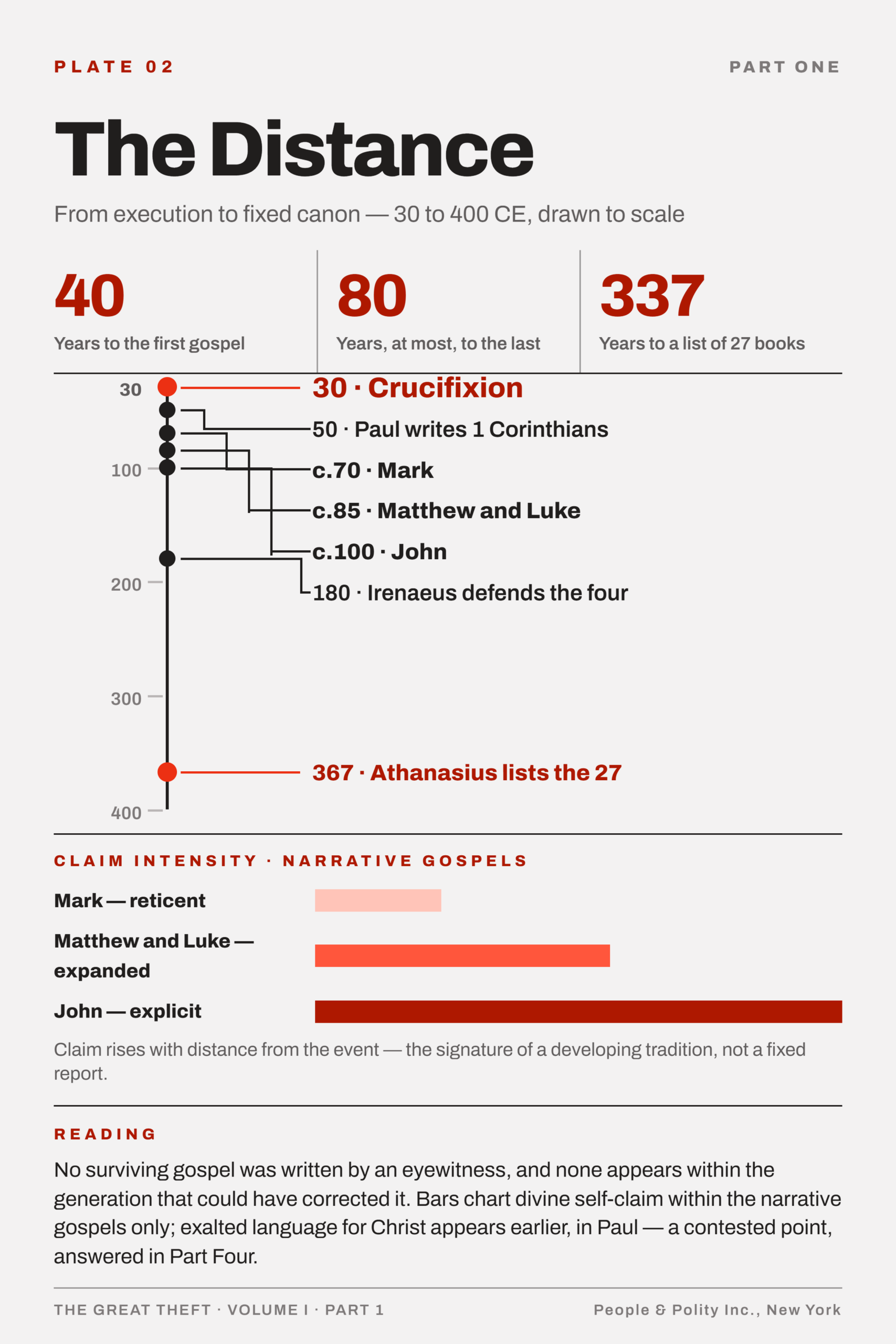
What actually happened is slower and harder to answer. Dozens of gospels circulated in the first three centuries, among them Thomas, Peter, Mary, Judas, and a shelf of infancy tales. The four that survived did so through long use, dispute, and the preference of powerful churches, not through a moment of divine choice. When Irenaeus defended exactly four around the year 180, his stated reason was that the world has four zones and four winds. The first list matching the twenty-seven books of the modern New Testament appears in a letter of Athanasius in 367, more than three hundred years after the crucifixion. Hebrews, Revelation, James, Jude, and 2 Peter were argued over for generations, while some churches read as scripture books that were later thrown out. The canon was negotiated by men with interests, and the negotiation ran longer than most countries have been alive.
Read also: How Religious Extremism Stifles Africa’s Progress
Inside the books the seams show to any reader paying attention. Genesis opens with two accounts of creation in different orders, plants before people in the first and people before plants in the second. Matthew and Luke give Jesus family trees that do not match, naming different fathers for Joseph across a different count of generations. Their birth stories cannot both stand: Herod died in 4 BCE and the census under Quirinius fell in 6 CE, a decade apart, yet the nativity needs both at once. Judas hangs himself in Matthew and bursts open in a field in Acts. God moves David to take a census in 2 Samuel; the Chronicler, retelling the same event, blames Satan. Mark sets the crucifixion at the third hour and John keeps Jesus before Pilate at the sixth, having shifted the death to the hour the Passover lambs were killed. That last change is not a copyist’s error. It is a decision, made by a writer who wanted his readers to see the lamb.
Older still is the borrowed material underneath, and here the debt can be traced rather than guessed. A long stretch of Proverbs follows an Egyptian instruction text written centuries earlier, in sequence and in wording, keeping even a count of thirty sayings that matches the Egyptian’s thirty chapters, a match recovered only after the papyrus was published in 1923. The law code of Exodus shares its shape and several rulings with the laws of Hammurabi, four centuries its senior. Genesis retells a flood already told in older Mesopotamian epics, keeping the boat, the birds sent to test the water, the mountain landing, and the god who smells the sacrifice and relents. The God of Israel takes on the titles of El, the high god of Canaan, whose name still sits inside the word Israel. The Egyptian text behind Proverbs was addressed by a father to a son and meant to train young officials for the royal service; the Hebrew writer kept its warnings against moving a widow’s boundary stone and against the company of hot-tempered men, and changed the names of the gods. None of this was concealed by the writers themselves, who lived inside these older cultures and drew on them as anyone would. It was concealed later, by a tradition that sold inherited work as first revelation.
Translation is the next place the book was shaped, and it shaped doctrine, not just wording. Every rendering is a series of choices, and some of those choices decided what readers would believe. When Jerome produced the Latin Vulgate that ruled Western Christianity for a thousand years, he translated the Greek word for repentance, a change of mind and heart, with a Latin phrase that came to mean do penance, an outward act. On that single shift the medieval machinery of confession, penance, and eventually the sale of indulgences found its textual footing, and the Reformation began, in part, when scholars went back to the Greek and saw what the Latin had done.
Two famous cases run the same way. Where the Hebrew of Exodus describes Moses coming down from Sinai with his face shining, a rare verb that can also suggest horns, Jerome chose horns, and for centuries European art gave Moses a horned head on the authority of a translator’s guess. Where Paul lists those barred from the kingdom, a pair of difficult Greek words describing, at most, particular acts in the ancient world were bundled by twentieth-century translators into a single modern category the apostle had no word for, and a verse was made to say something its author could not have written. None of this requires malice. It requires only that fallible people chose one word over another, under pressure of the beliefs they already held, and that the choices hardened into scripture.
Someone will answer that nearly all the differences among manuscripts are trivial, spelling slips and swapped words, and that no core doctrine hangs on a single disputed line. That is true, and worth granting plainly. Most variants are noise, and the New Testament is among the best-attested texts to survive from the ancient world. What is at stake is the small remainder that does real work: a proof of the Trinity that entered the text in the sixteenth century, a resurrection ending absent from the oldest copies, a canon closed by vote three centuries late, and a foundation of law and story lifted from older peoples and passed off as revelation. The claim is not that everything was altered. The claim is that the parts carrying doctrine were, and that no one in the pews was ever told.
What the record shows is narrow, and stating the limit is what earns the rest. None of it proves the men who built the book were liars; most did careful work by the light they had. The book has a history, that is all: compiled, translated, argued over, corrected, and now and then padded, by people whose names and dates and mistakes can be partly recovered. The claim that it dropped from heaven whole is not a claim about faith. It is a claim about publishing, and as a claim about publishing it is false.
Sources for this part appear in the Evidence Docket at the close of this volume.
Forensic Plates
A full evidence docket for this volume, with every source and citation, is compiled as a separate PDF released at the close of the volume.