
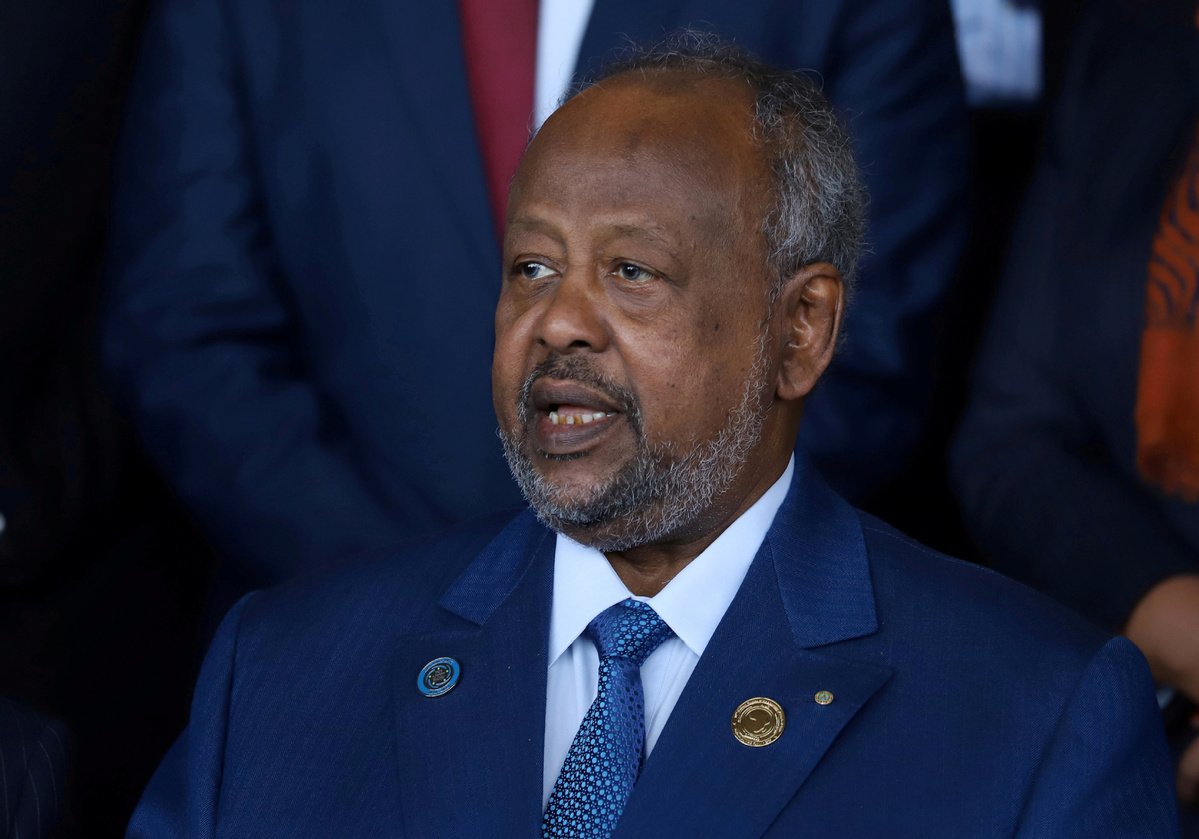
Djibouti’s parliament has demolished the last constitutional obstacle to Ismail Omar Guelleh extending his quarter-century grip on power, voting unanimously Sunday to eliminate the presidential age cap he himself imposed more than a decade ago.
All 65 lawmakers present backed removing the 75-year age ceiling, a maneuver that allows the 77-year-old leader—universally known as IOG—to contest elections scheduled for April 2026. The measure still requires either Guelleh’s signature followed by a second parliamentary vote on November 2, or submission to a national referendum. Given the president’s control over state institutions, neither represents a genuine hurdle.
Guelleh has ruled this strategic Horn of Africa nation since 1999, inheriting power from Hassan Gouled Aptidon, Djibouti’s founding president. The irony of Sunday’s vote isn’t lost on critics: Guelleh introduced the age restriction in 2010 as part of reforms that eliminated presidential term limits while reducing individual terms from six to five years. He sold those changes as modernization. Now he’s dismantling the only constraint those reforms created.
National Assembly Speaker Dileita Mohamed Dileita justified the reversal by invoking regional instability and claiming public support exceeds 80 percent—a figure Al Jazeera could not independently verify. His argument reflects a familiar authoritarian playbook: portray personal rule as national necessity, wrap self-interest in security concerns, and cite unverifiable popular will.
Guelleh telegraphed his intentions earlier this year in an interview with Jeune Afrique magazine. “All I can tell you is that I love my country too much to embark on an irresponsible adventure and be the cause of divisions,” he said—language that frames any leadership transition as dangerous rather than democratic.
Read also: Boat Disasters Claim 300 Lives In Nigeria, CILT Reveals
Rights advocates weren’t buying it. “This revision prepares a presidency for life,” said Omar Ali Ewado, who leads the Djiboutian League for Human Rights. He called instead for peaceful democratic transition, a concept that seems increasingly foreign in a country where Guelleh won his fifth term in 2021 with over 98 percent of votes after opposition groups boycotted an election they deemed rigged from the start.
Washington welcomed that result while gently urging Djibouti to “further strengthen its democratic institutions”—diplomatic speak that prioritizes American military interests over governance principles. The United States maintains its only permanent African military base in Djibouti, sharing the tiny nation with French, Chinese, Japanese and Italian installations that underline the country’s geopolitical weight.
Daher Ahmed Farah, a leader in the Movement for Democratic Renewal and Development, told Al Jazeera that foreign powers should reassess their calculations. “The country is in a strategic position and hosts many bases, but these interests lie with the Djiboutian people, not with a single man.”
That argument confronts cold reality: Djibouti’s stability matters more to international partners than its democracy. The nation of one million perches above the Bab al-Mandab Strait, the maritime chokepoint funneling shipping between Asia and Europe. While neighbors collapse—Sudan consumed by civil war, Somalia fractured and violent—Djibouti remains an island of predictability, however autocratic.
Guelleh ranks as East Africa’s third-longest-serving leader behind Uganda’s Yoweri Museveni, approaching four decades in power, and Eritrea’s Isaias Afwerki, at 27 years and counting. That company should embarrass regional bodies that claim to champion democratic norms, but it doesn’t. Stability trumps legitimacy when military bases and shipping lanes hang in the balance.
The constitutional manipulation follows a script perfected across Africa: leaders introduce term limits under pressure, serve their allotted turns, then engineer constitutional changes to stay indefinitely. What makes Guelleh’s version distinctive is the age limit removal—acknowledging biological reality while refusing to accept political mortality.