
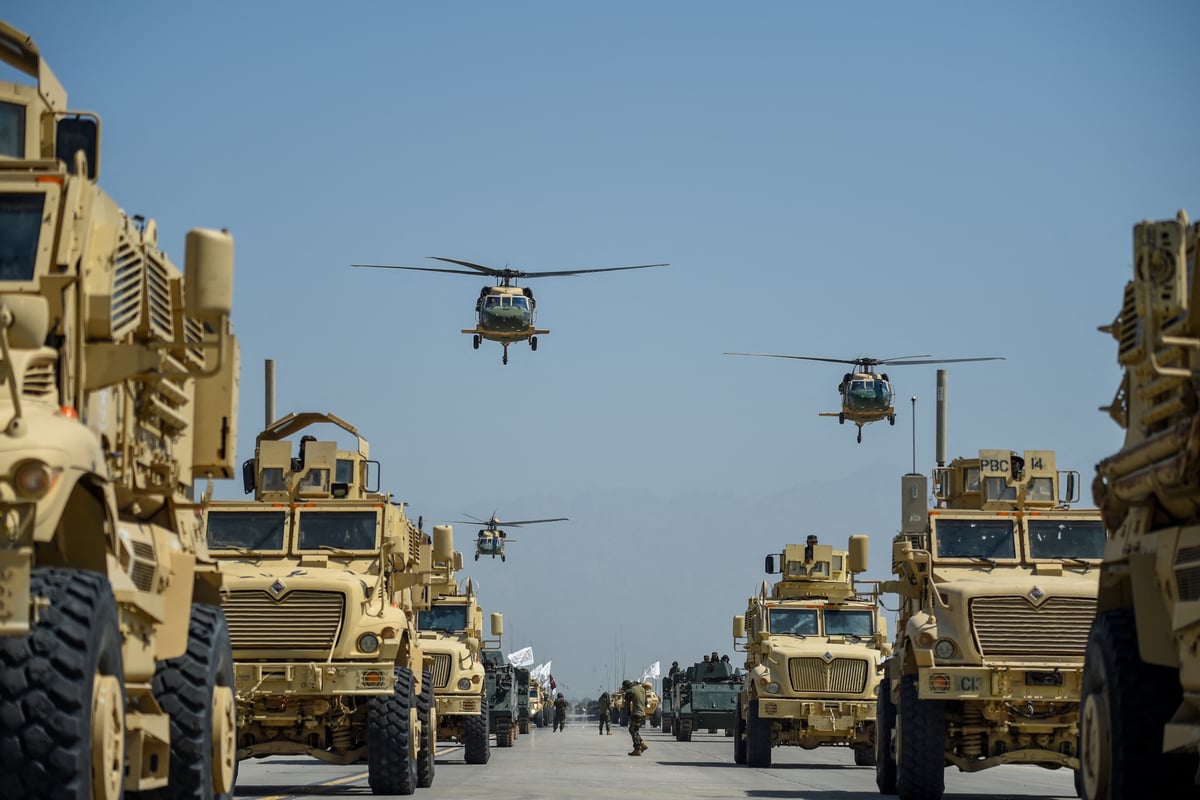
U.S. recent oversight report says American-funded weapons, equipment, and facilities abandoned during 2021 withdrawal now form the backbone of Taliban’s security forces.
U.S. oversight body has concluded that billions of dollars’ worth of American-funded weapons, equipment, and infrastructure left behind during the 2021 withdrawal from Afghanistan have become central to the Taliban’s security and military operations.
The assessment comes from the Special Inspector General for Afghanistan Reconstruction (SIGAR), which released a 137-page report detailing how nearly two decades of U.S. investment failed to secure a stable Afghan state. The United States spent roughly $144.7 billion between 2002 and 2021 on reconstruction and governance programs intended to build democratic institutions, develop the economy, and train Afghan security forces.
According to SIGAR, approximately $7.1 billion in U.S.-supplied equipment and material remained in Afghanistan following the collapse of the Western-backed Afghan government in August 2021. “These U.S. taxpayer-funded equipment, weapons, and facilities have formed the core of the Taliban security apparatus,” the report said, noting that inspectors have been unable to access any sites or hardware since the Taliban takeover.
Read Also: US Halts Afghan Immigration After Guard Shooting
Images from Kabul during the final days of the U.S. evacuation showed Taliban fighters dressed in American-supplied uniforms and standing beside U.S.-made vehicles and aircraft at Hamid Karzai International Airport. A separate Pentagon watchdog report released in 2022 found Afghan forces possessed more than 316,000 U.S.-funded weapons, valued at over $500 million, at the time of the government’s collapse, though the condition of the equipment was unclear.
The new SIGAR findings highlight what it describes as fundamental flaws in the U.S. approach to building Afghan security forces. The report argues that the Afghan National Defense and Security Forces (ANDSF) were designed as a near-mirror image of U.S. military structures—requiring advanced logistics, air support, and leadership that could not be sustained without ongoing American assistance. When U.S. troops withdrew and support rapidly dropped, Afghan morale and operational capacity collapsed.
Gene Aloise, the Acting Inspector General, wrote in an accompanying letter that early U.S. decisions to partner with corrupt powerbrokers undermined governance goals and strengthened insurgent groups. Efforts to promote lasting social and economic development, he said, did not achieve durable results.
Despite the Taliban takeover, the United States remains Afghanistan’s largest donor. SIGAR reports that Washington has disbursed more than $3.83 billion in humanitarian and development aid since 2021, including $120 million in the first quarter of 2025 alone.