
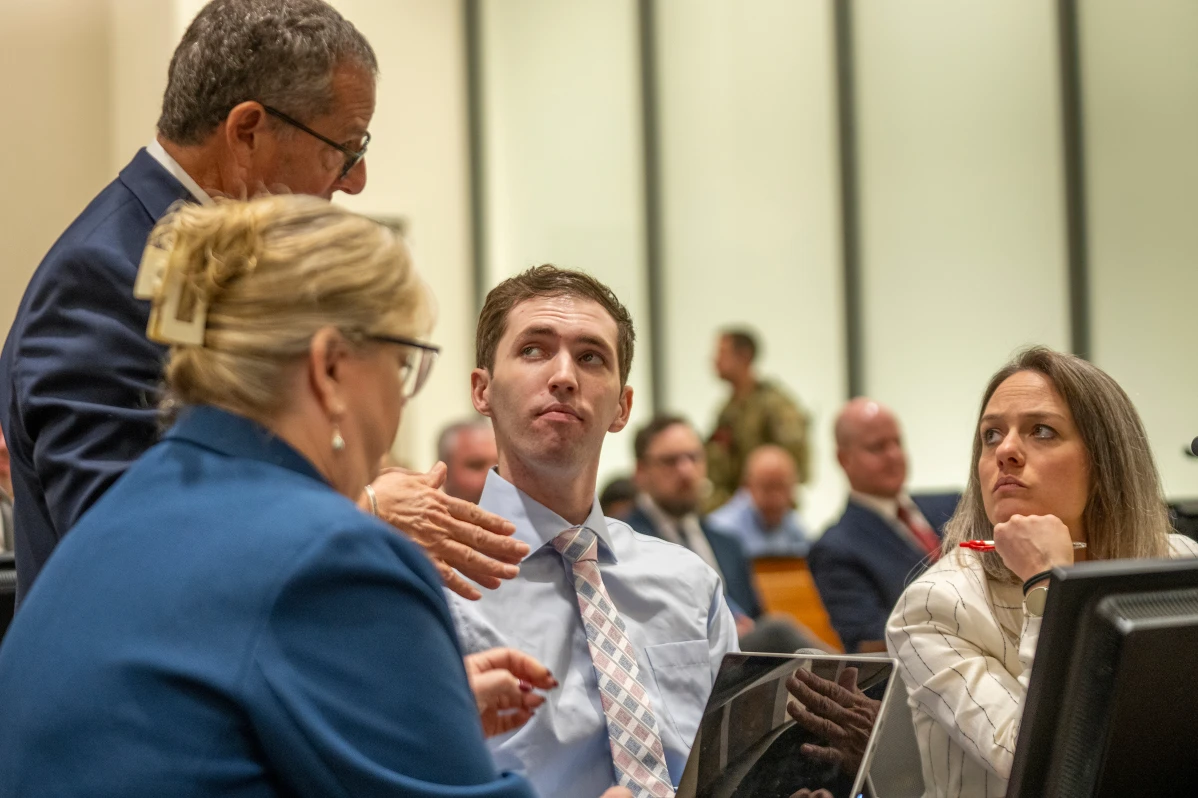
Tyler Robinson, the Utah man accused of killing conservative activist Charlie Kirk, appeared in court in person for the first time on Thursday as his legal team renewed efforts to curb media access in the closely watched murder case.
The hearing underscored the growing tension between public transparency and the defense’s concern that sustained media attention could make it harder to assemble an impartial jury. Prosecutors say they will pursue the death penalty for Robinson, who is charged with aggravated murder in the Sept. 10 shooting on the Utah Valley University campus in Orem.
Robinson, twenty-two, entered the courtroom under heavy security. He wore a dress shirt, tie and slacks and remained restrained at the waist, wrists and ankles under a standing security order. He greeted his parents and brother with a brief smile before taking his seat at the defense table, a shift from earlier court appearances conducted by video or audio feed from jail.
Shortly after proceedings began, state District Court Judge Tony Graf halted the courtroom livestream and asked that the camera be repositioned. Robinson’s attorneys said the broadcast had shown the defendant’s restraints, which they argued violated an October order restricting images of him in shackles.
Graf warned that any further violation could end future broadcasts entirely.
“This court takes this very seriously,” the judge said, adding that the need for public access must be weighed against “the constitutional rights of all parties in this case.”
Robinson’s attorneys, along with the Utah County Sheriff’s Office, have asked the court to ban cameras altogether. Graf has not issued a final ruling on that request.
Read Also: Grief, Praise Greet Death Of Conservative Figure Charlie Kirk
A coalition of national and Utah-based news outlets, including The Associated Press, is opposing additional restrictions and advocating for continued access. Media attorney David Reymann urged the judge to allow news organisations to weigh in whenever new limits or closed hearings are proposed.
He told the court that outlets are seeking “limited party status” so they can respond in real time to transparency concerns.
Defense attorney Staci Visser resisted the request.
“We don’t want the chaos that is out in the media in this courtroom,” she said.
Earlier this autumn, Graf held a closed hearing to discuss Robinson’s clothing and security protocols. Under his ruling, Robinson may appear in street clothes during pretrial hearings, but he must remain physically restrained because of security assessments. Images of those restraints remain prohibited.
Several students who say they saw the shooting attended Thursday’s session.
Zack Reese, a Utah Valley University student and self-described Charlie Kirk supporter, said he hoped attending the hearing would clarify lingering doubts about the arrest.
“I just want answers,” he said, adding that he has family connections to the region where the Robinson family lives.
Brigham Young University student William Brown, who said he stood about ten feet from Kirk at the time of the shooting, described the experience of seeing the defendant in person as overwhelming.
“I witnessed a huge event, and my brain is still trying to make sense of it,” he said. “Being here helps it feel more real than surreal.”
The case remains in its early stages, with the court expected to address pretrial motions—including the camera ban—over the coming months.