
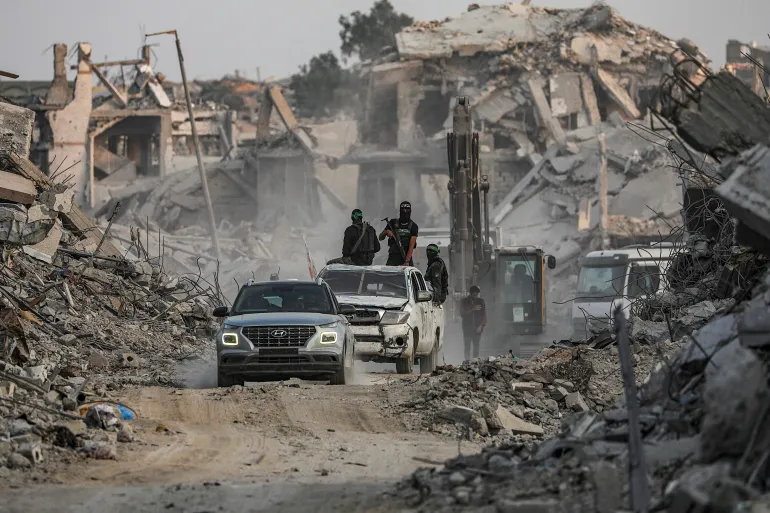
Hamas has confirmed that senior commander Raed Saad was killed in an Israeli strike near Gaza City, marking the highest profile killing of a Hamas leader since the ceasefire took effect in October.
The Israeli military said Saad was targeted in an attack on Saturday, adding that at least 25 people were wounded. Hamas confirmed his death on Sunday, accusing Israel of breaching the ceasefire agreement and urging international mediators to intervene.
In a recorded statement, Hamas Gaza leader Khalil al Hayya said the killing amounted to a serious violation of the truce. He called on ceasefire guarantors, including the United States, to pressure Israel to comply with the deal.
“In light of Israel’s continued violations, including the assassination of a Hamas commander just yesterday, we call on the mediators and especially the US administration and President Donald Trump to force the occupation to respect the ceasefire agreement,” al Hayya said.
According to Gaza authorities, Israeli forces have carried out nearly 800 attacks since the ceasefire began on October 10, killing at least 386 people. Israel disputes those figures. Reuters has reported continued Israeli military activity despite the truce.
Hamas officials also accused Israel of blocking humanitarian aid, saying restrictions have worsened conditions following Storm Byron, which flooded about 27,000 tent shelters housing displaced Palestinians.
Last week, the United Nations General Assembly overwhelmingly approved a resolution demanding unrestricted humanitarian access to Gaza and calling on Israel to comply with international law. The resolution also urged an end to attacks on United Nations facilities.
“Our priority is to move forward toward ending the war and completing phase one of the agreement,” al Hayya said. He stressed that aid deliveries, hospital rehabilitation, and infrastructure repairs must be allowed, including reopening the Rafah crossing with Egypt in both directions.
The ceasefire agreement envisions a second phase that would include an Israeli withdrawal, the formal end of the war, and discussions over Hamas disarmament. A proposal backed by President Trump also includes deploying an international stabilization force.
Al Hayya rejected any external control over Gaza, saying an international force could only be tasked with monitoring the ceasefire and separating forces along Gaza’s borders. He said Hamas and other Palestinian factions remain committed to the agreement but oppose guardianship imposed from outside.
Read Also: Gaza Plan Phase Two “Close,” Netanyahu Says
Meanwhile, the Israeli army said in a Telegram post that Saad had been working to rebuild Hamas military capabilities and described him as one of the planners of the October 7, 2023 attacks on Israel. An Israeli defense official told Reuters that Saad led Hamas weapons manufacturing operations. Hamas sources have described him as second in command of the group’s armed wing.
As talks over phase two approach, Hamas leader abroad Khaled Meshaal has sought to engage Washington on the group’s vision for disarmament. Speaking earlier this week on Al Jazeera Arabic, Meshaal said Hamas aims to prevent a return to war and is open to discussing how weapons might be handled, provided the process includes guarantees.
Earlier this month, senior Hamas official Basem Naim said a US draft proposal for phase two needed significant clarification. He said Hamas could consider freezing or storing weapons during the truce but would not accept an international force overseeing disarmament.
Negotiators are expected to resume discussions in the coming days, with humanitarian access and security arrangements likely to dominate the next round of talks.