
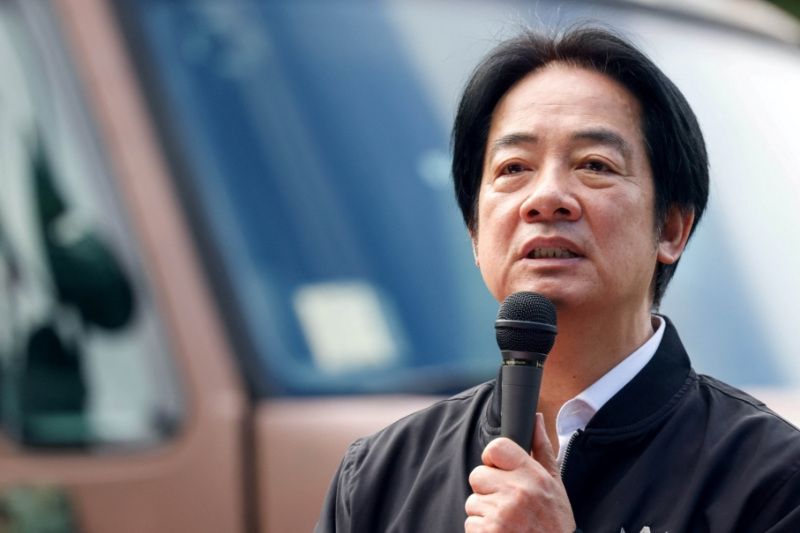
TAIPEI — Taiwan’s government will intensify its defense measures over the coming year, President Lai Ching-te said Sunday in a Chinese New Year message emphasizing national security amid ongoing tensions with China.
In the statement, released across social media platforms, Lai highlighted the role of the armed forces in protecting the island around the clock and outlined plans to continue strengthening Taiwan’s military and public security.
The address was recorded at Hsiaohsuehshan, a high-altitude radar station in Taiwan’s central mountains, which Lai visited earlier this month. Footage showed the president interacting with officers and inspecting the facility.
“We will continue to strengthen our national defense and public security efforts, safeguarding national security and maintaining social stability,” Lai said in the message, without extending customary greetings to mainland China.
Lai has framed defense spending as a critical priority for Taiwan, which Beijing considers a breakaway province.
Last year, his administration proposed an additional US$40 billion in military expenditure aimed at modernizing the armed forces and acquiring advanced weaponry from the United States, including fighter jets, missiles, and other systems designed to enhance Taiwan’s deterrence capabilities.
The proposals, however, have stalled in parliament, where the opposition Kuomintang (KMT) holds a majority.
Read Also: Taiwan–US Ties ‘Rock Solid,’ Taiwan’s President Says
The KMT has declined to review Lai’s full plan, instead advancing a scaled-back budget focused on select arms purchases, a move that analysts say may limit the speed and scope of Taiwan’s military modernization.
The Chinese government has repeatedly criticized Lai and his administration, labeling him a “separatist” for rejecting Beijing’s sovereignty claims.
In response, Beijing continues to assert that Taiwan is an inseparable part of China and has not ruled out the use of force to achieve reunification.
Military tensions have risen periodically, with China conducting large-scale exercises near the island, including a major round of war games in late December 2025.
In his address, Lai underscored Taiwan’s ongoing domestic defense initiatives. The video accompanying the message featured Taiwan’s first domestically developed submarine, currently undergoing undersea trials. The vessel is a central element in the island’s strategy to strengthen its undersea capabilities, offering potential advantages in deterrence and maritime defense.
Observers note that Lai’s messaging this year continues a pattern of highlighting self-reliance in defense and the operational readiness of the armed forces.
By recording the statement at a military radar station, the administration emphasized both technological advancement and frontline preparedness.
The Chinese New Year period holds symbolic and social importance across the region. Mainland China, South Korea, and several Southeast Asian countries also observe the holiday, often with extended travel and cultural celebrations.
In contrast to the customary greetings exchanged across borders during the festival, Lai’s address notably omitted references to Beijing, reflecting the persistent political and security friction between Taipei and the mainland.
Taiwan’s defense policy has increasingly focused on “asymmetric capabilities” designed to counteract a numerically superior adversary. This includes mobile missile systems, indigenous submarines, air defense upgrades, and investments in domestic weapons production.
Read Also: Taiwan Simulates Chinese Invasion In Major Defense Drill
Lai’s proposed US$40 billion budget last year was intended to accelerate these initiatives, signaling both a response to recent Chinese military pressure and a broader push for strategic self-sufficiency.
The domestic political landscape has complicated these efforts. While Lai and his Democratic Progressive Party (DPP) maintain executive authority, the opposition-controlled legislature has repeatedly challenged the size and scope of proposed defense expenditures.
KMT lawmakers argue for more targeted spending that prioritizes specific operational needs rather than a broad increase in military procurement.
Lai’s message also served as a public acknowledgment of the armed forces’ ongoing operational demands.
Taiwan’s military remains on high alert, conducting regular exercises, patrols, and monitoring operations, particularly in the face of repeated incursions by Chinese aircraft and naval vessels into its air defense identification zone.
Security analysts say the combination of increased defense spending and ongoing indigenous weapons development is intended to reassure both domestic audiences and international partners, particularly the United States, which provides arms and security assurances to Taipei under the Taiwan Relations Act. U.S. officials have repeatedly affirmed that they will continue supporting Taiwan’s self-defense capabilities, a stance that Beijing views as interference in internal Chinese affairs.
Looking ahead, Taiwan’s government has indicated that it will continue to pursue strategic upgrades while navigating a complex political environment at home.
Lai’s administration has yet to announce a new legislative timeline for reviewing defense proposals, leaving the implementation of the full US$40 billion program uncertain.
The Chinese New Year address concludes with the administration’s commitment to public safety and stability, stressing both the protection of citizens and the operational readiness of the armed forces.