
The Middle East entered one of its most volatile chapters in recent history this weekend as a coordinated United States–Israeli military campaign struck at the core of Iran’s political and military establishment, culminating in the death of Iran’s Supreme Leader, Ayatollah Ali Khamenei. The development marks a profound rupture in regional power dynamics and introduces immediate uncertainty across global energy markets, diplomatic corridors, and security architectures stretching from the Gulf to Washington.
The joint offensive, formally designated Operation Epic Fury, was launched after weeks of escalating rhetoric from US President Donald Trump, who had repeatedly warned Tehran that failure to accept a revised nuclear agreement would trigger military action. Washington maintains that the objective is singular: preventing Iran from acquiring a nuclear weapon. Tehran, for its part, has consistently insisted that its nuclear programme remains peaceful.
In an eight-minute video statement posted to Truth Social, President Trump declared that the operation would dismantle Iran’s missile capabilities and “raze their missile industry to the ground.” He further urged Iranian armed forces to surrender in exchange for “complete immunity,” warning that refusal would invite “certain death.” In language rarely heard in direct state-to-state confrontation, he also called on the Iranian public to prepare to assume control of their government once operations conclude.
Read Also: Russia Accepts US Security Blueprint For Ukraine – Kyiv
From Jerusalem, Israeli Prime Minister Benjamin Netanyahu framed the campaign as a necessary measure to eliminate what he described as an existential threat posed by Tehran. Israeli military officials later disclosed that roughly 200 fighter aircraft had conducted synchronized strikes across western and central Iran, dropping hundreds of munitions on approximately 500 targets. According to the Israel Defense Forces, the targets included missile arrays, air defence systems, drone launch sites, Islamic Revolutionary Guard Corps facilities, and military airfields.
Explosions were reported across 24 of Iran’s 31 provinces. Residents in Tehran, Karaj, Isfahan, Qom and Kermanshah described sustained blasts and rising columns of smoke. Iranian state media later confirmed that the Supreme National Security Council had verified the death of Ayatollah Khamenei. Prime Minister Netanyahu stated in a televised address that Israeli forces had destroyed “the compound of the tyrant Khamenei in the heart of Tehran.” President Trump subsequently wrote that Khamenei was dead, describing him in sharply condemnatory terms.
The office of President Masoud Pezeshkian was reportedly among early targets, though Iranian state television said he remained unharmed. A statement from the presidency later affirmed that government continuity would be maintained. Meanwhile, Iran has imposed a near-total internet blackout, severely restricting the flow of verifiable information from inside the country. Its Civil Aviation Organisation has closed national airspace indefinitely.
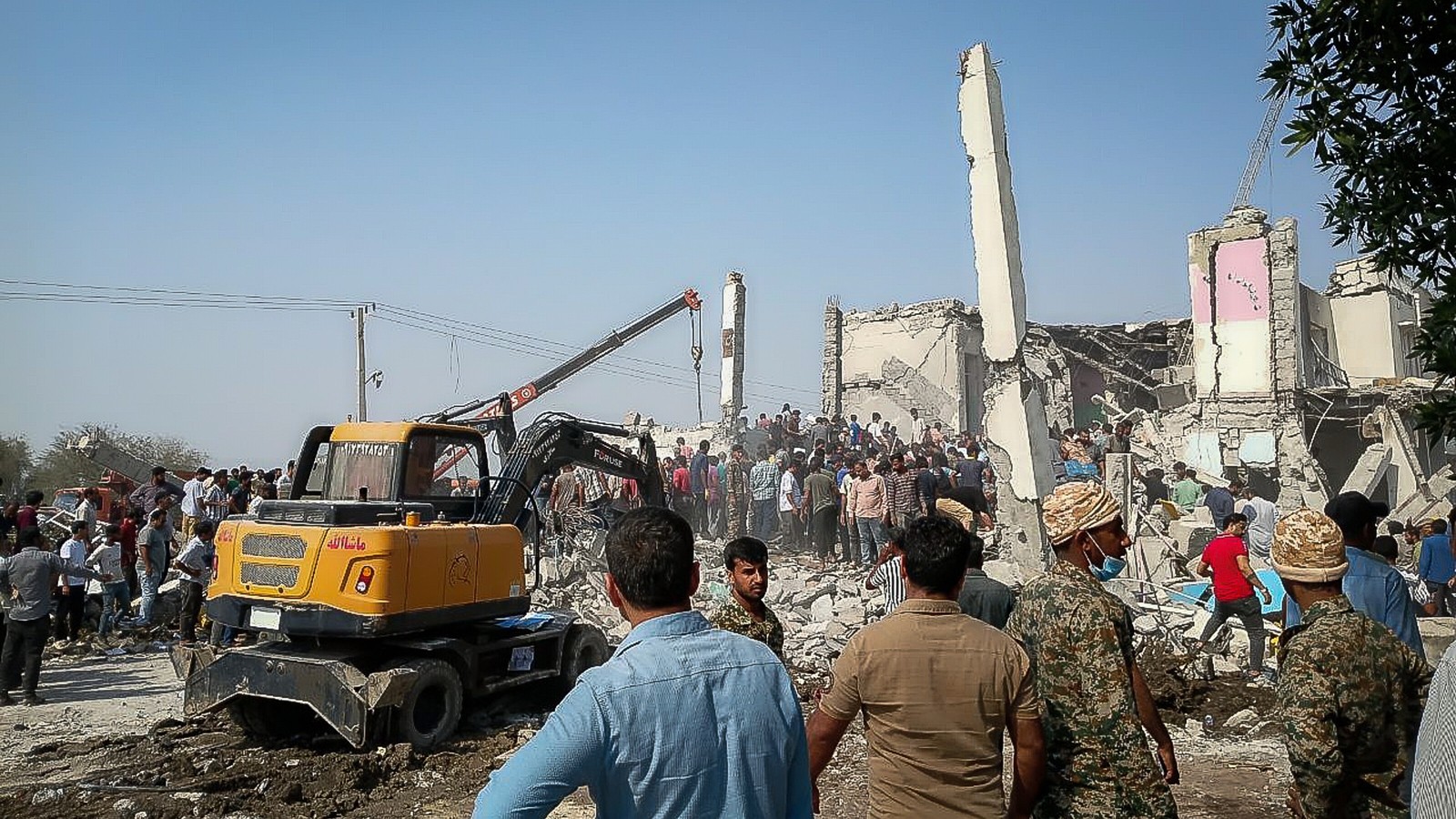
Humanitarian costs are mounting. The Iranian Red Crescent reports more than 200 fatalities and over 700 injuries nationwide. Among the most devastating incidents was an explosion at a school in southern Iran that local prosecutors say killed at least 108 people. Intelligence sources cited by Western media suggest that approximately 40 senior Iranian officials were killed. The Israeli military named seven high-ranking defence figures among the dead, including Defence Council secretary Ali Shamkhani, Defence Minister Brigadier General Aziz Nasirzadeh, and Islamic Revolutionary Guard Corps commander General Mohammad Pakpour. The IRGC has since appointed Ahmad Vahidi as its new commander-in-chief.
Iran’s Foreign Minister Abbas Araghchi denounced the operation as “wholly unprovoked, illegal, and illegitimate,” pledging retaliation. That response materialized swiftly.
Ballistic missiles and drones were launched toward US installations and allied territories across the Gulf. According to Iran’s semi-official Tasnim news agency, the IRGC targeted five major US military facilities: Al Udeid Air Base in Qatar, Al Dhafra Air Base in the United Arab Emirates, the US Fifth Fleet headquarters in Bahrain, Ali Al Salem Air Base in Kuwait, and Muwaffaq Salti Air Base in Jordan. Qatar, Bahrain, Jordan and Kuwait reported intercepting incoming projectiles, though falling debris caused localized damage.
The IRGC further claimed that a US combat support vessel sustained “severe blows” and that a US FP-132 radar system in Qatar had been destroyed. US Central Command countered that American forces had successfully defended against hundreds of missile and drone attacks, reporting no casualties and only minimal damage that did not disrupt operations.
Israel also came under sustained assault. Local media reported that approximately 150 ballistic missiles were fired in successive salvos, alongside dozens of drones. Air defence systems intercepted many of them, while others struck open areas. The Israel Defense Forces confirmed two fatalities and 456 injuries.
Beyond immediate military exchanges, the conflict is reverberating through global systems. The European Union naval mission EUNAVFOR ASPIDES reported that the IRGC broadcast warnings to commercial vessels in the Strait of Hormuz, declaring that no ships would be permitted to pass. The strait handles roughly one-fifth of global oil and gas shipments, making it one of the world’s most strategically sensitive chokepoints. Even the suggestion of disruption is likely to intensify volatility in energy markets.
Civil aviation has been thrown into disarray. Of more than 4,200 flights scheduled to arrive in the region on Saturday, nearly a quarter were cancelled, according to aviation analytics firm Cirium. Hundreds more were scrapped on Sunday. Airlines including Wizz Air, British Airways, Swiss International Air Lines, Lufthansa, Air India, Virgin Atlantic and Turkish Airlines have suspended or curtailed operations to key regional hubs. Kuwait has halted flights to Iran, and several states, including Iraq and Jordan, have closed their airspace. The United Arab Emirates has implemented partial and temporary closures.
Read Also: American Strikes On Iran Revive War Authority Legislation Push
The strategic implications extend well beyond the Middle East. For Washington, the operation represents a decisive shift from containment to direct confrontation with Iran’s ruling structure. For Israel, it signals an alignment of military timing with longstanding security concerns. For Tehran, the killing of its Supreme Leader constitutes not only a national trauma but a potential catalyst for internal political recalibration, though the regime’s institutional resilience remains formidable.
What emerges is not merely a military episode but a systemic shock. Regional deterrence frameworks have been tested. Energy supply chains face renewed risk. Air travel corridors are constrained. Diplomatic channels are strained to the breaking point.
The coming days will determine whether Operation Epic Fury evolves into a broader regional war or stabilizes into a tense, heavily militarized standoff. For now, the Middle East stands at a precarious threshold, its future contingent on decisions being made simultaneously in Tehran, Jerusalem and Washington.