
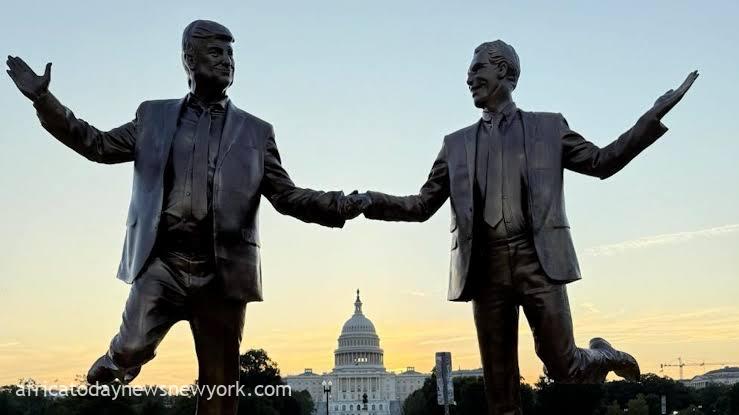
A provocative bronze pop-up statue titled “Best Friends Forever” appeared early Tuesday on the east end of the National Mall in Washington, D.C., depicting former President Donald Trump and Jeffrey Epstein holding hands — a visual nod to their controversial past.
The artwork, which stood roughly 12 feet tall and was permitted to remain until Sunday evening, showed the two men side by side with one foot playfully raised. A plaque at its base read, “We celebrate the long-lasting bond between President Donald J. Trump and his ‘closest friend’, Jeffrey Epstein.” The installation was captioned “In honour of friendship month.”
No credited artist has publicly claimed responsibility, but the statue follows a pattern of anonymous politically charged installations critical of Trump. In June, the same group — reportedly behind works like “Dictator Approved” — placed a sculpture featuring a golden thumbs-up crushing the Statue of Liberty’s crown.
The White House responded, with spokesperson Abigail Jackson telling The Washington Post:
“Liberals are free to waste their money however they see fit — but it’s not news that Epstein knew Donald Trump, because Donald Trump kicked Epstein out of his club for being a creep.”
Read Also: Former First Lady Kim Keon-hee Faces Corruption Hearing
Epstein, a convicted sex offender who died in jail in 2019, remains a controversial figure in Trump’s personal and political narrative. The statue rekindles long-running public scrutiny over their association, particularly following a congressional release of a “birthday book” given to Epstein. The 238-page volume, containing messages and photos, includes an alleged note bearing Trump’s signature — a link he has denied.
By Wednesday morning, the statue had been removed by U.S. Park Police for failing to comply with permit terms, despite having permission to stand until Sunday. Only a patch of disturbed ground remained where it once stood.
The removal sparked fresh debate about the boundaries between protest art, political message, and symbolic critique — particularly when that critique targets a former president during moments of revived interest in the Trump-Epstein connection.