
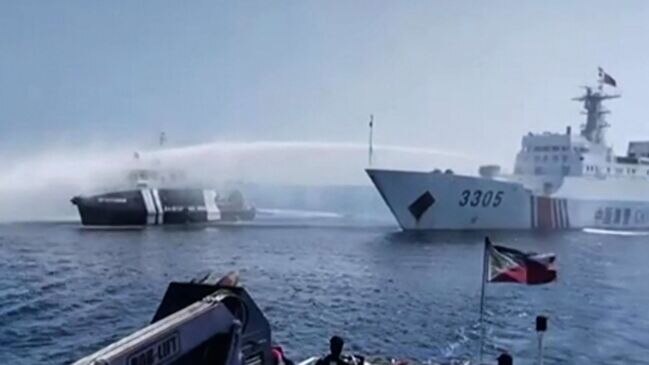
Tensions in the South China Sea have flared once again after the Philippines accused China of deliberately ramming one of its government vessels near Thitu Island, a territory Manila holds in the contested Spratly archipelago. The incident, which occurred on Sunday morning, adds to a long string of maritime confrontations that have defined the uneasy relationship between both nations in the disputed waters.
According to the Philippine coastguard, the encounter began around 9:15 a.m. local time when a Chinese coastguard ship unleashed a powerful jet from its water cannon at the BRP Datu Pagbuaya — a fisheries vessel operating under Manila’s Bureau of Fisheries and Aquatic Resources. Moments later, the Chinese ship reportedly struck the rear of the Filipino vessel, leaving it with minor damage but no casualties.
Coastguard spokesman Commodore Jay Tarriela shared video evidence on social media showing the Chinese vessel veering close to the Datu Pagbuaya before colliding briefly, forcing the Filipino crew to make a sharp evasive turn. Another clip captured the forceful spray of a water cannon in the direction of the Philippine boat — a scene that has since reignited public outrage at home and underscored the risks faced by Filipino crews in the disputed region.
Read also: Hundreds Saved After Snow Trap On Everest’s Tibetan Side
Tarriela described China’s actions as “deliberate” and “bullying,” echoing Manila’s growing frustration over what it sees as Beijing’s persistent attempts to intimidate smaller regional players. Thitu Island, locally known as Pag-asa, is one of nine islands occupied by the Philippines in the Spratlys — a cluster of reefs and atolls claimed by several countries but largely dominated by China’s military presence.
China, for its part, has denied wrongdoing. In a statement, Chinese coastguard spokesman Liu Dejun accused the Philippines of “ignoring repeated warnings” and “dangerously approaching” Chinese waters, insisting that the responsibility for the collision lay solely with Manila.
Beijing has long rejected the 2016 international tribunal ruling that invalidated its sweeping “nine-dash line” claim over most of the South China Sea. Despite that verdict, Chinese coastguard vessels continue to patrol — and often obstruct — ships from the Philippines, Vietnam, and other Southeast Asian nations.
In Manila, the latest confrontation has stiffened the government’s tone. Coastguard chief Admiral Ronnie Gil Gavan said the episode “only strengthens our resolve not to surrender a square inch of our territory to any foreign power.”
As both sides exchange blame, the waters off Thitu remain a volatile stage — one where fishing boats and coastguard ships have become symbols of sovereignty, and where every collision now carries geopolitical weight.