
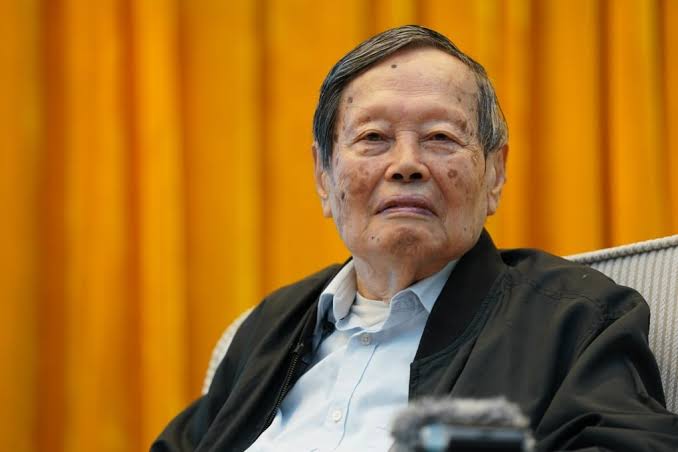
Chen Ning Yang, renowned physicist and Nobel laureate, died on October 18 in Beijing at the age of 103, Chinese media reported. CCTV cited illness as the cause of death.
With Yang’s death, a remarkable career that crossed continents and altered the foundations of physics comes to an end. Yang leaves a legacy of scientific audacity and mentoring after sharing the 1957 Nobel Prize in Physics with Tsung-Dao Lee for discovering parity violation in weak interactions.
Yang was born in Hefei, Anhui Province, in 1922. His father was a professor that taught mathematics at Tsinghua University, so he was raised in an academic family. After graduating from Tsinghua and the National Southwest Associated University, he traveled to the United States on a fellowship to study under Enrico Fermi at the University of Chicago. When Yang and Lee won the Nobel Prize at the age of 35, they disproved a long-held belief in particle physics by demonstrating that weak nuclear interactions do not follow mirror symmetry (parity). In his Nobel banquet address, he reflected on cultural identity: “I am heavy with an awareness of the fact that I am in more than one sense a product of both the Chinese and Western cultures.”
Yang also co-developed the Yang–Mills gauge theory with Robert Mills in the 1950s, which became a foundational pillar of the Standard Model of particle physics. Later in his career, he served as a professor at Tsinghua University and held an honorary dean post at its Institute for Advanced Study.
Read Also: US Economist Claudia Goldin Awarded Nobel Prize In Economics
Yang married Chih Li Tu in 1950, and the two of them had three kids. Tu remarried Weng Fan in 2004 following his death in 2003. Yang described her as his “last gift from God.” In a significant development, Yang resigned his U.S. citizenship in 2015, stating that while he valued the possibilities provided by the United States, he ultimately reaffirmed his strong links to China.
Reflecting on his life, Yang once said, “My life has been a circle, where I started out from a point, travelled a long way, and finally returned to where I came from.”
Yang’s research changed the way we think about fundamental forces. Fundamental ideas on subatomic interactions had to be revised by physicists as a result of the rejection of parity symmetry. The Yang–Mills framework, which was first put forth with Robert Mills, is now essential to the Standard Model and quantum field theories. Beyond his discoveries, Yang mentored students and contributed to the development of China’s research institutes, thereby strengthening scientific relations between China and the rest of the globe. The scientific community as a whole has paid tribute to him after his passing. The website of Tsinghua University was grayed out in observance.