
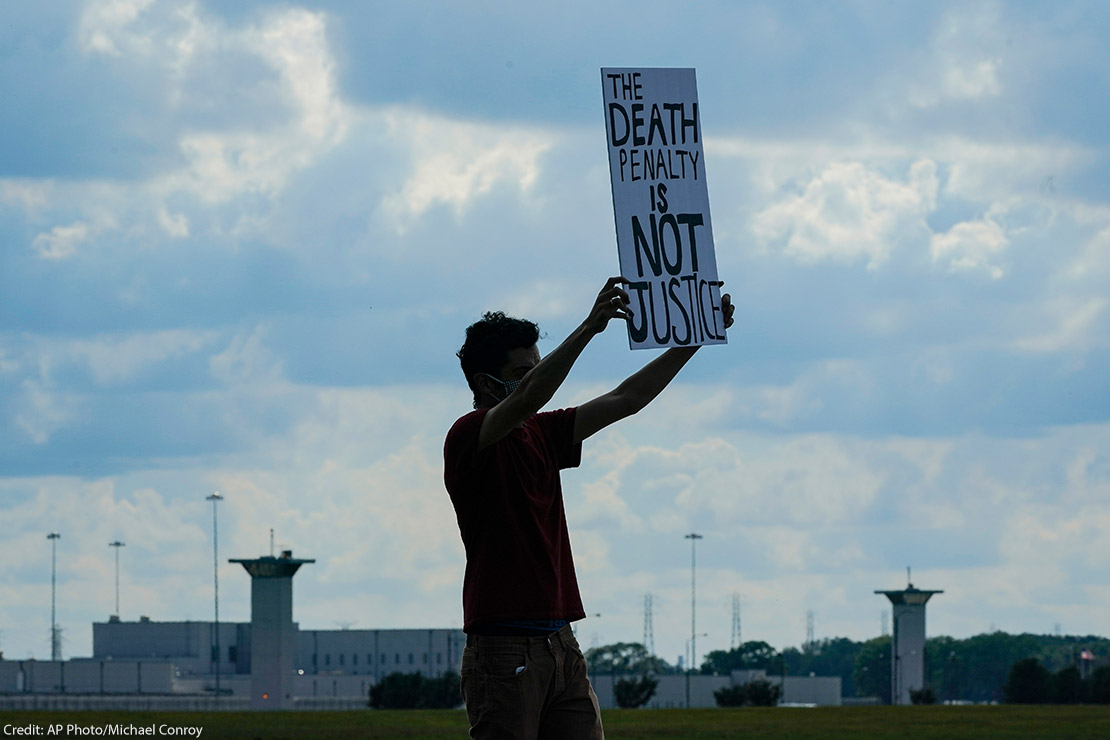
Alabama carried out its seventh nitrogen gas execution Thursday evening, putting to death a man who spent three decades maintaining his innocence in a killing prosecutors say stemmed from a drug debt dispute.
Anthony Boyd, 54, died after more than 20 minutes of visible distress following the administration of nitrogen gas, according to witnesses present at the execution. His final words echoed the claims he’d made throughout his imprisonment: “I didn’t kill anybody. I didn’t participate in killing anybody,” he said, according to CBS News. “There can be no justice until we change this system.”
Boyd was convicted in 1995 for the murder of Gregory “New York” Huguley, whom prosecutors said Boyd killed by setting him on fire over $200 in drug money. The jury that sentenced him to death reached its verdict by a 10-2 vote—a margin that wouldn’t be permitted under current legal standards in most states.
According to the Death Penalty Information Center, the case against Boyd rested entirely on witness testimony. No physical evidence linked him to the crime. The trial took place in an Alabama county that, at the time, held the dubious distinction of issuing death sentences at the highest per capita rate in the nation.
Sarah Clifton, a reporter for the Montgomery Advertiser who witnessed the execution, described a prolonged process that stretched nearly 40 minutes from the moment Boyd was restrained until officials declared him dead. The state began pumping nitrogen gas into Boyd’s mask at 5:57 pm local time. What followed, Clifton reported, was more than 20 minutes during which Boyd continued breathing and experienced spasms before finally lying still at 6:18 pm.
Even then, the procedure wasn’t over. Alabama continued the flow of nitrogen for another nine minutes, shutting it off at 6:27 pm. Boyd was pronounced dead six minutes later, at 6:33 pm.
The execution method itself has become a flashpoint in the ongoing national debate over capital punishment. Alabama has turned to nitrogen gas as states face growing difficulty obtaining the drugs used in lethal injection protocols. Pharmaceutical companies have increasingly refused to supply medications for executions, and some inmates have experienced complications during attempted intravenous procedures.
Read also: Oklahoma: Student Dies After High School Bathroom fight
Nitrogen hypoxia—which kills by replacing oxygen with nitrogen gas—was presented by Alabama officials as a more humane alternative. Critics, including medical professionals and civil rights advocates, have vehemently disputed that characterization, arguing the method can cause prolonged suffering.
Boyd’s legal team made an unusual request in the days before his execution: allow him to be killed by firing squad instead. They argued that a bullet would bring near-instantaneous death, sparing him the drawn-out process that nitrogen gas executions have demonstrated. Multiple courts rejected the plea.
The case reached the U.S. Supreme Court, where Boyd’s attorneys argued that nitrogen gas violates the Eighth Amendment’s prohibition on cruel and unusual punishment. The court’s conservative majority declined to intervene, clearing the way for the execution to proceed.
But the decision wasn’t unanimous. The Supreme Court’s three liberal justices—Sonia Sotomayor, Elena Kagan, and Ketanji Brown Jackson—dissented sharply. Justice Sotomayor’s written opinion didn’t mince words, describing nitrogen gas execution as “torturous suffocation.”
“Boyd asks for the barest form of mercy: to die by firing squad, which would kill him in seconds,” Sotomayor wrote. “The Constitution would grant him that grace. My colleagues do not. This Court thus turns its back on Boyd and on the Eighth Amendment’s guarantee against cruel and unusual punishment.”
Alabama began using nitrogen gas in January 2024, becoming the first state to execute someone by this method in modern American history. Since then, it has conducted seven such executions—all within roughly 15 months. No other state has adopted the practice, though some have considered it as they grapple with the same challenges Alabama faced in carrying out lethal injections.
The Boyd execution underscores several contentious aspects of American capital punishment. Beyond the method itself, his case highlights persistent questions about the reliability of witness testimony in death penalty cases, the standards for jury unanimity in sentencing, and geographical disparities in how aggressively prosecutors seek execution.
For death penalty opponents, Boyd’s prolonged death and his unwavering claims of innocence represent everything wrong with the current system. For supporters of capital punishment, his execution represented justice served for a brutal crime, regardless of the method used to carry out the sentence.
What’s undeniable is that nitrogen gas executions take considerably longer than the swift death Alabama officials initially promised. Witnesses to previous nitrogen executions in the state have reported similar patterns: extended periods of visible struggle before inmates finally stop moving.