
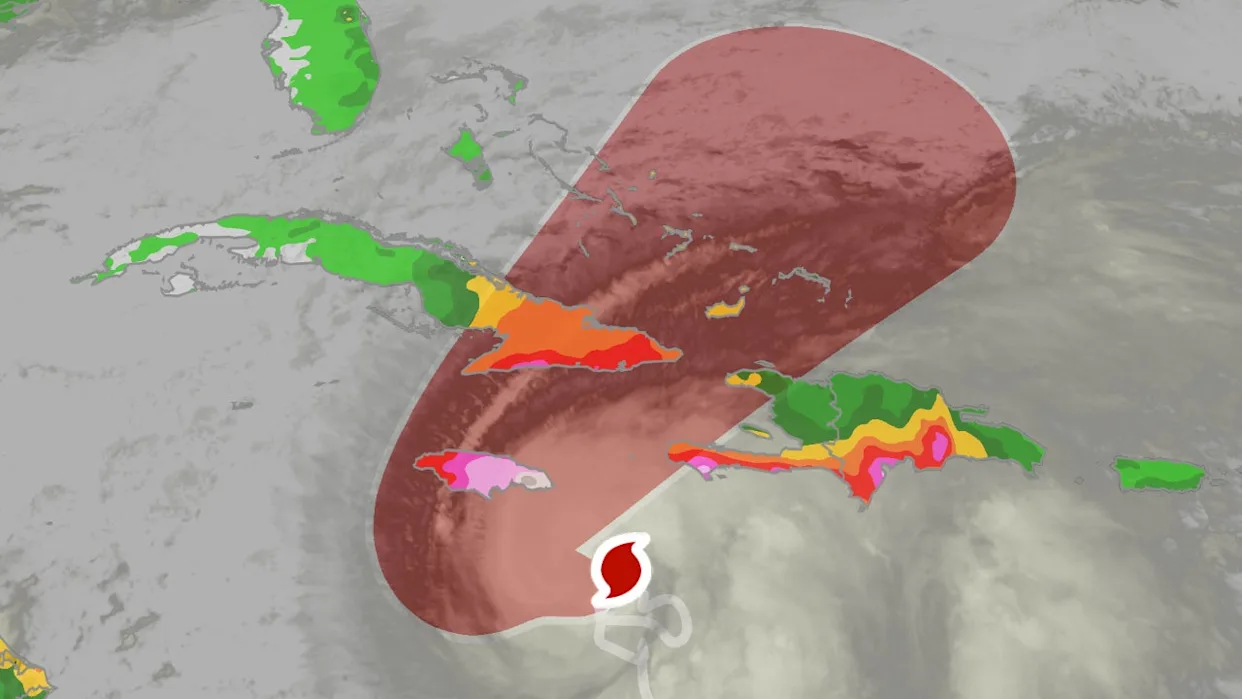
Hurricane Melissa has undergone explosive intensification, transforming into a dangerous Category 3 system that now threatens to pummel Jamaica with catastrophic force while unleashing deadly floods across Haiti’s already battered terrain.
The storm’s rapid strengthening caught forecasters’ attention Saturday as maximum sustained winds reached 185 kilometres per hour. More alarming than the wind speed is Melissa’s glacial pace—a crawling giant that meteorologists warn will spend up to four days grinding across the same vulnerable communities, dumping potentially historic rainfall totals.
“I urge Jamaicans to take this weather threat seriously,” Prime Minister Andrew Holness said in an urgent appeal to his nation. “Take all measures to protect yourself.”
By late Saturday, Melissa’s center sat roughly 200 kilometres south-southeast of Kingston, positioning the hurricane for a direct assault on Jamaica within the next day or two. The U.S. National Hurricane Center projects the storm will only grow stronger before landfall, driven by warm Caribbean waters that act as fuel for intensification.
Read also: Hong Kong, Southern China Brace For Typhoon Ragasa
Authorities have already shuttered Kingston’s Norman Manley International Airport, though officials haven’t announced whether Montego Bay’s Sangster airport on the island’s western coast will face similar closure. Across Jamaica, more than 650 emergency shelters have opened their doors. Government warehouses are stocked with supplies, and thousands of pre-packed food distributions stand ready for rapid deployment once conditions allow.
The true danger lies not in Melissa’s winds but in her rain. Forecasters predict accumulations reaching 76 centimeters across Jamaica and southern Hispaniola—the island shared by Haiti and the Dominican Republic. That volume of water falling on mountainous terrain creates textbook conditions for devastating landslides and flash floods that can wipe away entire hillside communities.
“Unfortunately for places along the projected path of this storm, it is increasingly dire,” said Jamie Rhome, deputy director of the hurricane center, his language unusually blunt for typically measured meteorological briefings.
Haiti has already paid in blood. At least three deaths there and one in the Dominican Republic are attributed to Melissa’s outer bands, with another person still missing. Rising rivers have breached banks in Sainte-Suzanne in Haiti’s northeast, destroying a bridge and isolating communities. Ronald Delice, a department director of civil protection, organized food distribution lines even as many residents refused evacuation orders, unwilling to abandon homes despite the approaching danger.
The Dominican Republic reports nearly 200 damaged structures and water system failures affecting over half a million customers. Floodwaters have cut off more than two dozen communities entirely, while fallen trees, disabled traffic signals and small landslides compound the crisis.
Cuba issued hurricane watches Saturday afternoon for Granma, Santiago de Cuba, Guantanamo and Holguin provinces, anticipating Melissa’s arrival by midweek. The Bahamas meteorology department warned that southeastern and central islands, along with Turks and Caicos, could face tropical storm or hurricane conditions by early next week.
Melissa marks the 13th named storm in an Atlantic hurricane season that runs through November 30—a season that keeps delivering threats to a region with limited capacity to absorb repeated disasters.