
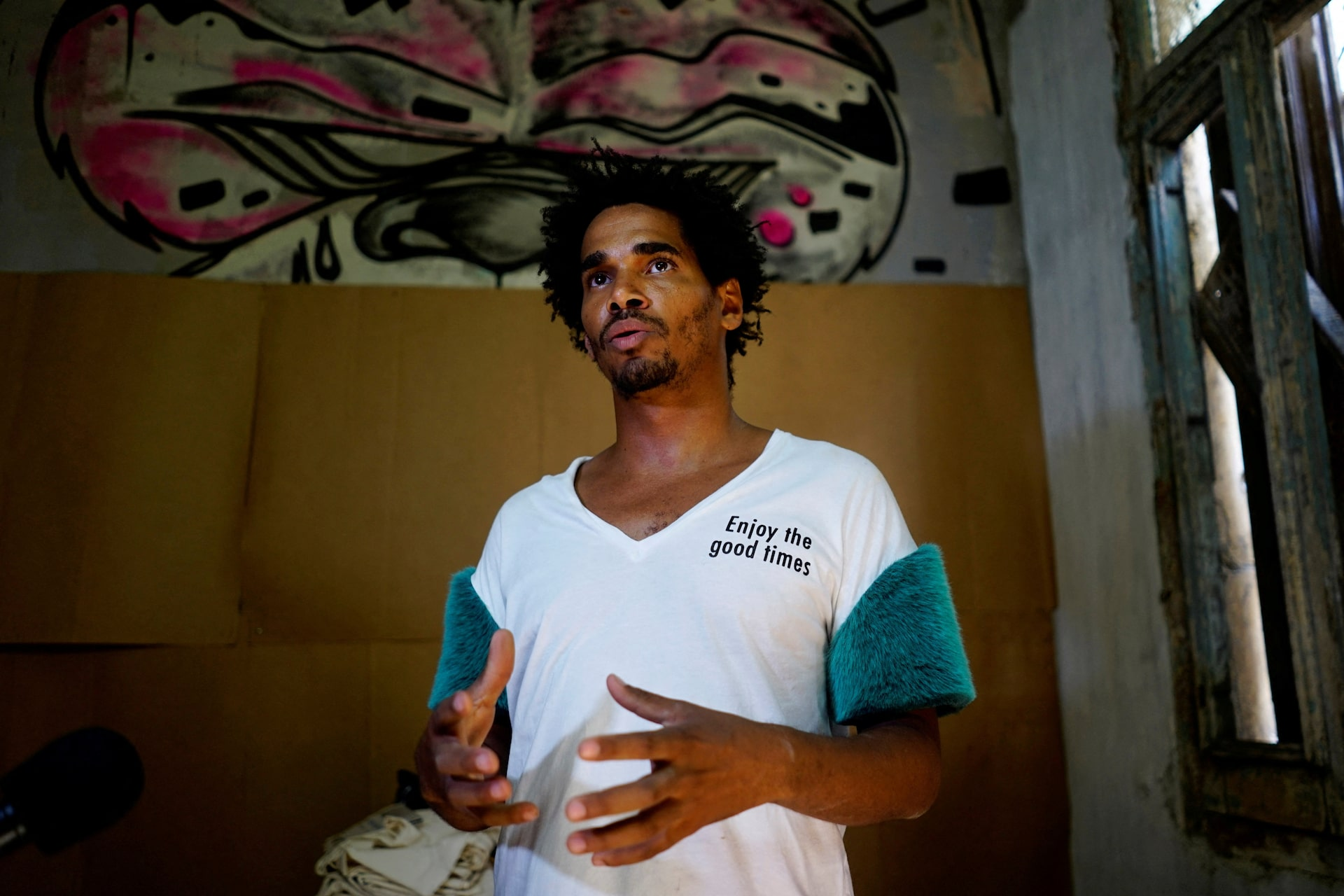
Cuban dissident artist Luis Manuel Otero Alcántara landed in Miami on Saturday, completing a five-year prison sentence in Cuba on the condition that he leave the island for exile in the United States.
Supporters greeted him at Miami International Airport with cheering and song, draping him in a Cuban flag printed with the words “Patria y Vida,” or “Homeland and Life,” the title of a song he shared a Grammy for that became an anthem of Cuba’s political opposition. He later visited the National Shrine of Our Lady of Charity, where he spoke to reporters and members of Miami’s Cuban community, thanking the United States and the European Union. He had brought with him from Cuba a broken statue of the Virgin Mary, which he described as a symbol of hope and of the chance to reassemble something meaningful from fragments.
Read also: Cuban Govt Beckons Exiles With Investment ‘Open Door’ Pledge
“I believe the dictatorship has to end, and the Castro dynasty has to end, as well,” Otero Alcántara said, arguing that corruption would persist as long as a member of the Castro family held power in Cuba. Rebuilding the country, he said, was a responsibility that belonged to Cubans themselves rather than to any outside government.
Otero Alcántara, 38, co-founded Havana’s San Isidro Movement, named for the low-income neighborhood where he lived and worked as an artist. He was arrested on July 11, 2021, during the largest anti-government protests Cuba had seen in decades, and was initially held at Havana’s Villa Marista prison before a 2022 court convicted him of disrespecting national symbols, contempt and public disorder. He served most of his five-year sentence at the Guanajay prison near Havana.
Cuban authorities had targeted Otero Alcántara for years before his final arrest, detaining him repeatedly over performance pieces protesting Decree 349, a law restricting independent artists’ work. Police raided the San Isidro Movement’s headquarters in April 2021 and seized and destroyed some of his artwork; in the days that followed, he was detained eight separate times within 100 meters of his home, according to the Organization of American States. Days before his July 2021 arrest, security agents removed him from his home while he was on a hunger strike protesting the confiscation of his artwork, then hospitalized him and cut off his contact with the outside world for weeks. Amnesty International and other human rights groups have described him as a political prisoner, a characterization Cuba’s government has rejected. The United Nations Working Group on Arbitrary Detention took up his case in February 2023.
Read also: Cuba’s Raul Castro Facing US Indictment, DOJ Source Says
Cuban authorities had previously offered Otero Alcántara early release in exchange for leaving the country, an option he repeatedly turned down. According to a Facebook page maintained by his family and friends, he had accepted exile as the only way to continue his work as an artist and activist since early 2023, after years of what they described as relentless repression, saying Cuban state security left him no other path to release. He was ultimately released this month and granted humanitarian parole to enter the United States, though for several days after his expected release date, supporters said they could not reach him or determine where he was being held. A U.S. Embassy official in Havana said the embassy had been pressing for his release.
Secretary of State Marco Rubio announced Otero Alcántara’s arrival in a statement that did not detail his whereabouts beforehand. “The Cuban government’s brutal crackdown against its own people five years ago is yet another reminder of the unique misery and evil that is innate to the communist system,” Rubio said, calling on Cuba to release all political prisoners and describing Otero Alcántara’s art as a demand for freedoms Cubans have been denied for nearly seven decades.
Otero Alcántara’s case, along with that of rapper Maykel Castillo, known as “Osorbo,” who co-wrote “Patria y Vida” and is serving an eight-year sentence in Cuba, has been a recurring source of tension between Washington and Havana. The crackdown following the July 2021 protests led to the imprisonment of more than 1,800 people, according to a letter Democratic Rep. Debbie Wasserman Schultz sent Rubio last year, with rights advocates saying most of those detained were young and Afro-Cuban.
Cuba’s government had not publicly commented on Otero Alcántara’s release or departure as of Saturday.