
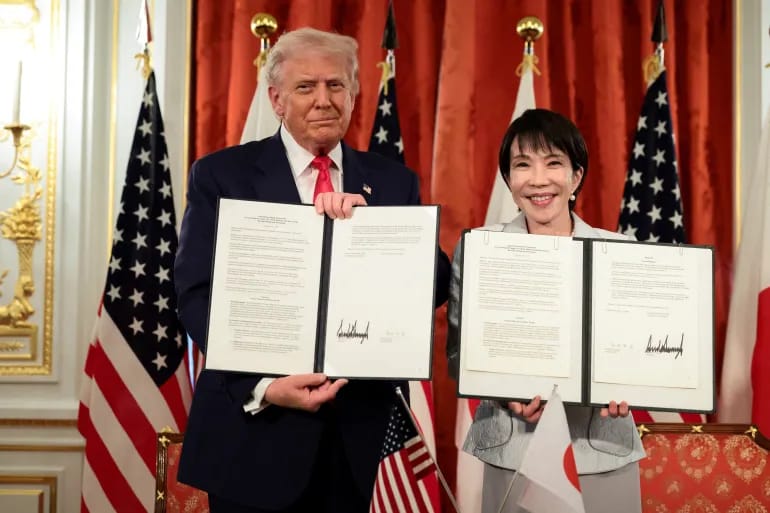
Donald Trump found a willing partner in Tokyo on Tuesday, as Japan’s newly minted Prime Minister Sanae Takaichi deployed flattery, golf memorabilia and a promise to nominate the American president for a Nobel Peace Prize while securing agreements on military buildup and mineral supply chains.
The meeting at the ornate Akasaka Palace marked Takaichi’s debut on the global stage as Japan’s first female leader, and she came prepared. According to the White House, she told Trump she plans to put his name forward for the Nobel, citing what she called his “unprecedented” achievements in brokering ceasefires between Cambodia and Thailand, and between Israel and Palestinian factions.
“In such a short period of time, the world started to enjoy more peace,” Takaichi said through an interpreter, adding: “I, myself, was so impressed and inspired by you, Mr President.”
Trump, never one to deflect praise, reciprocated enthusiastically. “Everything I know from Shinzo and others, you will be one of the great prime ministers,” he told Takaichi as they sat down with their respective delegations. “I’d also like to congratulate you on being the first woman prime minister. It’s a big deal.”
The reference to Shinzo Abe carried weight beyond pleasantries. Takaichi is a protégé of the assassinated former prime minister, who cultivated an unusually close relationship with Trump during his first term—one built partly on shared rounds of golf. She brought tangible reminders of that bond: Abe’s putter, a golf bag signed by major champion Hideki Matsuyama, and a gold-leaf golf ball, gifts that Trump’s assistant Margo Martin showcased on social media.
But beneath the ceremonial warmth lay hard-nosed strategic calculations. Takaichi arrived bearing a $550 billion investment package designed to preempt Trump’s potential demands that Japan shoulder more of its own defense costs. Reuters reported the offer includes commitments to American shipbuilding, increased purchases of soybeans, natural gas and pickup trucks—the kind of tangible economic wins Trump prizes.
Read also: Trump Japan Visit Begins With Royal Welcome And Trade Focus
More critically, Takaichi pledged last week to accelerate Japan’s defense spending to 2 percent of GDP, matching NATO benchmarks and addressing Trump’s longstanding complaint that allies don’t pay their fair share. That commitment takes on urgency as China’s military assertiveness grows in the East China Sea, where Tokyo administers disputed islands that Beijing claims.
Trump acknowledged Japan’s defense equipment purchases, though he stopped short of declaring Tokyo’s spending adequate. The two leaders then signed an agreement targeting a more existential vulnerability: both countries’ dependence on China for critical minerals and rare earths essential to modern electronics and weapons systems.
The White House statement framed the deal as pursuing “resilience and security of critical minerals and rare earths supply chains.” Practically, it means the U.S. and Japan will “jointly identify projects of interest to address gaps” in obtaining materials for permanent magnets, batteries, catalysts and optical systems—the technological building blocks China has weaponized through export controls.
Beijing currently dominates global rare earth processing, giving it leverage that both Washington and Tokyo are desperate to diminish. The agreement signals a coordinated effort to develop alternative sources, though actually building those supply chains will require years and enormous capital investment.
The leaders’ schedule reinforced the visit’s security dimension. They plan to tour the Yokosuka naval base near Tokyo, home to the aircraft carrier USS George Washington—a potent symbol of American military commitment to the region and a reminder to Beijing that Washington isn’t withdrawing from the Western Pacific despite Trump’s transactional approach to alliances.
Trump will meet Tokyo business leaders before departing Wednesday for South Korea, where he’s scheduled to sit down with Chinese President Xi Jinping. He’s indicated he hopes those talks will produce a trade war truce between the world’s two largest economies—a negotiation that could test whether his alliance-building in Tokyo and Seoul gives him leverage over Beijing or whether China plays the regional powers against each other.