
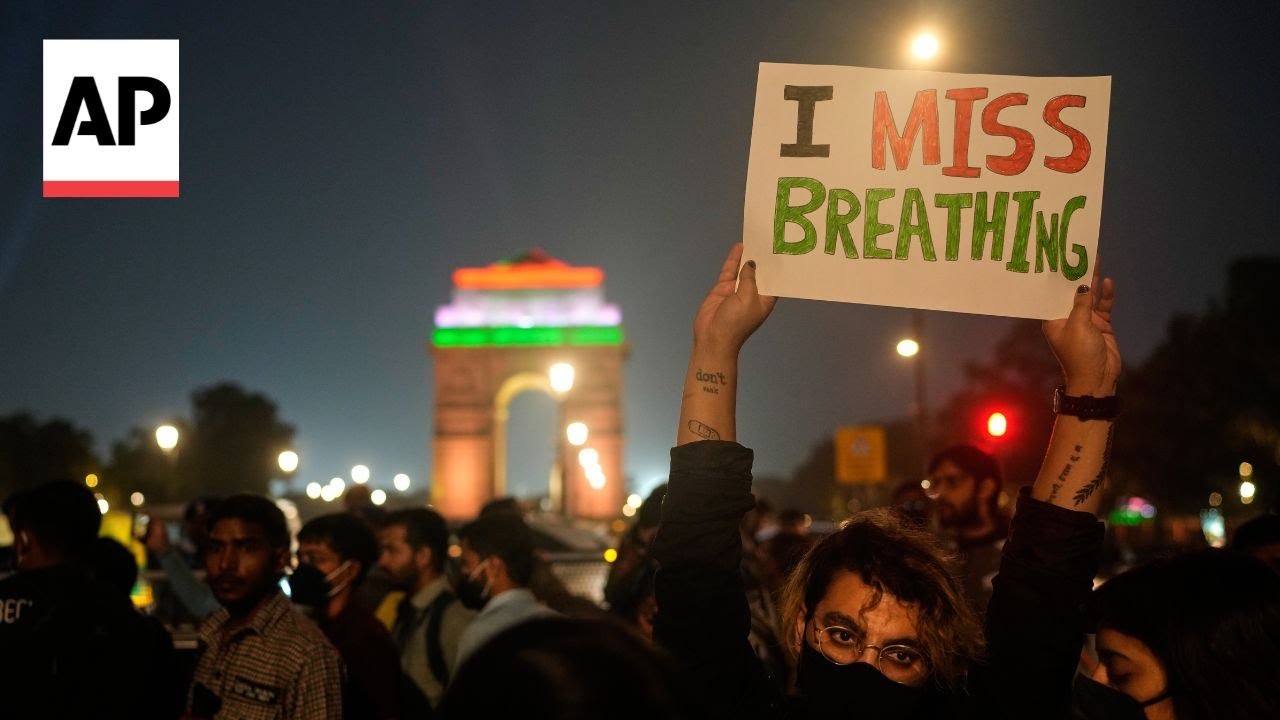
Residents of India’s capital took to the streets this weekend to demand government action as a thick blanket of toxic smog once again engulfed New Delhi, sending air pollution levels to “very poor” and “severe” categories.
Hundreds of protesters gathered at the India Gate monument on Sunday, holding banners and chanting slogans calling for “clean air now.” The rare demonstration underscored growing frustration over the government’s inability to curb the city’s recurring pollution crisis. Police detained several demonstrators and dispersed the rest, according to local reports.
By Monday morning, New Delhi’s Air Quality Index (AQI) had surpassed 350, according to India’s Central Pollution Control Board, placing it firmly in the “very poor” range. In some parts of the city, the index exceeded 400, a level classified as “severe” and considered hazardous to health.
Each winter, pollution levels in New Delhi spike as cooler air traps pollutants close to the ground. The crisis is largely driven by a combination of crop burning, vehicle emissions, industrial smoke, and construction dust.
Farmers in neighboring states like Punjab and Haryana often burn leftover crop stubble after harvest, and the smoke drifts into Delhi, where it mixes with urban pollution and moisture to form a dense smog layer.
Read Also: India And US Seal 10-Year Defence Pact Amid Trade Tensions
According to IQAir, a Switzerland-based global air monitoring organization, India is home to six of the world’s 10 most polluted cities, with New Delhi ranking as the most polluted capital globally.
“The right to clean air is a basic human right,” opposition leader Rahul Gandhi wrote on X, criticizing how police handled protesters.
Government officials defended their response, saying efforts are ongoing to curb emissions and protect residents. “We will continue every possible effort to prevent pollution,” said Manjinder Singh Sirsa, India’s environment minister under Prime Minister Narendra Modi’s Bharatiya Janata Party.
Authorities have activated a tiered emergency plan that restricts construction activity, bans diesel generators, and limits the number of vehicles allowed on the roads when pollution levels rise to dangerous levels.
However, previous mitigation efforts, including subsidies to discourage crop burning and a cloud seeding experiment to trigger artificial rainfall, have yielded little success. The cloud seeding attempt last month failed to generate rain or reduce pollution levels.
Doctors have long warned that Delhi’s worsening air quality causes respiratory illnesses, heart problems, and shortened life expectancy. Studies by India’s medical research agencies estimate that air pollution contributes to tens of thousands of premature deaths each year in the capital region alone.
The economic cost is also significant. A 2023 report by The Energy Policy Institute at the University of Chicago estimated that India’s poor air quality reduces average life expectancy by 5.3 years, with Delhi residents losing more than 10 years compared to WHO standards.