
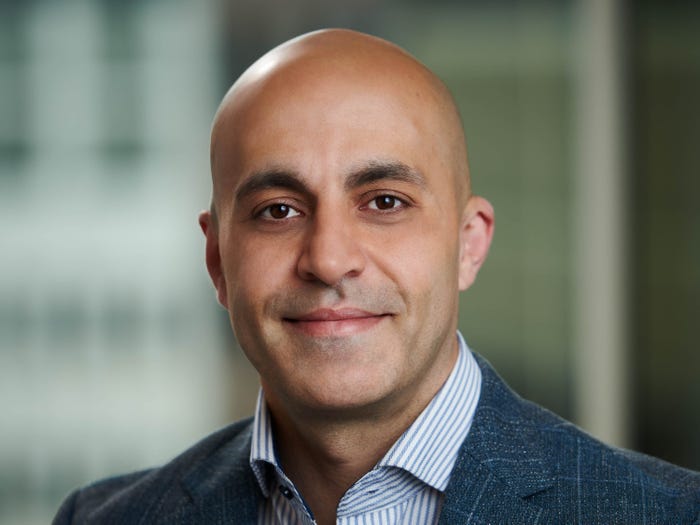
Databricks CEO Ali Ghodsi says AI systems already meet past definitions of AGI, accusing Silicon Valley of shifting standards as debate over superintelligence grows.
Databricks chief executive Ali Ghodsi has reignited one of the tech industry’s most contentious debates, arguing that artificial general intelligence — long viewed as a distant goal — has already been achieved.
Speaking at Goldman Sachs’ Communicopia + Technology Conference, Ghodsi said contemporary AI systems, including advanced chatbots, already satisfy the criteria researchers used a decade ago to describe Artificial General Intelligence (AGI): the ability to reason in ways comparable to humans.
“Everybody would say yes, but we kept moving the goalposts,” he said in remarks published Tuesday November 18, 2025. “Since we kind of achieved it, let’s come up with something even bigger,” he added, suggesting that Silicon Valley shifted its focus to “superintelligence” once earlier benchmarks were met.
Ghodsi, who holds a PhD in computer science, argued that while researchers now chase systems far smarter than humans, the fixation is “misdirected.” He said companies do not need machines capable of outthinking world-class experts. Instead, he said today’s AI is already powerful enough to automate workflows and support complex digital agents — provided firms invest in “the boring work” needed to deploy it effectively.
Read Also: “AI vs AI: How Smart Systems Are Fighting Crypto Fraud Surge”
His comments come as Databricks experiences rapid growth. The San Francisco-based data and AI firm raised $1 billion in September at a valuation above $100 billion, reinforcing its position among the most valuable private tech companies.
Ghodsi also cautioned that the explosive progress of recent years has slowed. The scaling laws that propelled breakthroughs in large language models have “come to a stop,” he said, adding that newer systems such as OpenAI’s GPT-5 and Anthropic’s Claude 4 are not delivering the dramatic leaps many expected.
“It’s getting harder and harder to get value out of the next pre-trained giant model,” he said.
His remarks land in the middle of a growing philosophical divide in the industry. Some leaders argue superintelligence should not be pursued at all. Mustafa Suleyman, CEO of Microsoft AI and cofounder of DeepMind, recently said superintelligence should be treated as an “anti-goal,” warning that systems far more capable than humans would be extremely difficult to control.
Others remain determined to push ahead. OpenAI CEO Sam Altman has repeatedly said the company is building toward superintelligence, calling it a potential catalyst for extraordinary scientific and economic progress. Google DeepMind cofounder Demis Hassabis has suggested AGI could emerge within five to ten years.
The debate is now defining the direction — and ambition — of the global AI race.