
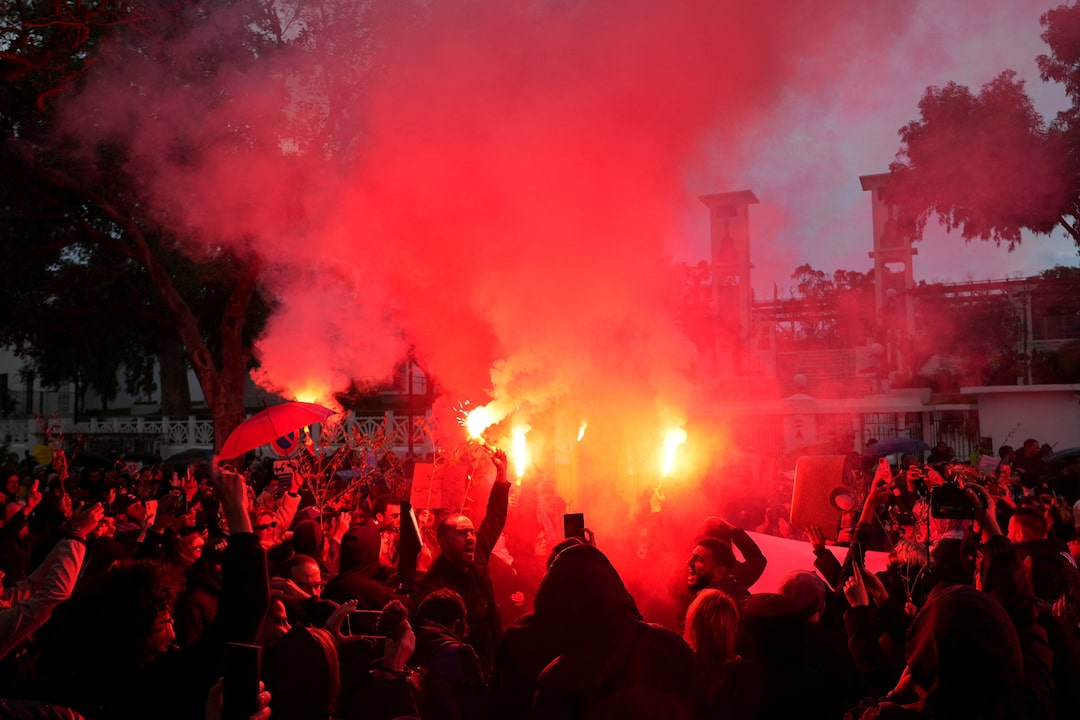
At least 2,000 protesters flooded Tunis streets Saturday, dressed in black and brandishing whistles and red ribbons, in a rare unified demonstration against President Kais Saied’s tightening grip on power and the imprisonment of government critics.
Marchers chanted “the people want the fall of the regime” and “no fear no terror, the street belongs to the people”—slogans echoing the 2011 Arab Spring uprising that toppled dictator Zine El Abidine Ben Ali. Placards declared “Enough repression” and “Not my president” as activists, NGOs and fragmented opposition parties set aside ideological differences to rally under the banner “against injustice.”
The demonstration followed a Tunisian court’s decision weeks earlier to sentence Ahmed Souab, a former administrative judge and vocal critic of judicial politicization, to five years in prison—one of dozens of opposition figures, journalists, lawyers and businesspeople jailed on accusations of “conspiring against state security.”
Tunisian journalist Said Zouari told Al Jazeera the protests revealed newfound unity among ideologically diverse groups. “But these protests are not finding any echo in the Carthage Palace,” he said, referring to the presidential residence where Saied has consolidated power since suspending parliament in 2021.
Critics accuse the 70-year-old president of weaponizing the judiciary and police against political opponents, dismantling democratic gains achieved in the birthplace of the Arab Spring. “All the progress of the past 14 years has been overturned,” said Ayoub Amara, a protest organizer. “Tunisia is big enough for all Tunisians, and no single person can rule it according to his whims.”
Monia Brahim, whose husband Abdelhamid Jlassi is detained as an opposition figure, joined the march because “many Tunisians are facing deep injustice.” She told The Associated Press: “Political prisoners know for a fact that they are in prison to pay the price for their principles, their constitutional right for civil and political activism, and are being held hostage by the regime established today in Tunisia.”
Read also: Tunisia’s President Inaugurated For Second Term Amidst Protests
Some detainees have launched hunger strikes, including constitutional law professor Jaouhar Ben Mbarek, who has refused food for over 20 days. Saturday’s march formed part of broader nationwide protests over political and economic turbulence under Saied’s rule. Thursday saw journalists demonstrate against widening press freedom restrictions and temporary suspension of several prominent civil society organizations.
Saied won democratic election in 2019, succeeding Beji Caid Essebsi, who died that year. The president suspended parliament and concentrated all governmental branches under his authority in 2021 before prosecuting political opponents and former officials.
Early crackdowns targeted the Ennahdha Party, which had formed part of Essebsi’s governing coalition. Courts handed multiple prison sentences to Ennahdha leader and former Parliament Speaker Rached Ghannouchi in cases supporters characterize as politically motivated.
Even Saied’s former allies haven’t escaped persecution. Nadia Akacha, his ex-chief of staff once considered among his closest and most influential aides, received a 35-year prison sentence in absentia last July.
Rights organizations accuse Saied of systematically suppressing Tunisian civil society. Amnesty International stated earlier this month that crackdowns on rights groups have reached critical levels, with arbitrary arrests, detentions, asset freezes, banking restrictions and suspensions targeting 14 NGOs.
Human Rights Watch reports more than 50 people—including politicians, lawyers, journalists and activists—have faced arbitrary arrest or prosecution since late 2022 for exercising freedom of expression, peaceful assembly or political activity. The group warned that broad antiterrorism and cybercrime legislation is being exploited to criminalize dissent and silence free speech.
The protests highlight Tunisia’s dramatic reversal from its post-2011 democratic experiment. Once celebrated as the Arab Spring’s sole success story, the country has watched Saied dismantle institutional checks on executive power while imprisoning those who challenge his authority.