
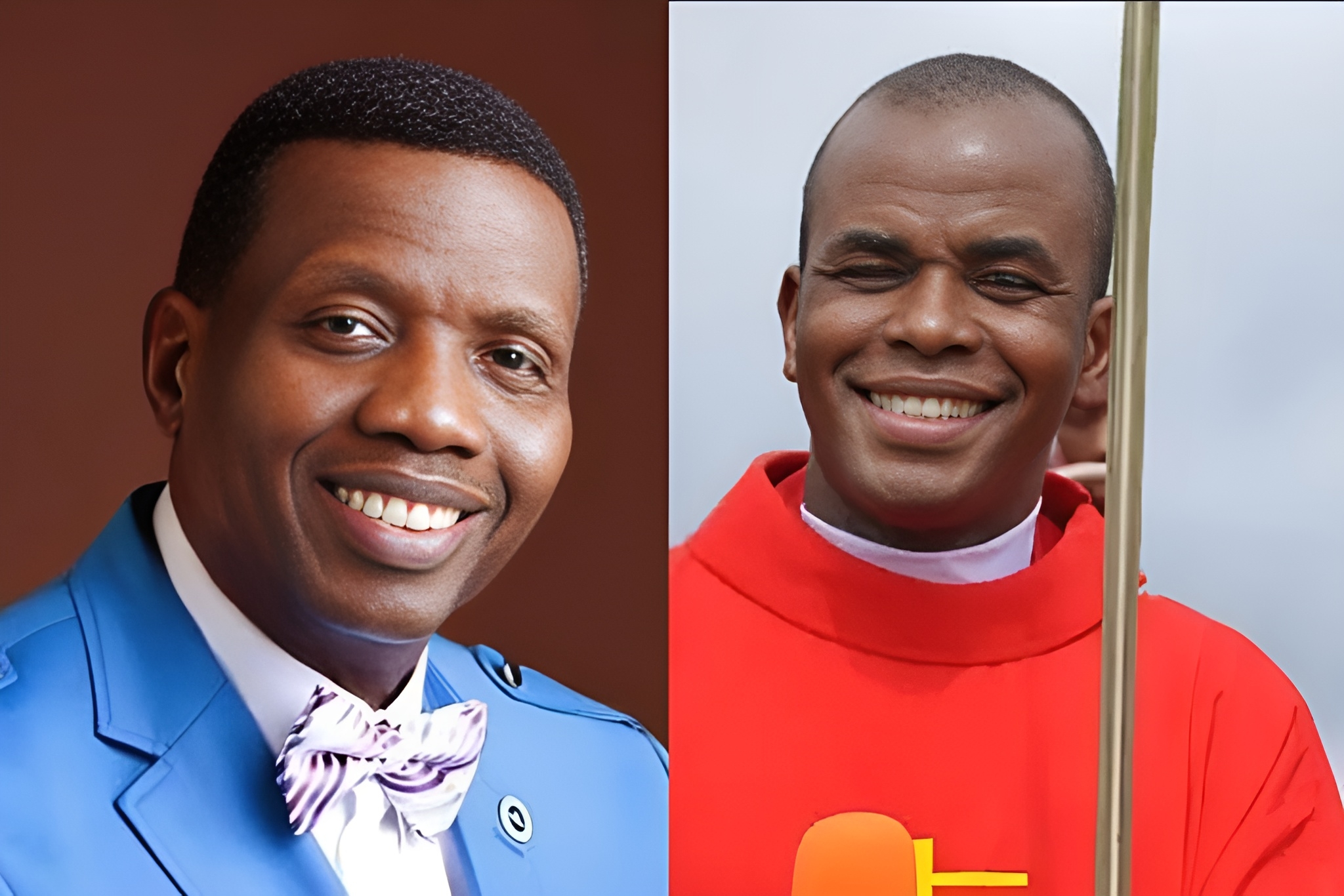
Every December in Nigeria, the nation pauses, church halls overflow, television sets flicker in millions of homes, and expectant hearts lean forward for the yearly revelation season. It is a familiar ritual: voices rise from glittering pulpits, the air thick with incense, emotion, and hope. At the center of this national theatre stand two men—Pastor E.A. Adeboye, patriarch of the Redeemed Christian Church of God, and Rev. Fr. Ejike Mbaka, fiery oracle of the Adoration Ministry. Their prophecies for 2026 promise renewal, divine favour, economic resurrection, and deliverance from unseen enemies. Cameras pan across tearful faces as congregations applaud and record on smartphones, clutching each word as destiny. But behind the stage lights and chants of “Amen!” lies a sobering pattern: the same predictions recycled yearly, untethered to fact, insulated from accountability. What masquerades as revelation has become ritual—an industry of emotional relief marketed as spirituality, hope sold by the sermon.
1. Economic Predictions vs. Economic Data
Both men have repeatedly forecast national economic turnarounds.
● Adeboye’s 2024 prophecy spoke of “the wind of prosperity” and “a reduction in hardship.”
○ Reality: Nigeria’s National Bureau of Statistics (NBS) reported inflation climbing from 28.9 % in December 2023 to 33.3 % by mid-2024, the highest in 27 years. Food inflation exceeded 40 %. The naira lost more than half its value against the dollar between June 2023 and May 2025.
○ Small-business sector: The SMEDAN survey for 2024 showed over 2 million MSMEs shut down operations because of fuel subsidy removal and rising costs—hardly the “blossoming” predicted.
● Mbaka’s annual declarations of “open doors” and “supernatural wealth transfer” likewise contrast with unemployment figures that remained above 33 % through 2024–25 (NBS Labour Force Survey).
Economic recovery in 2026 would require policy reform, not prophecy.
Read also: Africa’s Hidden Billions: The New Capital Flows
2. Migration Realities: The Myth of “Reverse Japa”
Adeboye’s claim that Nigerians abroad would begin returning (“Japada”) ignores verified migration trends.
● Data from Nigeria’s Diaspora Commission (NiDCOM) and the UK Home Office show the opposite: the number of Nigerian students granted UK visas rose from 59 000 in 2021 to 141 000 in 2024, and Canada admitted more than 20 000 new permanent residents from Nigeria that year—its highest ever.
● World Bank remittance data confirm continued outward movement: remittances hit US $21 billion in 2024, up from $19 billion in 2023, a clear sign that the diaspora is expanding, not shrinking.
The data simply do not support any “reverse Japa” phenomenon.
3. Weather and Global-Conflict Claims
Adeboye predicted “similar weather to 2025” and “less chance of major war.”
● Weather outcomes are matters of meteorological science, not revelation. The Nigerian Meteorological Agency (NiMet) and World Meteorological Organization release yearly outlooks based on satellite models, which any member of the public can review.
● On wars: 2025 still saw active large-scale conflicts in Ukraine, Sudan, and Gaza, with global defense spending reaching a record US $2.6 trillion (Stockholm International Peace Research Institute). None of these trends turned downward because of religious prediction.
4. Spiritual Rhetoric and Emotional Relief
Fr. Mbaka’s themes—“Year of Favour,” “Victory over Pharaoh,” “All Things New”—follow a consistent emotional formula rather than measurable foresight. Similar proclamations have been issued almost yearly since 2015. Followers often recall the 2020 “prophecy” of “unprecedented prosperity,” which coincided with a pandemic, oil-price crash, and national recession. When outcomes fail, explanations usually shift to claims that “people did not pray enough,” moving the goalposts beyond verification.
5. Why Nigerians Keep Listening
Sociologists of religion note that in countries with high poverty and weak public trust, prophetic authority replaces empirical reasoning. A Pew Research Center (2023) survey found that 83 % of Nigerian Christians believe “prophecies can accurately predict national events.” Yet repeated inaccuracies rarely diminish followership because the messages offer emotional hope amid economic despair.
6. A Call for Evidence-Based Faith
Faith and critical thinking are not enemies. The problem is not spirituality but blind credulity. The scriptures themselves warn that “by their fruits you shall know them.” Citizens must measure every prophetic statement against transparent data: inflation rates, employment statistics, migration records, and scientific forecasts. When a prophecy consistently fails empirical testing, it ceases to be revelation and becomes performance.
7. Moving Forward
Nigeria’s transformation will not emerge from the echo chambers of self-styled prophets or the annual theater of “divine declarations.” It will come from the disciplined labor of governance, accountability, and an enlightened citizenry. No nation has ever been built by wishful preaching. These so-called men of God have turned the sacred art of prophecy into a franchise—profiting from fear, disguising commerce as spirituality, and substituting spectacle for substance. Their pulpits have become stages, their prophecies recurring scripts. Each year, they recycle vague promises of breakthrough and favour while the nation sinks deeper into poverty and disillusionment.
True prophecy does not flatter power or numb the masses with false comfort. It unsettles injustice, speaks truth to authority, and calls a people to moral awakening. But what we hear now are not prophets—they are businessmen of belief, charlatans in cassocks.
Nigeria does not need more predictions; it needs principles. The revival we crave will not descend from heaven; it must rise from integrity, policy, and courage. The wind that must blow stronger in 2026 is not mystical—it is the wind of truth, reason, and collective responsibility. Only when citizens stop outsourcing their destiny to deceivers will Nigeria begin its real redemption.
Professor MarkAnthony Ujunwa Nze is an internationally acclaimed investigative journalist, public intellectual, and global governance analyst whose work shapes contemporary thinking at the intersection of health and social care management, media, law, and policy. Renowned for his incisive commentary and structural insight, he brings rigorous scholarship to questions of justice, power, and institutional integrity.
Based in New York, he serves as a full tenured professor and Academic Director at the New York Center for Advanced Research (NYCAR), where he leads high-impact research in governance innovation, strategic leadership, and geopolitical risk. He also oversees NYCAR’s free Health & Social Care professional certification programs, accessible worldwide at:
https://www.newyorkresearch.org/professional-certification/
Professor Nze remains a defining voice in advancing ethical leadership and democratic accountability across global systems.