
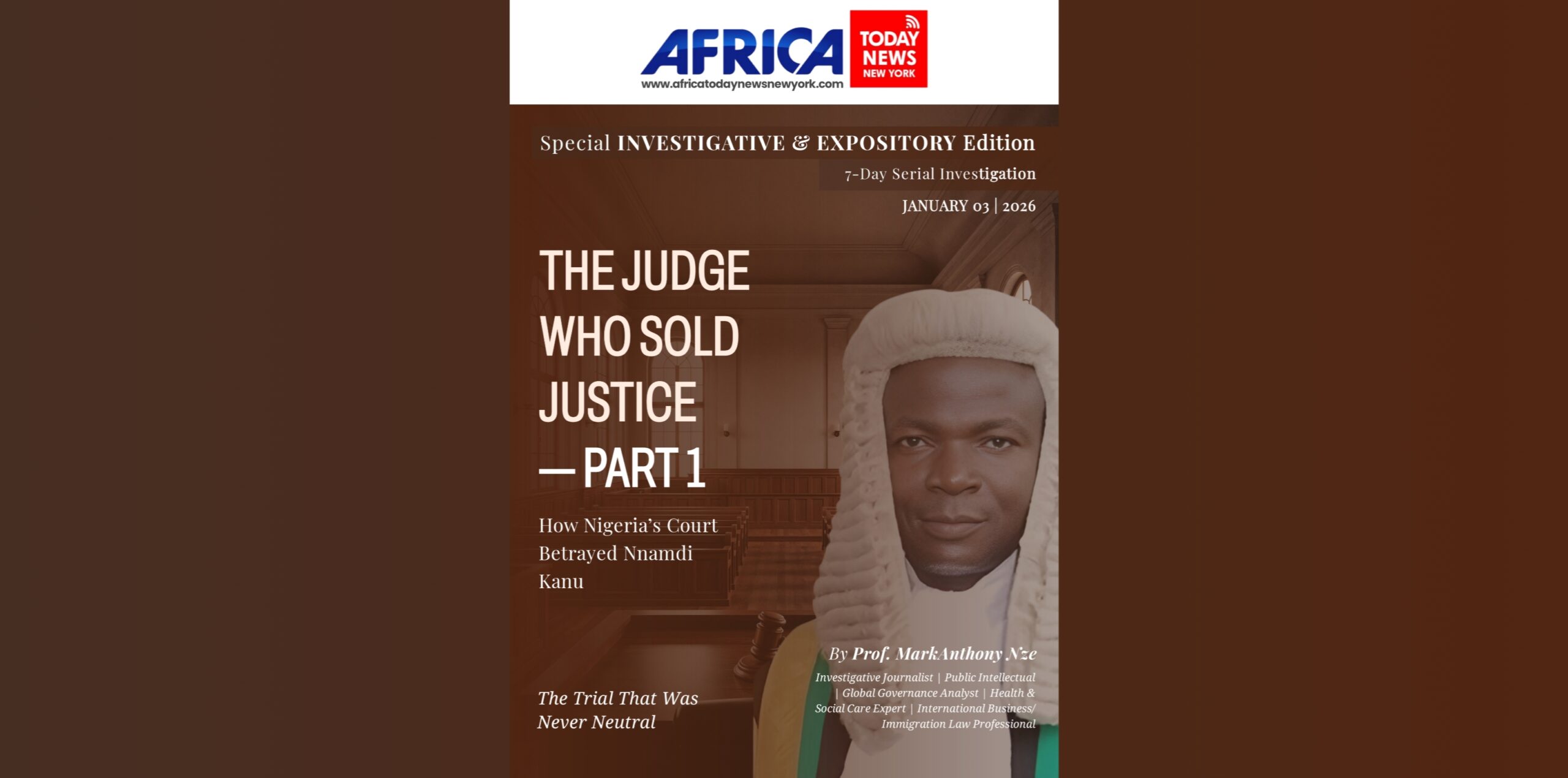
The Trial That Was Never Neutral
A Courtroom Is a Lie Detector
Every serious courtroom functions like a lie detector but not for defendants or witnesses. It tests institutions. It measures whether a judiciary still possesses the courage to restrain power or whether it has quietly accepted a different role: to smooth power’s path. In those moments, the law stops being an instrument of judgment and becomes an instrument of comfort for authority. The courtroom reveals this not through drama, but through posture—through what it interrogates, what it tolerates, and what it refuses to confront.
The prosecution of Nnamdi Kanu exposed that truth with unsettling precision. This was not a proceeding undone by legal ambiguity or doctrinal confusion. The law was clear enough. What failed was neutrality. It was not torn away in a single moment; it was eased aside—early, gently, and repeatedly. What emerged was not justice delayed or justice denied, but justice rehearsed: a performance arranged to resemble legality while advancing a political destination already agreed upon. This investigation is not animated by ideology, loyalty, or sentiment. It is driven by mechanics. It examines how power moves through institutions, how procedure can be bent without being broken, and how courts can appear active while surrendering their essential function. The question at the center of this inquiry is deliberately narrow, and therefore dangerous: did the court behave as a court, or did it behave as something else wearing judicial robes?
The answer is not found in a single ruling or transcript line, but in the accumulation of choices—what was scrutinized, what was hurried, and what was allowed to pass without resistance. Taken together, those choices form a pattern that no amount of formal language can disguise. The evidence does not merely suggest failure; it reveals a transformation. The court did not collapse. It adjusted. And in that adjustment, it ceased to judge.
Neutrality Is Not a Mood — It Is a Discipline
Judicial neutrality is often misunderstood as temperament. It is not.
It is a discipline of method: equal scrutiny, symmetrical patience, procedural fairness applied regardless of consequence. In difficult cases, neutrality is not easier—it is harder. That is why it matters most when the defendant is unpopular and the state is impatient. From the earliest stages of this trial, that discipline fractured.
Procedural safeguards—normally treated as non-negotiable—were approached as obstacles to be managed. Timelines appeared elastic when state convenience demanded it and rigid when the defense sought relief. The courtroom atmosphere conveyed direction rather than deliberation. The judge did not appear to be asking, What does the law require? but rather, How do we move this forward? That distinction is fatal in constitutional adjudication.
Predetermination Leaves a Signature
Predetermination is rarely announced. It leaves signatures. It appears in how interruptions fall—who is cut off and who is indulged. It appears in which applications are treated as urgent and which are postponed into irrelevance. It appears in tone: the subtle shift from inquiry to instruction.
In this case, those signatures accumulated. Each individual decision could be defended in isolation. Together, they formed a pattern too consistent to dismiss as coincidence. Legal scholars have long warned that this is how courts surrender independence without declaring it—through incremental alignment rather than overt capitulation (Ayobami, 2023; Tijani, 2024).
The courtroom became directional. And direction is not neutrality.
Security as the Master Key
Every captured judiciary has a master key. In Nigeria, that key is national security.
Once invoked, security reframes the entire legal environment. Rights become conditional. Due process becomes negotiable. Judicial skepticism is replaced by judicial accommodation. Scholars documenting Nigerian constitutional practice have shown how security rhetoric routinely compresses judicial scrutiny precisely when it should expand (Onnajiofor & Onnajiofor, 2025; Wada, 2025).
The Kanu trial unfolded squarely within this logic. The more the case was rhetorically elevated as a threat, the more the court’s posture softened toward the state. The burden quietly shifted—from the prosecution proving its case to the defendant justifying his entitlement to procedural fairness.
That inversion is not lawful. It is political.
Silence Is Not Neutrality
Judges often defend their restraint by invoking professionalism.
But restraint is not silence, and professionalism is not passivity.
There were moments—clear, unmistakable moments—when the bench could have asserted constitutional authority. Moments when procedural imbalance could have been corrected. Moments when the court could have drawn a visible line between executive interest and judicial obligation. Each time, the line dissolved.
Silence filled the space where scrutiny should have been. And silence, in constitutional systems, is never neutral. It has direction. It benefits someone. In this case, it benefited power.
Comparative studies of transitional democracies show that courts most often fail not under overt dictatorship, but under anticipatory obedience—when judges internalize political expectations and act accordingly without being told (African Legal Research, 2024). That pattern fits here with uncomfortable precision.
Alignment Without Orders
No memo was needed. No instruction delivered.
The court’s behavior aligned seamlessly with the broader political climate—one in which state authority, cohesion, and control were elevated as overriding imperatives. Under the administration of Bola Ahmed Tinubu, courts operate within a narrative environment that prizes firmness and discourages deviation. But constitutional design assumes judges will resist narrative pressure, not absorb it.
What occurred here was absorption.
The court did not need to be told what outcome would be acceptable. It behaved as if it already knew. This is how judicial capture actually works—not through coercion, but through alignment masquerading as prudence.
Read also: The Judge Who Sold Justice—Intro
Selling Justice Without Money
There is a persistent myth that justice is sold only when money changes hands.
That myth protects far more damaging transactions. Justice is also sold when fear substitutes for principle. When career preservation outweighs constitutional duty.
When judges trade independence for institutional comfort.
No envelopes need to pass. The sale is quieter, cleaner, and more deniable. But the effect is the same: the court ceases to function as a check on power and becomes an instrument of its stabilization.
Empirical research across African judiciaries confirms this pattern. Courts that routinely accommodate executive preferences lose public trust faster than those that err openly, because accommodation corrodes legitimacy while preserving the illusion of legality (Awoyale, 2023).
The Cost Is Always Collective
When a court fails in a high-profile case, the damage does not remain contained. It radiates.
Citizens recalibrate expectations. Lawyers adjust strategies. Lower courts take cues. Over time, the legal system internalizes a new rule: Some cases are not meant to be fair.
That rule is lethal to the rule of law.
International observers and legal analysts have increasingly noted that Nigeria’s judiciary struggles most not with competence, but with courage (Independent Nigeria, 2025). The Kanu trial has become emblematic of that deficit—not because of who the defendant is, but because of what the process demonstrates.
A judiciary that cannot convincingly perform neutrality in politically charged cases will not be trusted to do so in ordinary ones.
What This Series Establishes
Part 1 establishes a foundational finding: this trial was never neutral.
Not because neutrality was impossible, but because it was abandoned—step by step, decision by decision, silence by silence. The court did not collapse under pressure. It adjusted to it.
Future parts will examine how due process was hollowed out, how judicial discretion was weaponized through delay and selectivity, and how individual choices accumulated into institutional failure.
Justice rarely dies loudly.
It dies politely, procedurally, and with impeccable formatting.
That is how it died here.
Professor MarkAnthony Ujunwa Nze is an internationally acclaimed investigative journalist, public intellectual, and global governance analyst whose work shapes contemporary thinking at the intersection of health and social care management, media, law, and policy. Renowned for his incisive commentary and structural insight, he brings rigorous scholarship to questions of justice, power, and institutional integrity.
Based in New York, he serves as a full tenured professor and Academic Director at the New York Center for Advanced Research (NYCAR), where he leads high-impact research in governance innovation, strategic leadership, and geopolitical risk. He also oversees NYCAR’s free Health & Social Care professional certification programs, accessible worldwide at:
https://www.newyorkresearch.org/professional-certification/
Professor Nze remains a defining voice in advancing ethical leadership and democratic accountability across global systems.
Selected Sources
Ajol, A. C. (2025). Nnamdi Kanu’s detention: A threat to Nigeria’s rule of law and separation of powers. African Journal of Political and Administrative Studies.
Ayobami, J. S. (2023). The relevance of natural law, human rights, and judicial independence in constitutional states. Strathmore Law Journal, 7(1), 45–63.
Awoyale, O. (2023). Enhancing rule of law and social justice through constitutional separation of powers in Nigeria. Ogun Journal of Legal Studies, 6(1), 21–38.
African Legal Research. (2024). Rule of law challenges in the Nigerian judiciary: A contemporary analysis. African Legal Research Journal.
Independent Nigeria. (2025, December). The imperative of judicial independence. Independent Nigeria.
Onnajiofor, O., & Onnajiofor, D. (2025). The reality and practice of separation of powers in Nigeria. African Journal of Law and Human Rights, 9(2), 1–19.
Reuters. (2025, March 21). Separatist Kanu faces new trial in Nigeria under fourth judge. Reuters.
Tijani, A. (2024). Judiciary and the doctrine of separation of powers in Nigeria. Covenant University Journal of Politics and International Affairs, 12(2), 196–216.
Wada, I. I. (2025). Balancing national security and civil liberties in Nigeria. African Journal of Law, Ethics, and Education, 4(1), 33–52.