
Case File: Pregnancy Loss
Recurrent Pregnancy Loss and Early Miscarriage
A single miscarriage is usually bad luck written in chromosomes, not a punishment a woman earned. Repeated loss is not bad luck — it is a file that deserves opening.
Few events in medicine are met with as much blame and as little explanation as miscarriage. A woman is told she lifted something, worried too much, ate the wrong food, offended someone, or simply has a “weak womb,” and each of these accusations arrives faster than any test. The truth is gentler and more useful. A single early miscarriage is overwhelmingly a matter of chance — a chromosomal error at the very start that was never survivable — and nothing the mother did caused it or could have prevented it. What changes the story is not one loss but a pattern of them, and a pattern earns something the blame never offers: an investigation.
Start with how common loss is, because the isolation around it is built on the myth that it is rare. Somewhere between one in six and one in eight recognised pregnancies ends in miscarriage, most of them early, and when the tissue of those early losses is examined, around half carry a chromosomal abnormality — an extra or missing chromosome that occurred by chance when egg and sperm combined. These are not inherited flaws or maternal failings; they are copying errors incompatible with life, and their frequency climbs as a woman ages because the eggs themselves age. This is the ordinary, unspoken biology behind most single miscarriages.
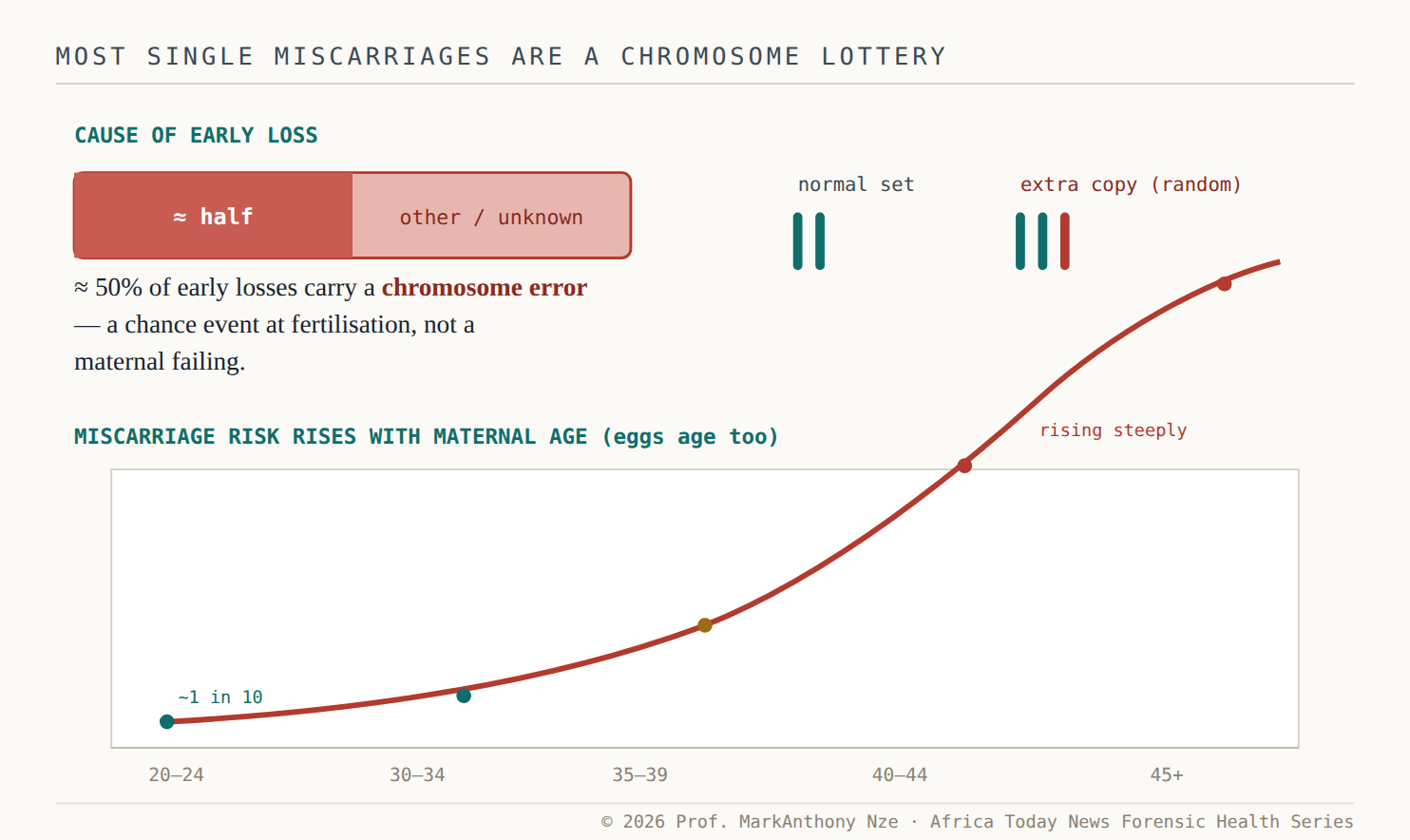
Fig. 25.1 Chance, not fault. About half of early losses are random chromosome errors, and the odds climb with maternal age as eggs age — biology, not behaviour, drives most single miscarriages.