
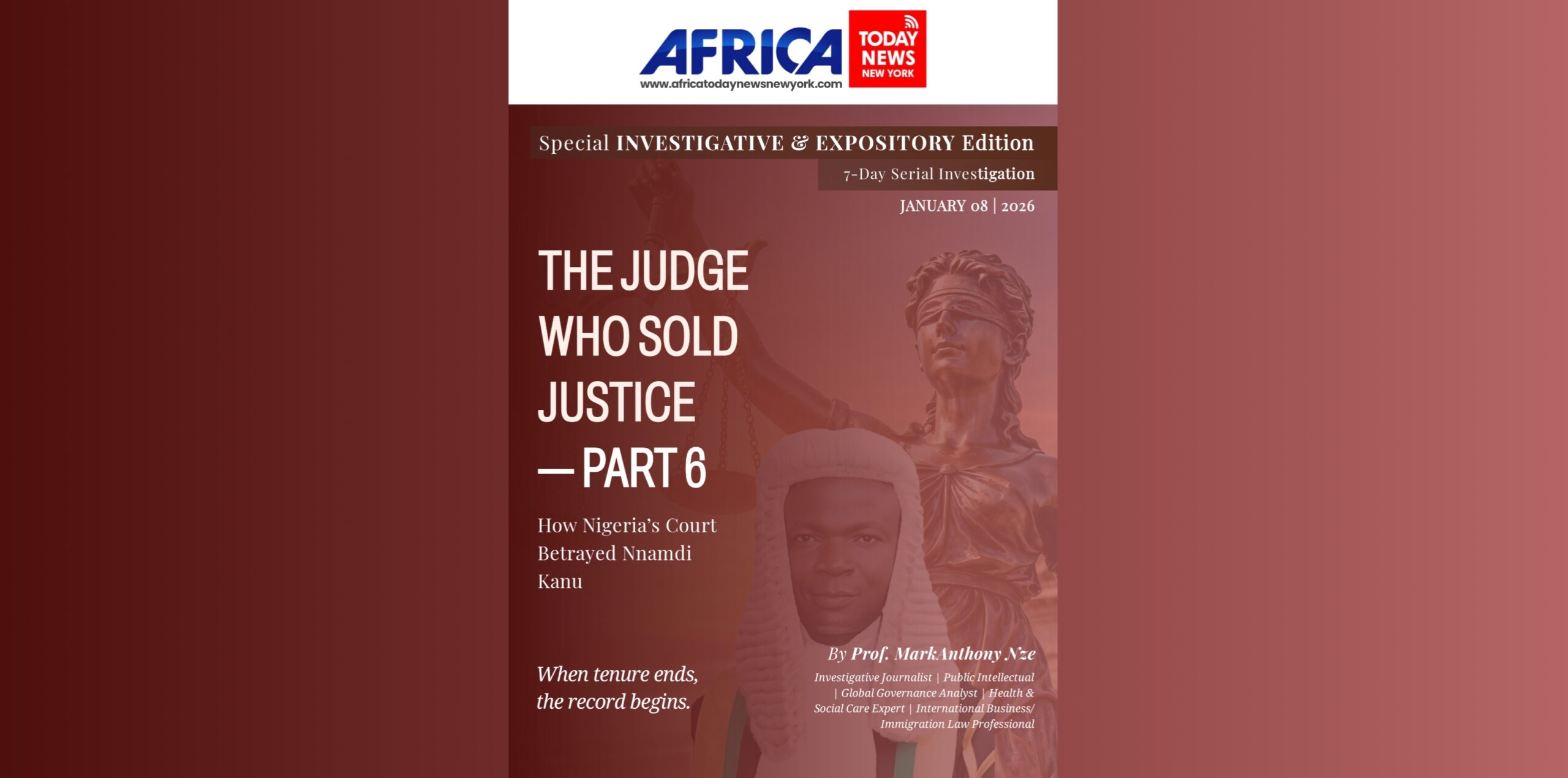
How History Will Remember the Judge
When tenure ends, the record begins.
Judges Do Not Retire From Consequence
Judges do not retire from history. They retire from schedules, from dockets, from the daily rituals of the bench—but not from consequence. The archive remains long after the robe is folded. Transcripts endure. Patterns harden. And history, unmoved by post-hoc explanations, renders its own verdict. This is the central burden of judicial office: authority is temporary; legacy is permanent.
The prosecution of Mazi Nnamdi Kanu will not persist as a passing controversy. It will endure as a test case of judicial character under pressure—an episode legal historians revisit precisely because neutrality carried a price. International standards frame this moment with clarity. Judicial independence, as articulated in the United Nations Basic Principles on the Independence of the Judiciary, is not a personal privilege but a public duty—owed most acutely when power presses hardest (United Nations, 2018). Independence exists to protect decision-making from fear and favor; it does not insulate judges from evaluation once the crisis has passed.
Independence Is a Duty, Not a Shield
That distinction is decisive. As the International Commission of Jurists emphasizes, decisional independence does not confer historical immunity. Judges may be shielded from retaliation, but they are not shielded from judgment when their conduct reveals sustained departures from fair-trial guarantees (International Commission of Jurists, 2020). Accountability, the Venice Commission explains, is as much historical as it is institutional: judges are assessed by posture as well as outcome—by whether they resisted pressure or absorbed it (European Commission for Democracy through Law, 2019).
Measured against those standards, the record surrounding Justice Binta Nyako Omotosho is not ambiguous. It is cumulative. History does not look for a single catastrophic ruling; it reads for patterns—how discretion is distributed, how silence clusters, and how intervention appears or disappears when it would be costly.
Procedure Versus Principle
Legal history does not ask whether a judge followed procedure mechanically. It asks whether procedure was deployed to protect rights or to pacify power. Lord Bingham’s formulation remains decisive: legality divorced from fairness is administration, not law (Bingham, 2019). Procedure is not a shield when substance collapses; it is an instrument whose use reveals purpose. Judges who retreat into form while rights erode do not escape responsibility by citing technical correctness; they incur it.
In this case, the procedure moved smoothly. Hearings progressed. Orders were issued. Yet smoothness is not the measure of justice. When a process functions as a conveyor belt rather than a filter—moving toward a destination rather than testing whether that destination is lawful—history marks the difference.
Read also: The Judge Who Sold Justice—Part 5
How Democracies Erode Through Courts
Comparative constitutional scholarship reinforces this austere arithmetic. Courts become historically culpable not when executives crush them, but when they normalize executive preference under the banner of restraint. Democratic erosion advances not by abolishing courts, but by keeping them open while draining their capacity to impose friction (Ginsburg & Huq, 2018). In moments of political stress, the judiciary’s vocation is not to manage outcomes but to resist them—by insisting on symmetrical scrutiny and visible independence.
The absence of friction is itself evidence. Where power expects deference, resistance must be visible to count. Where resistance is absent, accommodation becomes legible—even when couched in professionalism and calm.
Records of Alignment
Human rights monitoring bodies describe how reputations are formed from trajectories rather than isolated rulings. Judges who repeatedly accommodate state narratives in political cases leave “records of alignment” that outlast immediate controversy and define an era (Human Rights Watch, 2022). History maps interventions and silences, urgency and indulgence, skepticism and deference. It asks whether scrutiny clustered around moments of imbalance, and whether silence appeared precisely when speech was required.
On these metrics, the archive speaks with uncomfortable coherence. Patterns do not argue; they accumulate. And accumulation, in historical assessment, is decisive.
Survival Is Not Honor
The difference between judicial survival and judicial honor clarifies why this coherence matters. Survival is institutional; honor is historical. Survival asks whether a judge avoided sanction; honor asks whether the judge honored the purpose of the office when doing so carried cost. In pressured systems, judges often persuade themselves that quiet compliance preserves the institution. The evidence suggests otherwise. Judges remembered favorably are not those who preserved calm, but those who preserved principle when calm was purchased at the expense of fairness (International Bar Association, 2021).
This distinction is unforgiving. Institutions may applaud stability; history applauds courage.
Constraint Is the Test, Not the Excuse
This is why appeals to constraint fail under historical scrutiny. Constraints are the very conditions that define judicial courage. Neutrality, in such moments, is not passive; it is active resistance. To stand still while imbalance forms is not restraint—it is a choice. Waldron’s account of judicial responsibility captures the point with precision: courts exist to shoulder moral risk on behalf of society; when judges refuse that risk, they transfer it downward—to defendants, to minorities, to dissenters (Waldron, 2020).
That transfer is measurable. It appears in outcomes, in tone, and in who bears the consequences of judicial quietude.
Context Explains, It Does Not Absolve
Context explains behavior; it does not absolve it. Some will argue that executive dominance under President Bola Ahmed Tinubu created an environment in which judicial assertiveness carried cost. Comparative indices do not treat this as mitigating. Declines in judicial independence under dominant executives are warning signs, not excuses (Freedom House, 2024; V-Dem Institute, 2024).
Courts are remembered not for aligning with prevailing winds but for standing against them. Analyses of democratic erosion show that courts synchronizing with executive priorities during stress are later cited as accelerants of decline—not as victims of circumstance (McCoy & Somer, 2021).
What the Archive Will Reveal
What the archive will show is method rather than rhetoric. Scholars will read transcripts rather than press statements. They will compare what was demanded of the defense with what was indulged for the prosecution. They will examine how security claims were treated—whether interrogated with rigor or absorbed as tempo-setting assertions.
Judicial integrity, the UN Office on Drugs and Crime explains, is measurable by the consistency of skepticism; integrity collapses when skepticism becomes selective (UNODC, 2021). Selectivity, once documented, becomes legacy. It cannot be explained away by later commentary.
Public Trust and the Weight of Memory
Public trust follows the same evidentiary logic. According to the United Nations Development Programme, confidence in courts is built not by ceremonial affirmations of independence but by visible acts of courage in controversial cases (UNDP, 2022). When those acts are absent, trust erodes, and reputations harden accordingly.
Judges are remembered less by tenure and more by conduct under pressure; reputation is not self-assigned, it is conferred by evidence. The public, like history, learns from what it sees repeated.
A Cautionary Legacy
This is why Justice Omotosho’s legacy will not be written by retirement tributes or institutional commendations. It will be written by lawyers, scholars, and citizens who observed a bench choose accommodation over accountability, management over adjudication, and silence over intervention. By the standards that govern judicial ethics and democratic resilience, that is not a neutral legacy. It is a cautionary one.
History is an unforgiving editor. It cuts excuses, compresses complexity, and distills character from conduct. Courts that refuse moral risk pass that risk to those least able to bear it—and history notices the transfer even when courts decline to name it (Waldron, 2020).
What Part 6 Establishes
Part 6 establishes a sober and precise finding: the bench may move on, but the record will not. Decisions and silences have already entered the ledger. They will be cited, compared, and taught—not as exemplars of courage, but as illustrations of accommodation.
This is not about punishment; it is about remembrance. Judges do not retire from history. They meet it. And history, unlike the courtroom, does not grant adjournments.
Professor MarkAnthony Ujunwa Nze is an internationally acclaimed investigative journalist, public intellectual, and global governance analyst whose work shapes contemporary thinking at the intersection of health and social care management, media, law, and policy. Renowned for his incisive commentary and structural insight, he brings rigorous scholarship to questions of justice, power, and institutional integrity.
Based in New York, he serves as a full tenured professor and Academic Director at the New York Center for Advanced Research (NYCAR), where he leads high-impact research in governance innovation, strategic leadership, and geopolitical risk. He also oversees NYCAR’s free Health & Social Care professional certification programs, accessible worldwide at:
👉 https://www.newyorkresearch.org/professional-certification/
Professor Nze remains a defining voice in advancing ethical leadership and democratic accountability across global systems.
Selected Sources
African Commission on Human and Peoples’ Rights. (2020). Principles and guidelines on the right to a fair trial and legal assistance in Africa. ACHPR.
Bingham, T. (2019). The rule of law (Updated ed.). Penguin Books.
European Commission for Democracy through Law (Venice Commission). (2019). Judicial independence and accountability: Comparative perspectives. Council of Europe.
Freedom House. (2024). Freedom in the world 2024: Nigeria. Freedom House. https://freedomhouse.org
Ginsburg, T., & Huq, A. Z. (2018). How to save a constitutional democracy. University of Chicago Press.
Human Rights Watch. (2022). Nigeria: Judicial accountability and the legacy of political trials. Human Rights Watch. https://www.hrw.org
International Bar Association. (2021). Judges, history, and accountability: When tenure ends but records remain. IBA Human Rights Institute. https://www.ibanet.org
International Commission of Jurists. (2020). Judicial accountability and historical responsibility. ICJ. https://www.icj.org
McCoy, J., & Somer, M. (2021). Democratic erosion and the judiciary’s role in history. Journal of Democracy, 32(2), 5–19. https://doi.org/10.1353/jod.2021.0020
Reuters. (2025, March 21). Separatist Kanu faces new trial in Nigeria under fourth judge. Reuters. https://www.reuters.com
United Nations Basic Principles on the Independence of the Judiciary. (2018). Commentary and implementation. United Nations.
United Nations Development Programme. (2022). Judicial accountability, legitimacy, and public trust. UNDP. https://www.undp.org
United Nations Office on Drugs and Crime. (2021). Global judicial integrity report. UNODC. https://www.unodc.org
V-Dem Institute. (2024). Democracy report 2024: Judicial independence and accountability. University of Gothenburg. https://www.v-dem.net
Waldron, J. (2020). The rule of law and judicial responsibility in constitutional democracies. NYU Public Law Review, 13, 1–26.