
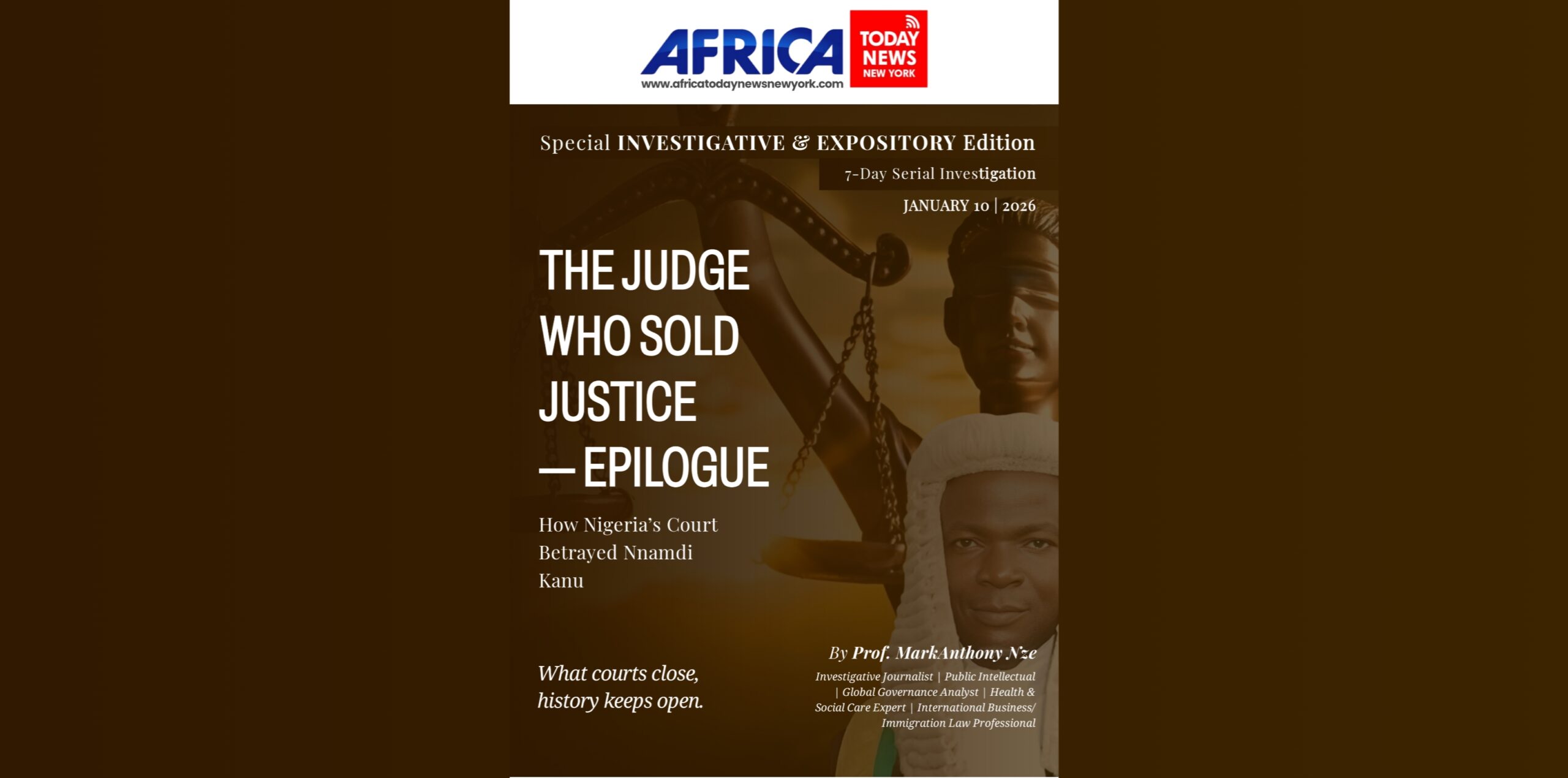
After the Gavel Falls
What courts close, history keeps open
By Prof. MarkAnthony Nze
The gavel always falls. What follows is what endures.
Institutions are designed to proceed. Courts clear dockets, judges rotate, administrations invoke continuity, and the legal system treats closure as a professional virtue. History does not. History waits. It rereads transcripts. It compares posture to principle and silence to consequence. It asks questions that no appeal court can dismiss as academic. In that slower, sterner forum, legitimacy is judged not by technical compliance but by moral coherence.
The prosecution of Mazi Nnamdi Okwu Kanu has crossed that threshold. It no longer belongs only to the logic of procedural completion. It has entered the public archive—the place where courts are measured by whether they persuaded society that power was restrained by law. As Lord Bingham warned, legality that cannot command public confidence is a hollow achievement; the rule of law lives or dies by the trust it earns (Bingham, 2019). Here, persuasion failed—and failure, once visible, does not dissipate with time.
Silence as the Final Exhibit
The most damaging evidence in compromised trials is rarely a document or a witness. It is silence. Silence at the precise moments when imbalance becomes visible. Silence when procedure hardens into choreography. Silence when rights are treated as inconveniences rather than guarantees.
International standards have long cautioned against this danger. Fair-trial violations arise not only through overt denial, but through judicial passivity that allows inequality of arms to persist unchecked (United Nations Human Rights Committee, 2018). Silence, in such moments, is not neutral. It is action by omission—directional and consequential. The UN’s guidance is explicit: judges are required to intervene when imbalance threatens fairness, not to preside politely over it (UNODC, 2022). Where intervention is withheld, the process does not remain impartial; it drifts.
In this case, silence did not preserve integrity. It completed its erosion.
What Institutions Teach Without Speaking
Institutions educate by example. Courts teach prosecutors how far to push, defense counsel which objections matter, and citizens what to expect when law meets power. When courts accommodate executive narratives without visible scrutiny, they teach compliance. When they refuse to intervene at moments of procedural imbalance, they teach resignation.
The consequences are measurable. The World Justice Project documents how rule-of-law decline accelerates when public expectations adjust downward—when citizens accept partial justice as normal because full justice appears unattainable (World Justice Project, 2024). That adjustment is not apathy; it is learning. People observe patterns and adapt. Institutional failure spreads quietly, rationally, and with devastating efficiency—without conspiracy, only repetition.
Memory Outlasts Tenure
Judges retire. Courts rotate. Governments change. Memory remains.
Judicial reputations are formed not by longevity or title, but by conduct during defining moments—especially political trials that test the boundary between independence and accommodation (International Bar Association, 2022). Titles expire. Records do not. The Venice Commission captures this reality with precision: judicial accountability is inseparable from public memory; visible failure cannot be erased by a return to routine (European Commission for Democracy through Law, 2021).
History remembers patterns, not excuses. Routine does not neutralize rupture. Normalcy does not undo what has already been taught.
The Cost of Denial
After public judicial failure, denial is tempting. It promises stability, avoids discomfort, and protects institutional pride. But denial is corrosive.
When institutions respond to visible failures with deflection rather than accountability, public trust erodes faster than before because citizens recognize the refusal to reckon as a second injury (Amnesty International, 2023). Reform rhetoric without acknowledgment deepens cynicism. Silence after exposure is no longer ignorance; it is choice. And choice, once perceived, reshapes legitimacy permanently.
Democratic repair does not begin with reassurance. It begins with admission—specific, uncomfortable, and complete.
Can Trust Be Rebuilt?
Yes—but not cheaply, and not quickly.
Comparative research shows that institutions regain legitimacy only when behavior changes, not when language does. Courts recover when they reassert their constraining role visibly, especially in cases where executives prefer quiet compliance (Ginsburg & Huq, 2018). Courage, once absent, must become observable to matter. Trust returns not by proclamation, but by proof.
The United Nations Development Programme reaches the same conclusion: confidence in courts is rebuilt through a sequence of decisions that demonstrate independence under pressure, not through campaigns or conferences (UNDP, 2023). One courageous ruling can matter more than a decade of procedural normalcy. But courage cannot be retroactive; it must arrive after failure, not be claimed before it.
Executive Comfort and Judicial Recovery
No recovery is possible without confronting executive dominance. Courts that internalize executive preference cannot reform themselves; they can only repackage compliance.
Global evidence is unambiguous. Democratic backsliding often follows a familiar pattern: executives consolidate influence while courts retreat into procedural minimalism—keeping institutions intact while draining their constraining force (V-Dem Institute, 2024). Recovery requires reversal. Freedom House shows that democracies arrest decline when courts reassert their role as constraints rather than collaborators (Freedom House, 2024). Friction is not a defect of constitutionalism; it is its proof.
Reform that leaves executive comfort untouched is not reform. It is postponement dressed as prudence.
Learning From Recovery—and Its Price
Judiciaries have recovered before. But never without cost.
Successful recovery depends on institutional memory—on courts internalizing lessons from failure and altering behavior accordingly. Where courts refuse to learn, decline accelerates; where they learn publicly, legitimacy can return, slowly and conditionally (Ginsburg & Huq, 2018). Human Rights Watch documents post-crisis recoveries in which courts restored credibility by revisiting flawed procedures, reopening space for dissent, and affirming rights in cases where executives preferred silence (Human Rights Watch, 2023). These acts did not erase the past; they redirected the future.
Recovery is not absolution. It is redirection.
Normalization: The Quietest Threat
The greatest danger after judicial failure is normalization. When citizens adjust expectations downward—accepting partial justice as the new normal—the rule of law hollows out even as institutions remain standing. The World Justice Project warns that normalization corrodes legitimacy more reliably than overt repression (World Justice Project, 2024). Courts continue to function; trust quietly drains away.
Normalization is seductive because it feels stable. It trains lawyers to self-censor, judges to self-limit, and citizens to self-abandon. Reform must therefore be disruptive. It must interrupt the habits that failure taught—habits of silence, accommodation, and selective skepticism.
Read also: The Judge Who Sold Justice—PART 7
The Legal Community’s Burden
Judicial recovery is not the responsibility of judges alone. Bar associations, senior advocates, academics, and civil society carry decisive weight. Silence from the legal community after high-profile failures compounds damage because it signals acceptance (International Commission of Jurists, 2021). Where lawyers treat compromised trials as awkward episodes best forgotten, courts interpret that silence as permission.
Conversely, where lawyers insist on standards publicly and persistently, courts feel pressure to recalibrate. The law polices itself—or it decays.
The Shadow Beyond the Case
Political trials cast long shadows. They shape international perception, domestic legitimacy, and future judicial behavior long after verdicts are delivered (Human Rights Watch, 2023). They become reference points—invoked by advocates, cited by scholars, remembered by citizens.
Reuters’ continued reporting underscores this reality: international attention has not faded because the issues exposed were not technical; they were structural (Reuters, 2025). Process, not personality, remains under scrutiny. The case will be cited not for its outcome, but for what it revealed about judicial posture under pressure.
History’s Accounting
History is not dramatic. It is precise.
Institutional reckoning occurs when archives are reopened, patterns are mapped, and responsibility is located—not to punish, but to understand how failure became possible (International Commission of Jurists, 2021). History does not ask whether judges intended harm. It asks whether they prevented it when they could.
Freedom House and V-Dem both caution that judicial accommodation during periods of executive dominance accelerates democratic backsliding (Freedom House, 2024; V-Dem Institute, 2024). Courts that choose comfort over confrontation do not stabilize democracies; they weaken them. That lesson will frame how this moment is remembered.
After Knowing, Silence Is Choice
The epilogue of every institutional failure is written not by the failure itself, but by what follows. After the truth is visible, silence is no longer ignorance; it is consent.
Judicial integrity frameworks succeed only when institutions confront uncomfortable facts and recalibrate conduct accordingly (UNODC, 2022). Without confrontation, frameworks become theater and memory becomes indictment. Once exposed, failure demands response.
Closing the Record
This series did not ask whether the law exists. It asked whether the law was used. It did not question the power of courts. It examined whether that power was exercised when it mattered.
The answer now resides in the public record.
What remains is choice—by institutions, by the legal community, by the state. Courts may declare closure, but history does not adjourn. The gavel has fallen. The archive is open. And history, indifferent to status or explanation, will do what it always does.
It will remember.
Professor MarkAnthony Ujunwa Nze is an internationally acclaimed investigative journalist, public intellectual, and global governance analyst whose work shapes contemporary thinking at the intersection of health and social care management, media, law, and policy. Renowned for his incisive commentary and structural insight, he brings rigorous scholarship to questions of justice, power, and institutional integrity.
Based in New York, he serves as a full tenured professor and Academic Director at the New York Center for Advanced Research (NYCAR), where he leads high-impact research in governance innovation, strategic leadership, and geopolitical risk. He also oversees NYCAR’s free Health & Social Care professional certification programs, accessible worldwide at:
👉 https://www.newyorkresearch.org/professional-certification/
Professor Nze remains a defining voice in advancing ethical leadership and democratic accountability across global systems.
Selected Sources
African Commission on Human and Peoples’ Rights. (2020). Principles and guidelines on the right to a fair trial and legal assistance in Africa. ACHPR.
Amnesty International. (2023). Nigeria: Restoring the rule of law and judicial accountability. Amnesty International. https://www.amnesty.org
Bingham, T. (2019). The rule of law (Updated ed.). Penguin Books.
European Commission for Democracy through Law (Venice Commission). (2020). Judicial accountability and discipline: Comparative analysis. Council of Europe.
Freedom House. (2024). Freedom in the world 2024: Nigeria. Freedom House. https://freedomhouse.org
Ginsburg, T., & Huq, A. Z. (2018). How to save a constitutional democracy. University of Chicago Press.
Human Rights Watch. (2023). Repairing judicial independence after political trials. Human Rights Watch. https://www.hrw.org
International Bar Association. (2022). Judicial reform after crisis: Rebuilding trust and legitimacy. IBA Human Rights Institute. https://www.ibanet.org
International Commission of Jurists. (2021). Accountability after capture: Can courts recover? ICJ. https://www.icj.org
McCoy, J., & Somer, M. (2021). Democratic erosion and democratic recovery. Journal of Democracy, 32(2), 5–19. https://doi.org/10.1353/jod.2021.0020
Reuters. (2025, March 21). Separatist Kanu faces new trial in Nigeria under fourth judge. Reuters. https://www.reuters.com
United Nations Development Programme. (2023). Rebuilding judicial trust in fragile democracies. UNDP. https://www.undp.org
United Nations Human Rights Committee. (2018). General Comment No. 32: Article 14 – Right to equality before courts and tribunals. United Nations.
United Nations Office on Drugs and Crime. (2022). Judicial reform and integrity frameworks. UNODC. https://www.unodc.org
V-Dem Institute. (2024). Democracy report 2024: Recovery, resilience, and judicial reform. University of Gothenburg. https://www.v-dem.net
World Justice Project. (2024). Rule of law index 2024: Constraints on government powers. World Justice Project. https://worldjusticeproject.org