
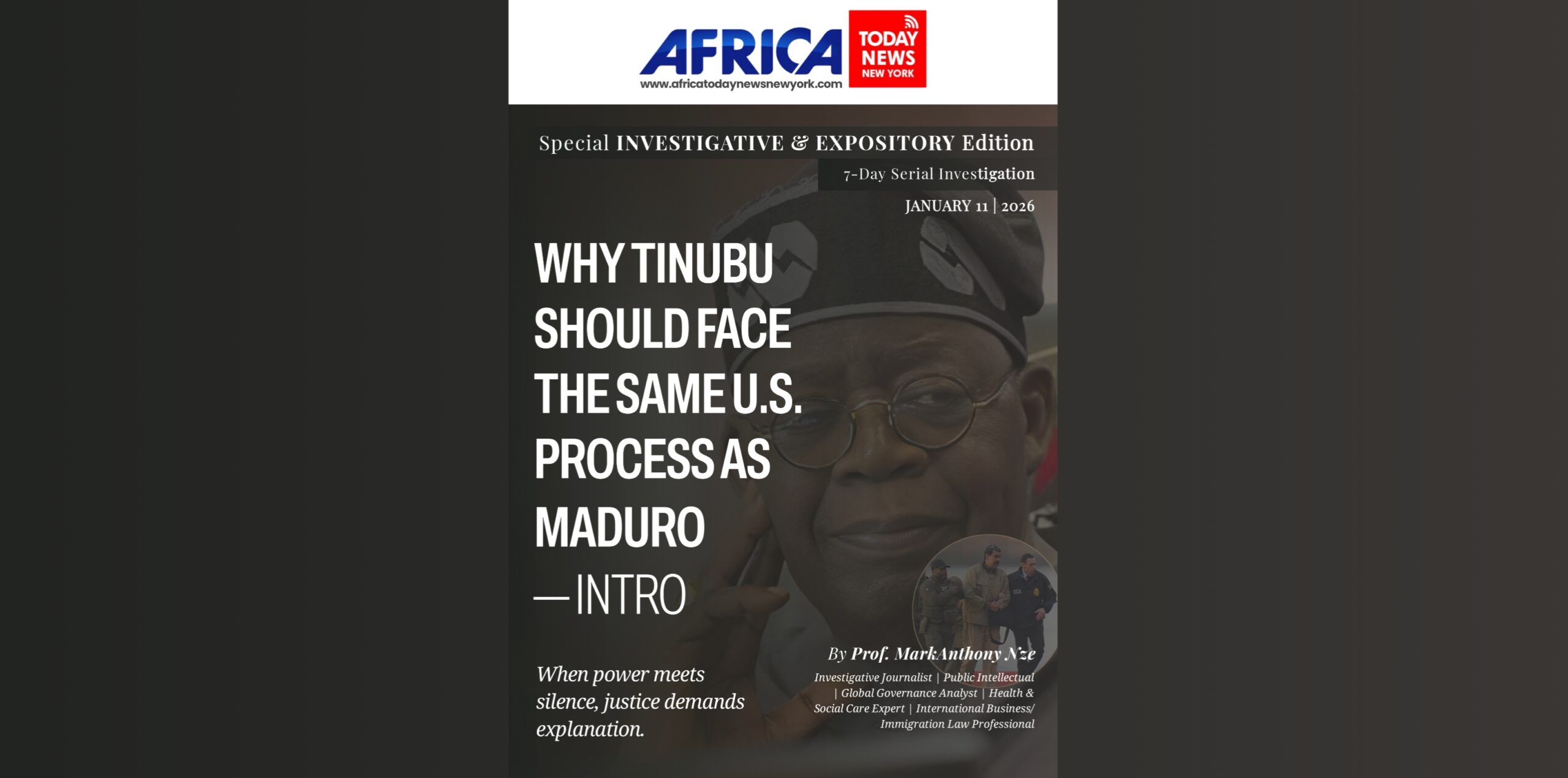
When power meets silence, justice demands explanation.
By Prof. MarkAnthony Nze
Justice rarely collapses in public. According to decades of U.S. judicial practice, it more often erodes quietly—inside files that stop moving, inside decisions never announced, inside records that exist but are never resolved. The most dangerous failure of the rule of law is not injustice declared, but justice withheld: procedurally, selectively, and without explanation.
This investigation begins with that silence.
According to the U.S. Department of Justice’s own enforcement architecture, American legal power expresses itself through process. It files sworn complaints. It invokes statutes. It assigns docket numbers. It submits claims to judges. As the Congressional Research Service has repeatedly emphasized in its analyses of forfeiture and criminal procedure, these steps are not symbolic gestures; they are the mechanisms through which state power becomes law.
That is why this series begins with a fact that is neither speculative nor contested: a formal U.S. legal record exists in which federal authorities invoked civil forfeiture and federal money-laundering statutes in relation to Bola Tinubu. According to federal court practice and Justice Department policy, such a record can only be generated by the government itself, under oath, within the jurisdiction of a U.S. court. It is not journalism. It is not activism. It is the state speaking in its own legal language.
Once such a record exists, the conversation changes. According to U.S. law, the issue ceases to be political and becomes procedural.
As defined by the Legal Information Institute at Cornell Law School, a verified forfeiture complaint signals that authorities believe they have crossed the constitutional threshold of probable cause—the same standard that authorizes arrests, searches, and seizures throughout the American legal system. According to the Justice Department’s Asset Forfeiture Policy Manual, probable cause does not establish guilt, but it does authorize action. It is the point at which inaction becomes legally indefensible.
Civil forfeiture exists precisely for this moment. According to both the Justice Department and the Congressional Research Service, forfeiture is designed for cases involving serious crime—often transnational—where criminal prosecution may be delayed or complex, but where the government believes illicit funds have entered the financial system. In that sense, forfeiture is not peripheral to enforcement. It is one of its earliest and most consequential tools. It is how attention becomes action.
The forfeiture complaint filed in 1993 in the Northern District of Illinois did exactly what such complaints are designed to do. According to the language of the filing itself, it asserted probable cause to believe that specific funds held in U.S. bank accounts were either proceeds of narcotics trafficking or involved in financial transactions prohibited by federal money-laundering statutes, including 18 U.S.C. §§ 1956 and 1957. As documented in U.S. Code and explained in Justice Department guidance, these statutes are the core provisions used to follow illicit money through the banking system.
This matters because statutes are commitments. According to U.S. prosecutorial doctrine, invoking them is not rhetorical; it engages a legal framework that carries procedural expectations.
Equally important is what the complaint did not do. According to established U.S. legal doctrine, civil forfeiture does not convict. It does not indict. It does not assign criminal liability. It targets property, not people. As scholars writing in the Stanford Law Review and New York University Law Review have emphasized, this limitation is not a flaw—it is the design. But design still requires resolution.
Based on U.S. forfeiture procedure, once an action is initiated it ordinarily moves toward one of several visible outcomes: administrative forfeiture, judicial contest, dismissal with explanation, or escalation into criminal prosecution. As the Administrative Office of the U.S. Courts explains, even abandoned cases leave traces—docket entries, notices, or stipulated orders. The process leaves fingerprints.
In this case, publicly accessible records show no clear terminal explanation. There is no visible judicial opinion resolving the forfeiture on the merits. No publicly documented settlement. No formal declination explaining why the matter ended. Instead, according to the available record, the process appears to have stalled.
Read also: U.S. Attack On Venezuela Leaves 100 Dead After Maduro Ousted
Stall, according to U.S. enforcement logic, is not a conclusion. It is a condition.
As enforcement scholars and oversight bodies have noted, unfinished process is not neutral. According to the Justice Department’s Office of the Inspector General, forfeiture and financial-crime tools carry extraordinary power and therefore demand transparency and discipline. Reuters’ investigative reporting on forfeiture practices has shown that when such tools are misused or withdrawn, public explanation is required precisely because of their impact.
Silence, therefore, has consequences.
First, according to deterrence theory in financial-crime enforcement, predictability matters. When enforcement appears selective or unresolved, the signal sent is not about legality but about insulation. Second, according to international governance frameworks cited by the United Nations Office on Drugs and Crime, legitimacy depends on consistency. Third, as investigative journalism standards recognize, silence invites speculation. Journalism’s responsibility is not to exploit that pressure, but to force institutions to explain it.
That is why a later judicial intervention matters. In 2025, according to a memorandum opinion issued by a U.S. district judge in Greenspan v. Executive Office for U.S. Attorneys, federal agencies were ordered to lift so-called “Glomar” responses—refusals to confirm or deny the existence of investigative records. As the court made clear, such extreme secrecy could not be justified merely by inconvenience. The ruling did not determine what records exist or what they show. It did something more basic: it affirmed that the question itself was legitimate.
According to U.S. transparency law, that matters. It places this inquiry firmly in the present, not the past.
At this point, comparison becomes unavoidable—not as accusation, but as method.
When the United States decides to pursue a foreign political figure aggressively, it does not rely on administrative quiet. According to public court filings and Justice Department releases, it files indictments, names statutes, and creates a public procedural arc. The handling of Nicolás Maduro demonstrates what full activation of U.S. legal process looks like in practice. Whatever one thinks of the politics, the mechanics are clear: the system moved.
The contrast is not moral. According to legal analysis, it is operational. One case produced public law. The other produced silence.
Prosecutorial discretion, according to U.S. legal doctrine, allows prioritization. It does not authorize permanent exemption. As legal scholars have warned, when discretion becomes opaque—especially in cases involving extraordinary power—it ceases to function as judgment and begins to resemble protection.
This is why the existence of a forfeiture complaint invoking narcotics-linked money-laundering statutes is not a historical footnote. According to U.S. law, it is a trigger that demands either continuation or closure.
This series does not argue guilt. It establishes something narrower and more defensible: that U.S. legal process was initiated, and that its public resolution remains unexplained.
According to the rule-of-law tradition the United States claims to champion, initiation carries obligations. Silence does not erase them.
The investigation that follows will examine documents, statutes, and enforcement doctrine with forensic restraint. It will distinguish allegation from proof and process from outcome. And it will insist—according to the standards of democratic accountability—that where power acts, it must also explain.
Not to convict. Not to absolve. But to demand what the law itself promises:
If process is warranted, let it begin.
If it begins, let it conclude.
And if it does not, let the silence be explained.
That is not activism.
According to the law, that is accountability.
Professor MarkAnthony Ujunwa Nze is an internationally acclaimed investigative journalist, public intellectual, and global governance analyst whose work shapes contemporary thinking at the intersection of health and social care management, media, law, and policy. Renowned for his incisive commentary and structural insight, he brings rigorous scholarship to questions of justice, power, and institutional integrity.
Based in New York, he serves as a full tenured professor and Academic Director at the New York Center for Advanced Research (NYCAR), where he leads high-impact research in governance innovation, strategic leadership, and geopolitical risk. He also oversees NYCAR’s free Health & Social Care professional certification programs, accessible worldwide at:
https://www.newyorkresearch.org/professional-certification/
Professor Nze remains a defining voice in advancing ethical leadership and democratic accountability across global systems.
Selected Sources (APA 7th Edition)
Administrative Office of the U.S. Courts. (2022). Understanding the federal docket system.
https://www.uscourts.gov
Carpenter II, D. M. (2023). Policing for profit: The political economy of civil asset forfeiture. New York University Law Review, 98, 205–263.
https://www.nyulawreview.org/issues/volume-98-number-1/
Congressional Research Service. (2023). Criminal forfeiture: An overview (R43890).
https://crsreports.congress.gov/product/pdf/R/R43890
Didwania, S. H. (2025). Asset forfeiture and inequality. Stanford Law Review, 77(1), 159–213.
https://review.law.stanford.edu/77/asset-forfeiture-and-inequality
Howell, B. A. (2025). Memorandum opinion and order: Greenspan v. Executive Office for U.S. Attorneys,
No. 23-1816 (D.D.C. Apr. 8, 2025).
https://ecf.dcd.uscourts.gov
Legal Information Institute. (2023). Probable cause. Cornell Law School.
https://www.law.cornell.edu/wex/probable_cause
Reuters. (2024, November 21). U.S. suspends controversial asset forfeiture program after watchdog report.
https://www.reuters.com
Transparency International. (2023). Exporting corruption: Enforcement gaps in transnational justice.
https://www.transparency.org
United Nations Office on Drugs and Crime. (2022). Money laundering and the proceeds of crime: Global overview.
https://www.unodc.org
U.S. Code. (2024). 18 U.S.C. §§ 1956–1957: Laundering of monetary instruments.
Legal Information Institute, Cornell Law School.
https://www.law.cornell.edu/uscode/text/18
U.S. Department of Justice. (2024). Asset forfeiture policy manual.
Criminal Division, Money Laundering and Asset Recovery Section.
https://www.justice.gov/criminal-mlars/asset-forfeiture-policy-manual
U.S. Department of Justice, Office of the Inspector General. (2023). Audit of the DEA’s cash seizure and forfeiture practices.
https://oig.justice.gov
U.S. Department of the Treasury. (2024). National strategy for combating terrorist and other illicit financing.
https://home.treasury.gov/system/files/136/2024-Illicit-Finance-Strategy.pdf