
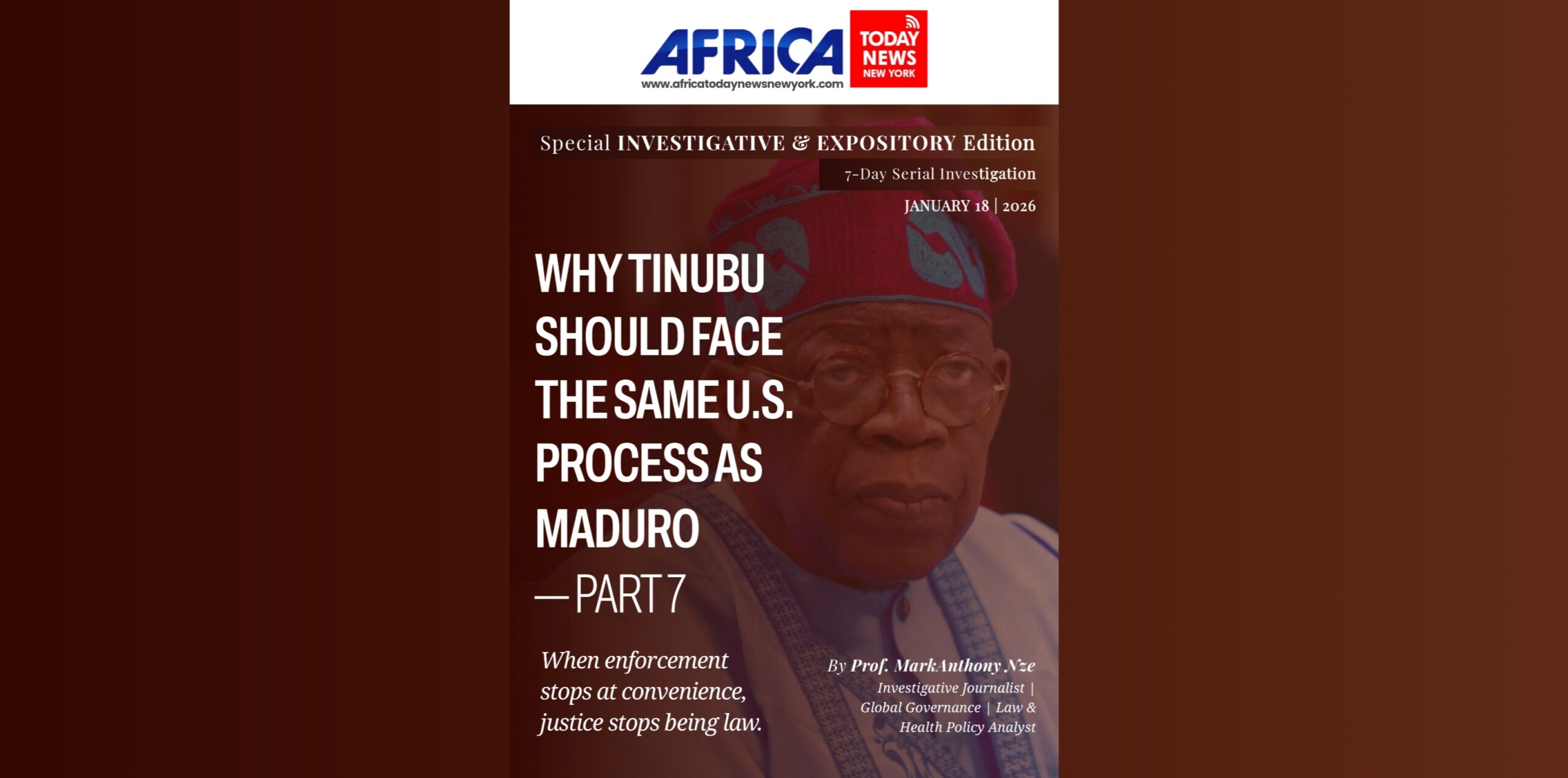
When enforcement stops at convenience, justice stops being law.
Selective Enforcement, Geopolitics, and the Price of Exemption
For more than half a century, the United States has grounded its global authority in a simple proposition: that law, once triggered, does not bend to power. That proposition has justified sanctions regimes, transnational corruption cases, narcotics prosecutions, and the pursuit of foreign political leaders once thought immune to accountability. It has been repeated in courtrooms and press conferences alike. But the credibility of that claim has never rested on rhetoric. It rests on procedure. Law earns legitimacy only when it completes what it begins (Barkow, 2019; Pfaff, 2020).
This is why the unresolved U.S. enforcement record surrounding Bola Ahmed Tinubu, now president of Nigeria, can no longer be dismissed as historical residue or bureaucratic inertia. It is a live test of whether American law still means what it says when the subject is powerful, aligned, and geopolitically convenient. The question is not whether Tinubu is guilty of any offense. Courts decide guilt. The question is why a process that was formally initiated, legally grounded, and publicly acknowledged was never brought to resolution, and why that silence has been allowed to harden into a practical exemption (Rubinstein, 2020).
The comparison that exposes this failure is not hypothetical. It is supplied by the United States itself.
The Maduro Precedent: How Credibility Is Supposed to Look
When U.S. federal authorities concluded that evidence supported a narcotics-linked conspiracy involving Nicolás Maduro and senior Venezuelan officials, they did not equivocate. The Department of Justice followed a sequence that American law has long treated as orthodox: investigation, sealed indictment, public unsealing of charges, and judicial testing in open court (U.S. Department of Justice [DOJ], 2020). The process was visible. The record was complete. The system invited scrutiny.
Agreement with the prosecution’s merits was irrelevant. What mattered was that the law finished its work. That sequence is not exceptional; it is the minimum threshold of legitimacy when the United States invokes its most serious transnational criminal statutes against a foreign head of state. It signals seriousness to courts, allies, and adversaries alike, and it communicates a foundational rule: evidence—not alignment—governs enforcement (Transparency International, 2022; World Justice Project, 2023).
In that sense, the Maduro prosecution functioned as a demonstration case. It showed how American law behaves when it is willing to accept the costs of consistency.
The Tinubu Record: Legal Thresholds Crossed, Then Abandoned
The Tinubu matter followed a markedly different trajectory. U.S. authorities crossed consequential legal thresholds. A civil forfeiture proceeding occurred. Probable cause was asserted. Assets were seized under statutes reserved for serious criminal conduct, including narcotics-related money laundering. Under American law, these steps are not symbolic gestures. They are activating events that trigger downstream obligations (Administrative Office of the U.S. Courts, 2022).
Federal forfeiture law—particularly 18 U.S.C. § 983—treats seizure as an early enforcement step, not a terminal one. Department of Justice policy is explicit that forfeiture in narcotics and financial-crime contexts commonly precedes criminal review and potential prosecution (DOJ, 2023). Once the government invokes these tools, it assumes a duty to proceed, to decline with explanation, or to submit the matter to judicial resolution.
None of those obligations were fulfilled.
There has been no public indictment.
No formal declination explaining why prosecution would not proceed.
No judicial adjudication on the merits of the forfeiture.
The record does not close. It simply stops.
That silence is not neutral. It is legally anomalous—and the anomaly is precisely where the rule of law begins to fracture.
Why Silence After Probable Cause Is Not Discretion
Prosecutorial discretion is a real and necessary feature of American law. But it is not unbounded. Discretion allows prioritization; it does not authorize erasure. Contemporary scholarship on nonenforcement is clear: discretion must remain principled, reviewable, and consistent with announced standards. When it becomes opaque and outcome-determinative, it ceases to be discretion, and becomes exemption (Barkow, 2019; Pfaff, 2020).
This boundary matters most after the state has asserted probable cause and seized property. At that point, the law demands accountability. Action may end in indictment, declination, or dismissal—but not disappearance. Silence is not an outcome recognized by statute or doctrine.
The absence of explanation in the Tinubu matter therefore does not imply exoneration. It signals procedural failure. And procedural failure at this level is not a technical defect; it is a legitimacy crisis that cuts to the core of American claims about equal justice (Rubinstein, 2020).
Selective Enforcement Is Established by Pattern, Not Confession
Selective enforcement almost never announces itself. It is revealed through comparison. When similar factual predicates generate radically different procedural outcomes, the disparity itself becomes evidence (Harris, Evans, & Beckett, 2018).
Empirical research demonstrates that uneven application of state power erodes legitimacy most acutely among those best positioned to observe inconsistency—courts, informed citizens, and international observers (Harris et al., 2018). Legal remedies are difficult precisely because selective enforcement is rarely admitted; it is inferred from patterns of action and inaction (Rubinstein, 2020).
Here, the pattern could not be clearer. In one case, investigation matured into indictment, public charging, and judicial testing. In the other, seizure and probable cause were followed by silence. The law supplies the comparator. The discrepancy supplies the conclusion.
Transparency, Oversight, and the Price of Non-Explanation
Oversight institutions have warned for years that unresolved enforcement actions corrode institutional integrity. Inspector General audits consistently emphasize that forfeiture without resolution invites perceptions of favoritism and abuse (Office of the Inspector General, 2021). Transparency doctrine reinforces the same principle: once enforcement activity is acknowledged, secrecy becomes harder—not easier—to justify (Pozen, 2019).
FOIA scholarship explains why mechanisms such as Glomar responses are least defensible precisely where enforcement has already occurred. Courts increasingly distinguish legitimate confidentiality from avoidance (Electronic Privacy Information Center, 2023). Silence after action is not protection; it is evasion.
Recent Supreme Court jurisprudence underscores this logic. In cases involving property retention and due process, the Court has been explicit: government power must complete its work in daylight; retention without justification violates constitutional norms (Tyler v. Hennepin County, 2023; Culley v. Marshall, 2024). Enforcement pathways that begin and then vanish fail the same constitutional test.
Read also: Why Tinubu Should Face The Same U.S. Process As Maduro—Part 6
The Global Consequences of Domestic Exemption
Selective enforcement does not remain domestic. It travels.
Global governance research demonstrates that when powerful actors are treated differently, deterrence collapses and credibility erodes (Transparency International, 2022). Anti-narcotics and anti-corruption regimes cannot function if their application appears contingent on geopolitical alignment rather than evidence. Consistency is not a moral aspiration; it is an operational requirement.
According to the World Justice Project, consistency in enforcement is among the strongest predictors of public trust in legal systems (World Justice Project, 2023). Deviations are noticed and remembered. Systems that preach uniformity while practicing exception pay a reputational price that no press release can repair.
For Nigeria, the consequences are immediate. An unfinished U.S. process becomes domestic political capital, invoked as proof that allegations are either baseless or politically motivated. For the United States, the cost is systemic. Its capacity to demand accountability elsewhere weakens every time exemption is tolerated at home.
Why the United States Cannot Plausibly Claim Neutrality
The United States cannot credibly argue that the Tinubu matter is too old, too complex, or too inconvenient. Age has not halted other prosecutions. Complexity has not deterred indictments. Inconvenience has never been a legal standard.
What distinguishes this case is not law. It is politics.
But law that bends to politics is not law. It is a preference enforced selectively. The unavoidable question therefore remains: why was one process completed while the other was abandoned? If the answer cannot be stated publicly and on the record, the appearance of a dual standard hardens into fact (Warren, 2024).
What Equal Process Requires—and What It Does Not
Equal process does not require a predetermined outcome. It does not require indictment or conviction. It requires only what the law already demands: completion of the enforcement sequence; a public explanation if declination is chosen; judicial resolution where assets were seized; and transparency sufficient to permit oversight (DOJ, 2023; Office of the Inspector General, 2021).
Anything less is exemption.
Applying the same procedural rigor to the Tinubu matter that was applied in the Maduro case would not prejudice guilt. It would restore credibility.
The Forensic Conclusion
This investigation began with discretion and ends with exemption. The Tinubu record exposes a system willing to activate its most powerful tools—and then fall silent when completion becomes inconvenient. That silence is not benign. It is performative. It shields power, erodes trust, and weakens the norms the United States claims to defend.
The law does not demand that every case end the same way. It demands that every case be allowed to end. If the United States believes in the standards it invoked elsewhere, it must apply them here—or explain, publicly and on the record, why it will not.
Because justice that advances against one head of state but stalls for another is not discretion.
It is exemption.
And exemption, once exposed, destroys credibility far more efficiently than acquittal ever could.
Professor MarkAnthony Ujunwa Nze is an internationally acclaimed investigative journalist, public intellectual, and global governance analyst whose work shapes contemporary thinking at the intersection of health and social care management, media, law, and policy. Renowned for his incisive commentary and structural insight, he brings rigorous scholarship to questions of justice, power, and institutional integrity.
Based in New York, he serves as a full tenured professor and Academic Director at the New York Center for Advanced Research (NYCAR), where he leads high-impact research in governance innovation, strategic leadership, and geopolitical risk. He also oversees NYCAR’s free Health & Social Care professional certification programs, accessible worldwide at:
https://www.newyorkresearch.org/professional-certification/
Professor Nze remains a defining voice in advancing ethical leadership and democratic accountability across global systems.
Selected Sources (APA 7th Edition)
Administrative Office of the U.S. Courts. (2022).
Probable cause and constitutional standards.
U.S. Courts
https://www.uscourts.gov/about-federal-courts/types-cases/criminal-cases/probable-cause
Barkow, R. E. (2019).
Institutional design and the policing of prosecutors. Stanford Law Review, 72(1), 1–68.
Stanford Law Review
https://review.law.stanford.edu/articles/institutional-design-and-the-policing-of-prosecutors/
Culley v. Marshall, 601 U.S. ___ (2024).
Supreme Court of the United States
https://www.supremecourt.gov/opinions/23pdf/22-585_k5fl.pdf
Electronic Privacy Information Center. (2023).
FOIA, Glomar responses, and accountability.
EPIC
https://epic.org/issues/open-government/freedom-of-information-act/
Harris, D. A., Evans, H., & Beckett, K. (2018).
Drawing blood from stones: Legal consciousness and unequal enforcement. Law & Society Review, 52(3), 637–672.
Wiley (Publisher)
https://onlinelibrary.wiley.com/doi/10.1111/lasr.12337
Office of the Inspector General. (2021).
Audit of the Department of Justice asset forfeiture program.
U.S. Department of Justice, OIG
https://oig.justice.gov/reports/audit-department-justice-asset-forfeiture-program
Pfaff, J. F. (2020).
The limits of prosecutorial power. University of Chicago Law Review, 87(3), 775–832.
University of Chicago Law Review
https://lawreview.uchicago.edu/publication/limits-prosecutorial-power
Pozen, D. E. (2019).
Freedom of information beyond the Freedom of Information Act. University of Pennsylvania Law Review, 167(5), 1097–1158.
University of Pennsylvania Law Review
https://scholarship.law.upenn.edu/penn_law_review/vol167/iss5/1/
Rubinstein, J. B. (2020).
Selective prosecution and the crisis of legitimacy. Georgetown Law Journal, 108(5), 1231–1284.
Georgetown Law Journal
https://www.law.georgetown.edu/georgetown-law-journal/in-print/volume-108/issue-5/selective-prosecution-and-the-crisis-of-legitimacy/
Transparency International. (2022).
Exporting corruption: Progress report 2022.
Transparency International
https://www.transparency.org/en/publications/exporting-corruption-2022
Tyler v. Hennepin County, 598 U.S. ___ (2023).
Supreme Court of the United States
https://www.supremecourt.gov/opinions/22pdf/22-166_8n59.pdf
U.S. Department of Justice. (2020).
United States v. Nicolás Maduro Moros et al.: Indictment and press release.
U.S. Department of Justice
https://www.justice.gov/opa/pr/justice-department-charges-venezuelan-president-nicolas-maduro-and-other
U.S. Department of Justice. (2023).
Asset forfeiture policy manual.
U.S. Department of Justice
https://www.justice.gov/criminal-mlars/asset-forfeiture-policy-manual-2023
Warren, R. K. (2024).
Prosecutorial incentives and public legitimacy. Harvard Law & Policy Review, 18(1), 45–92.
Harvard Law & Policy Review
https://hlpronline.com/2024/01/prosecutorial-incentives-and-public-legitimacy/
World Justice Project. (2023).
Rule of law index 2023.
World Justice Project
https://worldjusticeproject.org/rule-of-law-index/global/2023