
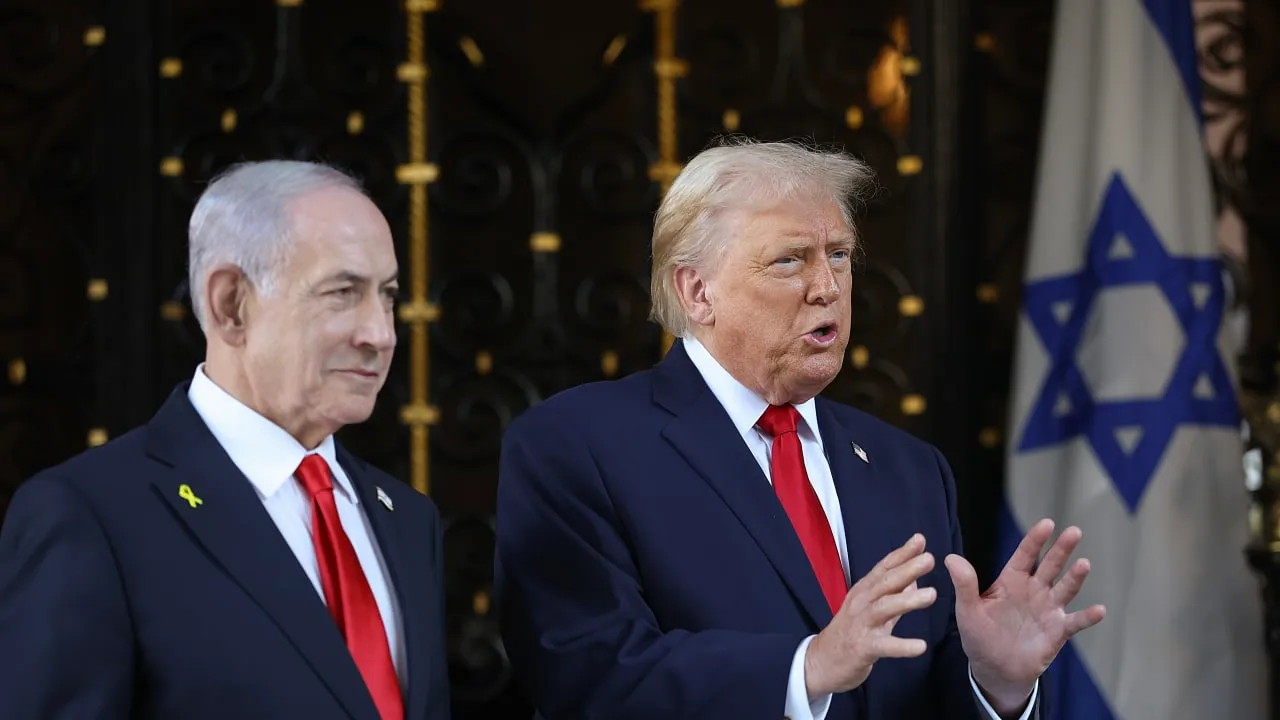
Israeli Prime Minister Benjamin Netanyahu said on Wednesday that he has agreed to join US President Donald Trump’s newly announced Board of Peace, reversing earlier objections from his office over the composition of the body’s executive leadership and its alignment with Israeli policy.
The board, chaired by Trump, was initially conceived as a limited forum of world leaders tasked with overseeing the implementation of a ceasefire plan for Gaza. In recent days, however, the initiative has expanded significantly, with the Trump administration presenting it as a broader platform that could play a role in mediating conflicts beyond the Middle East. Trump has issued invitations to dozens of countries and suggested the board could evolve into a central actor in global diplomacy.
Netanyahu’s office had previously criticized the makeup of the board’s executive committee, saying it was formed without coordination with Israel and conflicted with government policy. Particular concern was raised over the inclusion of Turkey, a regional rival of Israel. Finance Minister Bezalel Smotrich, a key figure in Israel’s far right, went further, rejecting the board outright and arguing that Israel should unilaterally determine Gaza’s future rather than rely on international mechanisms.
Despite those objections, Netanyahu’s decision to participate places Israel alongside a growing list of countries that have accepted Trump’s invitation. Current members include the United Arab Emirates, Morocco, Vietnam, Belarus, Hungary, Kazakhstan, and Argentina. Other governments, including the United Kingdom, Russia, and the European Union’s executive arm, have confirmed receiving invitations but have not yet announced whether they will join.
Read also: Netanyahu Meets U.S. Trump In Florida To Push Gaza, Iran Talks
The announcement came as Trump traveled to the World Economic Forum in Davos, Switzerland, where he is expected to outline the board’s mandate and structure in greater detail. Significant questions remain unanswered, including how many countries will ultimately be involved and how decision making authority will be exercised.
Trump has fueled controversy by openly questioning the relevance of existing multilateral institutions. Asked on Tuesday whether the Board of Peace could replace the United Nations, he said it “might,” while also criticizing the UN as ineffective and underperforming, even as he acknowledged its unrealized potential. Those remarks prompted pushback from European officials. French Foreign Minister Jean Noel Barrot said France supports Trump’s peace proposals but firmly opposes creating a body that would supplant the United Nations.
Tensions also flared between Trump and French President Emmanuel Macron. After suggesting Macron was unlikely to join the board, Trump remarked that “nobody wants him” and predicted he would soon leave office. A day later, Trump softened his tone, calling Macron a friend but repeating his belief that the French leader’s time in power is limited.
The executive board includes several prominent figures, among them US Secretary of State Marco Rubio, Trump envoy Steve Witkoff, Jared Kushner, former British prime minister Tony Blair, Apollo Global Management CEO Marc Rowan, World Bank President Ajay Banga, and Trump’s deputy national security adviser Robert Gabriel.
In parallel, the White House announced a separate Gaza Executive Board responsible for implementing the second phase of the ceasefire, including deploying an international security force, disarming Hamas, and rebuilding Gaza. Former UN Middle East envoy Nickolay Mladenov will oversee day to day operations, alongside representatives from the United States, Turkey, Qatar, Egypt, the UAE, Israel, and Europe. The board will also supervise a committee of Palestinian technocrats tasked with managing Gaza’s daily governance.