
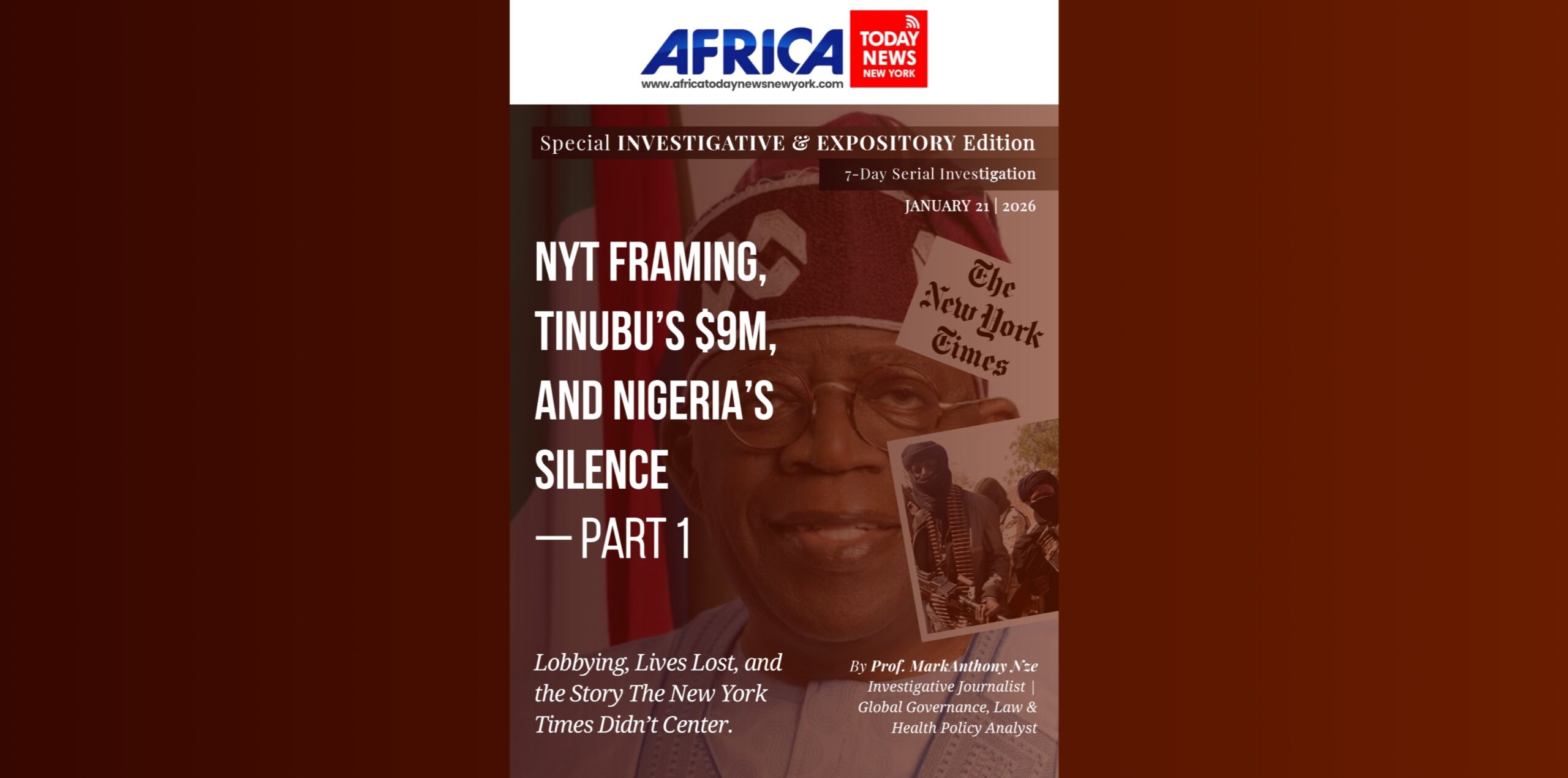
How Narrative Substitution Displaced Accountability in Nigeria’s Blood Crisis
When Framing Becomes the Story
There are moments when journalism fails not because it is inaccurate, but because it is incomplete in precisely the wrong places. These failures do not announce themselves as errors. They present as coherence. They feel balanced. They read plausibly. And yet, beneath the surface, they perform a more consequential act, they reassign causality away from power. When that happens, journalism ceases to illuminate reality and begins to manage it.
The New York Times’ recent framing of U.S.–Nigeria security developments represents such a moment.
The reporting did not fabricate events. It did something more structurally dangerous. It reordered responsibility. By centering U.S. political dynamics, privileging anecdotal testimony, and foregrounding external action, the coverage subtly repositioned Nigeria’s internal collapse as contextual rather than causal. The result was not false journalism in the narrow sense. It was distorted journalism in the systemic sense, where emphasis replaces evidence and narrative substitutes for accountability.
That distinction matters because Nigeria is not experiencing an episodic security challenge. It is enduring one of the most sustained and lethal governance failures in the world, a reality documented consistently by humanitarian agencies, conflict analysts, and Nigeria’s own statistical institutions (Institute for Economics & Peace, 2024; Human Rights Watch, 2024; Nigeria Bureau of Statistics, 2024).
The Question the Reporting Did Not Ask
The most revealing aspect of the Times’ coverage was not what it claimed, but what it declined to interrogate.
The implicit narrative advanced by the reporting suggested that U.S. counterterrorism actions in Nigeria were reactive, politically inflected, and catalyzed by localized or anecdotal intelligence—most notably the testimony of a civilian trader. That framing leaned heavily on human-interest sourcing while leaving unexplored the institutional machinery that governs the use of lethal force by the United States.
This omission is not trivial.
Under U.S. law, the law of armed conflict, and standing intelligence doctrine, counterterrorism strikes require multilayered intelligence corroboration, interagency vetting, legal review, and executive authorization (U.S. Department of Defense, 2023; U.S. Office of the Director of National Intelligence, 2023). These decisions are among the most bureaucratically dense in modern governance. They are not triggered by single-source accounts, however compelling those accounts may be narratively.
To allow readers to infer otherwise is to collapse institutional reality into anecdotes. That collapse is not an error of fact; it is an error of framing—and framing is where power hides.
Narrative Substitution as a Form of Power
Scholars of media and democracy have long documented how complex crises are rendered legible through narrative substitution: individual stories are elevated to stand in for structural causality, allowing audiences to process tragedy without confronting systemic responsibility (Electronic Frontier Foundation, 2022). The technique is effective. It is also perilous.
In the Nigerian case, the substitution functioned with disturbing clarity:
● Systemic state failure was replaced by individual testimony
● Persistent mass violence was reframed as episodic instability
● Domestic governance collapse was displaced by foreign intervention optics
● Nigerian state accountability disappeared from the center of the story
The problem was not the inclusion of civilian voices. The problem was allowing those voices to replace intelligence architecture, security doctrine, and sovereign responsibility. That is not balance. It is narrative displacement.
What the Evidence Shows—Without Narrative Filters
When narrative framing is stripped away, the empirical record of Nigeria’s crisis is unambiguous and brutal.
The Global Terrorism Index places Nigeria among the countries most affected by organized violence, with civilian deaths driven not only by jihadist groups but by armed non-state actors operating with near impunity (Institute for Economics & Peace, 2024). Amnesty International documents three consecutive years of mass killing in farmer–herder conflicts alone, describing patterns of attack that persist because of weak enforcement and political inertia (Amnesty International, 2024).
The International Crisis Group traces this violence to a combination of elite accommodation, security-sector fragmentation, and the absence of credible accountability mechanisms (International Crisis Group, 2023). The International Organization for Migration confirms that millions of Nigerians are internally displaced, many repeatedly, by insecurity that the state has failed to contain (International Organization for Migration, 2024). Humanitarian agencies report worsening protection failures across multiple regions, with civilians bearing the cost of state paralysis (Office for the Coordination of Humanitarian Affairs, 2024).
These findings are not contested. They are corroborated across institutions.
What is contested—dangerously so—is whether they are treated as the story or merely its backdrop.
Read also: NYT Framing, Tinubu’s $9m, And Nigeria’s Silence—Intro
The Nigerian State: The Missing Actor
The most consequential absence in the Times’ reporting was not a statistic or a document. It was the Nigerian state itself.
Nigeria’s crisis is not primarily a failure of international attention. It is a failure of domestic governance layered upon decades of institutional erosion. Multidimensional poverty has expanded rather than receded (Nigeria Bureau of Statistics, 2024). Development indicators have stagnated while peer countries advanced (United Nations Development Programme, 2024). The World Bank identifies institutional weakness and policy incoherence as central constraints on Nigeria’s progress (World Bank, 2024). The World Health Organization documents one of the weakest health systems relative to population size globally (World Health Organization, 2024).
These conditions are not incidental to insecurity. They are its enabling environment.
Yet they were relegated to context, while narrative energy was expended elsewhere. That choice matters. When governance failure is treated as atmospheric rather than causal, accountability dissolves.
Money, Silence, and the $9 Million Fact
Nowhere was this dissolution more evident than in the omission of financial context.
Public disclosures under U.S. law confirm that the Nigerian government spent approximately $9 million on foreign lobbying and narrative management in the United States during a period of escalating domestic crisis (Center for Responsive Politics, 2024; U.S. Department of Justice, 2024). Nigerian investigative reporting confirms the scale and timing of the expenditure (Premium Times Nigeria, 2025).
These funds were not directed toward healthcare, displacement relief, or security reform. They were allocated to image management abroad. This is not an allegation. It is a record.
The omission of this fact from mainstream international framing is not neutral. Budgetary choices are moral documents. When a state invests millions in perception while its citizens face mass violence and deprivation, journalism has an obligation to interrogate that choice. Failure to do so converts silence into complicity.
Media Framing and Manufactured Plausibility
Research on political violence in Nigeria shows that ethnic militias and armed groups flourish where state authority is selective and elite incentives are misaligned (Arriola & Johnson, 2019). Media framing that downplays these dynamics does not merely misinform; it manufactures plausibility for inaction.
International coverage that foregrounds foreign political controversy while backgrounding domestic responsibility performs a subtle absolution. It relocates moral gravity away from Abuja and toward Washington. Human rights organizations have repeatedly warned that African governance failures are too often treated as natural conditions rather than policy outcomes (Human Rights Watch, 2024).
This is not a conspiracy. It is a pattern.
What the Story Took—and What It Left Behind
What was taken from the story was proportion.
What was left behind was:
● The scale of civilian killing
● The persistence of state inaction
● The diversion of public funds
● The collapse of health and security systems
● The lived reality of communities abandoned by governance
What remained was a narrative that felt complete while being structurally incomplete. And structural incompleteness, when it shapes global perception, becomes a form of misinformation.
Why This Failure Matters
This investigation does not argue that The New York Times fabricated facts. It argues something more serious: that it failed to apply proportional scrutiny to power where power was most responsible.
Journalism is not measured solely by accuracy. It is measured by causality, proportionality, and moral clarity. When those fail, even technically correct reporting becomes misleading.
Nigeria does not need sympathy.
It needs accountability.
And journalism that cannot confront power—whether in Abuja or New York—does not expose reality.
It manages it.
Professor MarkAnthony Ujunwa Nze is an internationally acclaimed investigative journalist, public intellectual, and global governance analyst whose work shapes contemporary thinking at the intersection of health and social care management, media, law, and policy. Renowned for his incisive commentary and structural insight, he brings rigorous scholarship to questions of justice, power, and institutional integrity.
Based in New York, he serves as a full tenured professor and Academic Director at the New York Center for Advanced Research (NYCAR), where he leads high-impact research in governance innovation, strategic leadership, and geopolitical risk. He also oversees NYCAR’s free Health & Social Care professional certification programs, accessible worldwide at:
https://www.newyorkresearch.org/professional-certification/
Professor Nze remains a defining voice in advancing ethical leadership and democratic accountability across global systems.
Selected Sources (APA 7th Edition)
Amnesty International. (2024). Nigeria: Harvest of death—Three years of bloody clashes between farmers and herders.
https://www.amnesty.org/en/documents/afr44/9753/2024/en/
Arriola, L. R., & Johnson, M. C. (2019). Ethnic militias, state power, and civil violence in Nigeria. African Affairs, 118(472), 1–27.
https://academic.oup.com/afraf/article/118/472/1/5369185
BBC News. (2024). Nigeria insecurity: Why attacks continue despite government assurances.
https://www.bbc.com/news/world-africa
Center for Responsive Politics. (2024). Foreign lobbying disclosures: Nigeria.
https://www.opensecrets.org/fara
Electronic Frontier Foundation. (2022). Media framing, power, and narrative control.
https://www.eff.org/issues/free-speech-and-media
Human Rights Watch. (2024). World report 2024: Nigeria.
https://www.hrw.org/world-report/2024/country-chapters/nigeria
Institute for Economics & Peace. (2024). Global terrorism index 2024.
https://www.visionofhumanity.org/resources/global-terrorism-index-2024/
International Crisis Group. (2023). Stopping Nigeria’s spiralling farmer–herder violence.
https://www.crisisgroup.org/africa/west-africa/nigeria
International Organization for Migration. (2024). Nigeria displacement tracking matrix.
https://dtm.iom.int/nigeria
Nigeria Bureau of Statistics. (2024). Multidimensional poverty index.
https://www.nigerianstat.gov.ng/
Office for the Coordination of Humanitarian Affairs. (2024). Nigeria humanitarian needs overview.
https://www.unocha.org/nigeria
Premium Times Nigeria. (2025). Nigeria spends millions on foreign lobbying amid domestic crisis.
https://www.premiumtimesng.com/
Reuters. (2024). Nigeria’s security crisis deepens as civilian deaths mount.
https://www.reuters.com/world/africa/
United Nations Development Programme. (2024). Human development report 2023/2024.
https://hdr.undp.org/
United Nations Office on Drugs and Crime. (2024). Global study on homicide.
https://www.unodc.org/unodc/en/data-and-analysis/global-study-on-homicide.html
U.S. Department of Defense. (2023). Law of war manual (Rev. ed.).
https://dod.defense.gov
U.S. Department of Justice. (2024). Foreign Agents Registration Act (FARA) database.
https://www.justice.gov/nsd-fara
U.S. Office of the Director of National Intelligence. (2023). Annual threat assessment.
https://www.dni.gov/index.php/gt2040-home
World Bank. (2024). Nigeria development update: Turning the corner.
https://www.worldbank.org/en/country/nigeria
World Health Organization. (2024). Nigeria: Health system profile.
https://www.who.int/countries/nga