
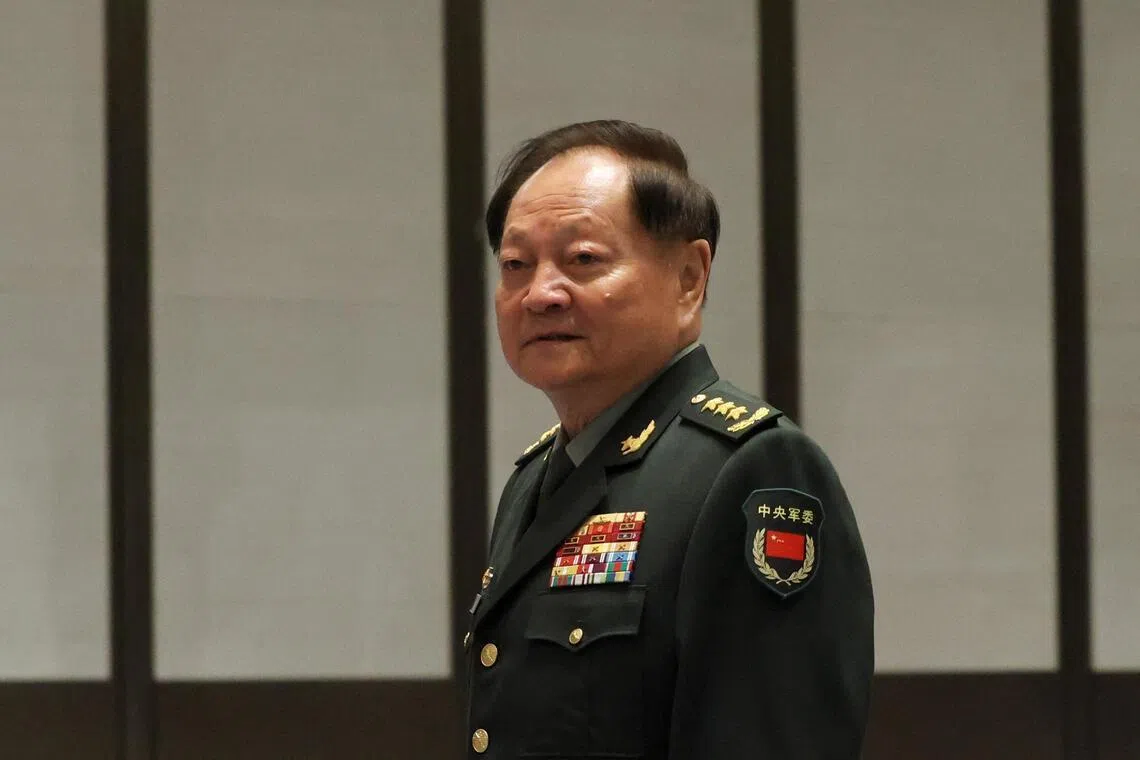
China has launched a high-level investigation into two of its most senior military officers, signaling a renewed escalation in President Xi Jinping’s long-running crackdown on corruption within the armed forces, according to a statement issued Saturday by the country’s defense ministry.
The ruling Communist Party said Zhang Youxia, vice chairman of the Central Military Commission (CMC), and Liu Zhenli, chief of staff of the CMC Joint Staff Department, are being probed for “serious violations of discipline and law,” the phrase commonly used to describe corruption and political misconduct cases in China.
The move places unprecedented scrutiny on the top command structure of the People’s Liberation Army (PLA), especially given Zhang’s status as one of Xi Jinping’s closest military allies.
Read Also: South Korea-China-North Korea Mediation Gains Momentum
Zhang, 75, is a member of the elite Politburo and one of only two vice chairmen of the Central Military Commission — China’s highest military authority. A veteran of past border conflicts, he is also among the few senior officers with actual combat experience and has long been associated with the modernization of China’s military.
Liu Zhenli, meanwhile, oversees daily military operations as head of the Joint Staff Department, a role comparable to a chief of defense staff in Western militaries.
Together, the two men sit at the core of China’s military command.
The investigation fits into a sweeping anti-graft campaign ordered by Xi shortly after he took power in 2012, which has repeatedly targeted the armed forces as a key area of concern.
In October 2025, eight senior generals were expelled from the Communist Party on corruption charges, including He Weidong, then China’s second-highest ranking officer and a former colleague of Zhang on the CMC.
Read Also: TikTok US Deal Ends Ban Threat After Years Of Pressure
Two former defense ministers have also been removed from the party in recent years over graft allegations, underscoring the depth of the crackdown.
The campaign has had visible consequences beyond personnel, slowing military procurement and affecting revenue streams at several major state-owned defense firms.
Zhang’s removal marks only the second time a serving Central Military Commission member has been targeted since the Cultural Revolution, which ran from 1966 to 1976 — highlighting the political sensitivity of the case.
Zhang has not appeared publicly since November 20, when he held talks with Russia’s defense minister in Moscow.
Earlier that same month, Zhang had published an article urging the military to root out “fake loyalty” and “two-faced men,” calling for the elimination of what he described as “poisonous influences and long-standing problems” within the ranks.
Foreign diplomats and security analysts are closely monitoring the situation, given the Central Military Commission’s central role in shaping China’s defense posture and military modernization.
The probe comes at a time when Beijing has taken a more assertive stance in the East China Sea, South China Sea, and toward Taiwan, which China claims as its own. Last year, the PLA conducted its largest military exercises ever around the self-governed island.
While China has not fought a major war in decades, the leadership continues to invest heavily in its military capabilities — making stability within the top command a key international concern.