
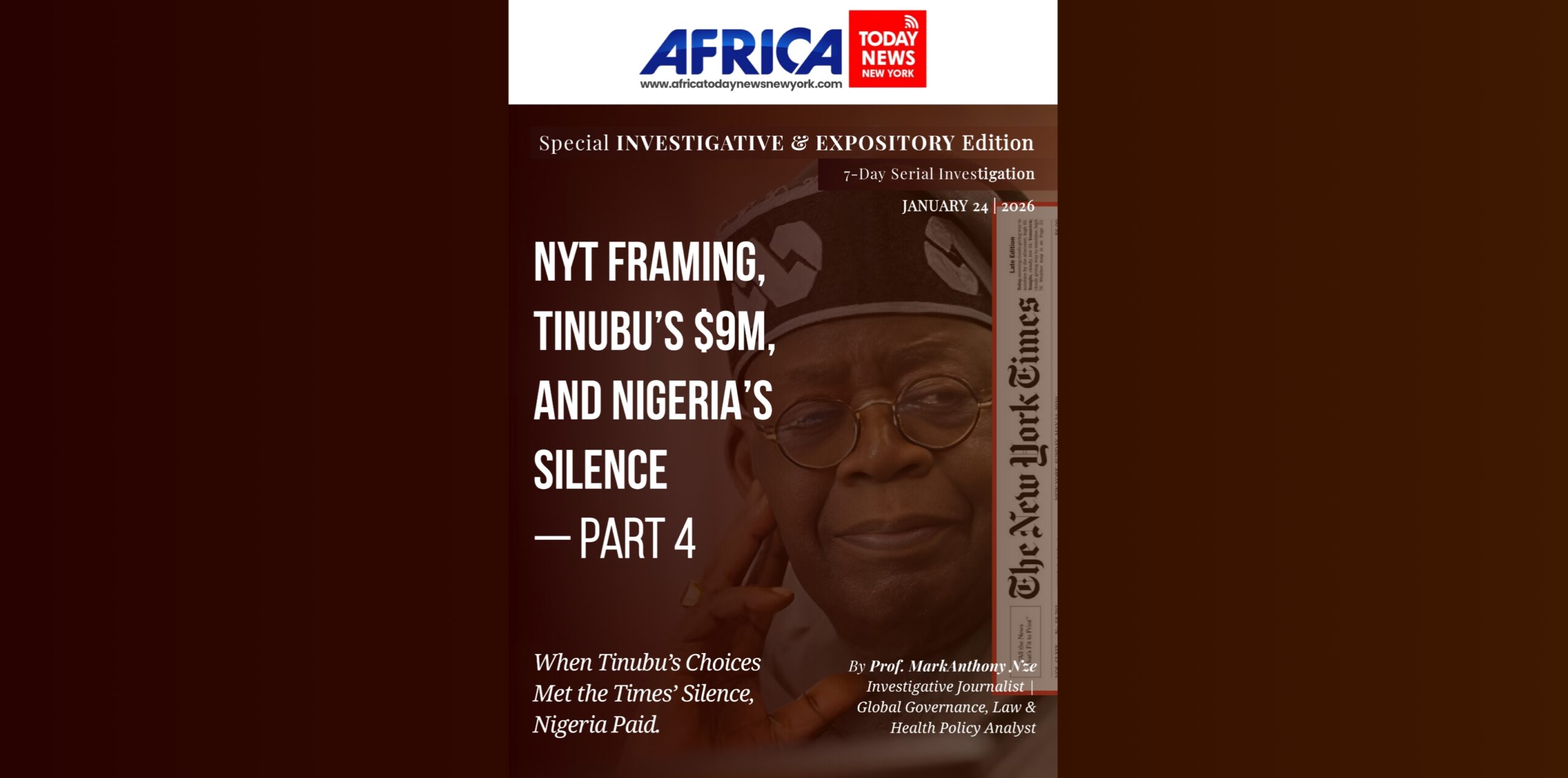
When Tinubu’s Choices Met the Times’ Silence, Nigeria Paid.
A Nation in Reverse
Nigeria’s decline is not subtle, and it is not speculative. It can be traced, year by year, across the most basic measures of human development: whether children learn, whether work pays, whether poverty recedes, and whether institutions convert public money into public goods. The data are public. The pattern is consistent. My view is straightforward: this reversal reflects political prioritization, not inevitability—and it has been made easier to sustain by international coverage that treats outcomes as context rather than as consequences of policy.
This is not an argument about motives. It is an argument about results.
Human development stalled, then slid
The Human Development Index asks three plain questions: are people living longer, learning more, and earning enough to improve their lives? Nigeria has struggled on all three. The UNDP’s 2023/2024 Human Development Report places Nigeria firmly in the low human development category, with gains so modest that inflation and currency depreciation effectively erase them (UNDP, 2024). The African Development Bank’s Nigeria Economic Outlook reinforces the point: growth has not translated into inclusion, and reforms have not delivered at scale (African Development Bank Group, 2024).
Comparison removes doubt. Countries that once lagged Nigeria invested steadily in schooling, protected incomes during shocks, and built social protection. Nigeria did not. The divergence widened over time, not because Nigeria lacked plans, but because plans were not funded, protected, or executed with discipline (African Development Bank Group, 2023).
Education: predictable failure
Nigeria’s education crisis is not a puzzle. UNESCO and UNICEF document one of the world’s largest populations of out-of-school children and deep learning deficits among those enrolled (United Nations Educational, Scientific and Cultural Organization, 2022; United Nations Children’s Fund, 2023). The World Bank’s learning poverty assessment confirms that too many children reach age ten unable to read a simple text (World Bank, 2022).
The drivers are familiar. Teachers are too few and underpaid; classrooms are overcrowded; capital budgets lag enrollment growth and inflation. Education International details shortages and pay gaps that undermine teaching quality and retention (Education International, 2023). Nigeria’s own annual school census shows the same strain—facilities stretched beyond capacity and uneven access across regions (Nigeria Federal Ministry of Education, 2024).
International benchmarks sharpen the diagnosis. OECD comparisons place Nigeria well below peers in per-student investment (Organisation for Economic Co-operation and Development, 2021). When education spending is treated as discretionary rather than foundational, outcomes deteriorate slowly at first and then decisively. The damage compounds.
Work and wages: effort without reward
Most Nigerians work; what they lack is security and purchasing power. Informality dominates the labor market, and earnings lag prices. National statistics show persistent underemployment and vulnerability even when headline unemployment shifts (National Bureau of Statistics, 2023).
Inflation has done the rest. The ILO’s Global Wage Report documents real wage declines across many countries, with Nigeria among those hardest hit as prices rose faster than pay (International Labour Organization, 2023). IMF analysis ties these dynamics to rising poverty and inequality, warning that adjustment without strong social protection disproportionately harms low-income households (International Monetary Fund, 2024).
This is not abstract macroeconomics. It is the arithmetic households live by: when food, transport, and energy costs rise and wages do not, families cut essentials first.
Poverty: expanding by default
Nigeria’s poverty profile has worsened. The National Bureau of Statistics’ Multidimensional Poverty Index shows a majority of Nigerians facing overlapping deprivations in education, health, and living standards (National Bureau of Statistics, 2024). The World Poverty Clock places Nigeria among the countries with the largest numbers of people living in extreme poverty (World Poverty Clock, 2024).
Inequality magnifies the problem. Oxfam’s global analysis demonstrates how wealth concentration accelerates deprivation at the bottom (Oxfam International, 2023). Data from the World Inequality Database confirm skewed income distribution and limited redistribution in Nigeria (World Inequality Database, 2023). These outcomes are not accidents. They follow from weak social investment, eroded wages, and policy drift.
Read also: NYT Framing, Tinubu’s $9m, And Nigeria’s Silence—Part 3
Institutions: why money doesn’t land
Human development depends on institutions that turn budgets into classrooms, clinics, and jobs. Nigeria’s institutional weakness is well documented. The World Justice Project places the country low on constraints on government power, regulatory enforcement, and access to justice (World Justice Project, 2023). These deficits matter because they determine whether spending produces outcomes or dissolves into announcements.
Multilateral assessments converge here. Both the African Development Bank and the World Bank identify institutional capacity as a binding constraint on Nigeria’s development; where institutions are weak, even increased spending delivers limited returns (African Development Bank Group, 2023; World Bank, 2024). Governance, not intent, becomes destiny.
The Tinubu record, read plainly
President Bola Ahmed Tinubu inherited a difficult landscape. What distinguishes his tenure is the pattern of urgency. Where politics and perception were at stake, the state showed speed and coordination. Where human development required sustained, patient investment—education reform, wage protection, poverty reduction—the response was slower and thinner.
Leadership is revealed by trade-offs. Education reform is unglamorous and slow. Income protection is expensive and politically quiet. Image management and power consolidation deliver quicker returns. The evidence across education outcomes, wage erosion, and poverty trends suggests which path received priority.
This is not an argument about intent. It is a reading of outcomes aligned with choices.
Read also: NYT Framing, Tinubu’s $9m, And Nigeria’s Silence—Part 2
Media framing: context without cause
International coverage has often emphasized events—elections, diplomacy, security—while treating development failure as background. Research on policy and media framing warns that this emphasis shifts accountability away from domestic decision-makers (European Parliament, 2019). The effect is subtle: audiences learn about Nigeria without seeing the ledger that connects budgets to outcomes.
This is not a claim of fabrication. It is a critique of proportion. When outcomes are framed as atmosphere rather than consequence, leaders benefit from the gap. Citizens live with the results.
Comparison settles the question
The strongest case against inevitability is comparison. Countries with fewer resources invested consistently in education, protected wages during shocks, and expanded social protection. Nigeria did not. UNDP comparisons show divergence widening over time (United Nations Development Programme, 2024). Regional analyses confirm underperformance despite advantages (African Development Bank Group, 2023).
This is not fate. It is decision repeated.
Time is the harshest variable
Losses in human development compound. Children who miss foundations rarely recover fully. Workers whose wages collapse do not rebuild savings quickly. Families pushed into poverty need years to escape. Each year of delay raises the cost of repair.
The World Bank’s Nigeria Development Update warns that without decisive investment in human capital, growth will continue to bypass the majority (World Bank, 2024). The warning is measured. The reality is unforgiving.
A clear conclusion
Nigeria’s reversal is not a debate about narratives. It is a record. Education was underfunded. Wages lost ground. Poverty expanded. Institutions weakened. Leadership choices favored short-term political returns over long-term investment in people. International coverage often blurred cause into context.
If there is one insight to keep, it is this: Nigeria does not lack plans or potential. It lacks prioritization. Until leadership treats human development as non-negotiable—and until coverage insists on cause, not just color—the
Professor MarkAnthony Ujunwa Nze is an internationally acclaimed investigative journalist, public intellectual, and global governance analyst whose work shapes contemporary thinking at the intersection of health and social care management, media, law, and policy. Renowned for his incisive commentary and structural insight, he brings rigorous scholarship to questions of justice, power, and institutional integrity.
Based in New York, he serves as a full tenured professor and Academic Director at the New York Center for Advanced Research (NYCAR), where he leads high-impact research in governance innovation, strategic leadership, and geopolitical risk. He also oversees NYCAR’s free Health & Social Care professional certification programs, accessible worldwide at:
https://www.newyorkresearch.org/professional-certification/
Professor Nze remains a defining voice in advancing ethical leadership and democratic accountability across global systems.
Selected Sources (APA 7th Edition)
African Development Bank Group. (2023). Nigeria economic outlook 2023: Sustaining recovery.
https://www.afdb.org/en/countries-west-africa-nigeria/nigeria-economic-outlook
African Development Bank Group. (2024). African economic outlook 2024.
https://www.afdb.org/en/documents/african-economic-outlook-2024
Education International. (2023). Global status of teachers and the teaching profession.
https://www.ei-ie.org/en/item/28246:global-status-of-teachers-and-the-teaching-profession
European Parliament. (2019). Foreign lobbying, transparency, and democratic accountability.
https://www.europarl.europa.eu/thinktank/en/document/EPRS_STU(2019)637967
International Labour Organization. (2023). Global wage report 2022–23.
https://www.ilo.org/global/research/global-reports/global-wage-report/2022-23
International Monetary Fund. (2024). Nigeria: Selected issues.
https://www.imf.org/en/Publications/CR
National Bureau of Statistics. (2023). Labour force statistics: Q4 2023.
https://www.nigerianstat.gov.ng
National Bureau of Statistics. (2024). Multidimensional poverty index.
https://www.nigerianstat.gov.ng
Organisation for Economic Co-operation and Development. (2021). Education at a glance 2021.
https://www.oecd.org/education/education-at-a-glance/
Oxfam International. (2023). Survival of the richest: How we must tax the super-rich now to fight inequality.
https://www.oxfam.org/en/research/survival-richest
United Nations Children’s Fund. (2023). Nigeria education fact sheet.
https://www.unicef.org/nigeria/education
United Nations Development Programme. (2024). Human development report 2023/2024.
https://hdr.undp.org
United Nations Educational, Scientific and Cultural Organization. (2022). Global education monitoring report.
https://www.unesco.org/reports/gem-report
World Bank. (2022). Learning poverty in Nigeria.
https://www.worldbank.org/en/country/nigeria
World Bank. (2024). Nigeria development update: Turning the corner.
https://www.worldbank.org/en/country/nigeria
World Inequality Database. (2023). Nigeria country data.
https://wid.world/country/nigeria/
World Justice Project. (2023). Rule of law index 2023.
https://worldjusticeproject.org/rule-of-law-index
World Poverty Clock. (2024). Nigeria poverty data.
https://worldpoverty.io